
Essential Sailing Terms: 20 Words to Know for Your First Time on the Water
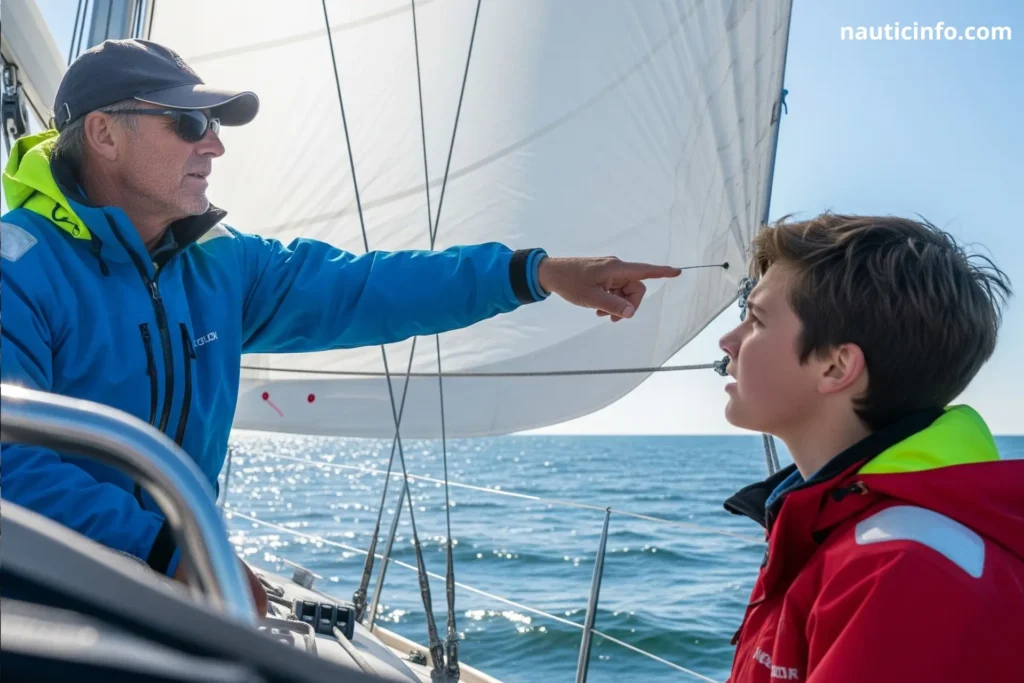
Stepping onto a sailboat for the first time is a thrilling experience—a promise of freedom where the only sounds are the wind in the sails and the waves against the hull. However, the essential Sailing Terms you’ll quickly realize there’s a unique language spoken on board. “Sheet in the mainsail!” “Prepare to tack!” “Watch the boom!” These phrases can sound like a foreign language to a newcomer. Yet, mastering this jargon isn’t just for show; it’s absolutely critical for safety, efficient maneuvering, and the joy of sailing as a team. Indeed, every term has a precise meaning that allows for fast, unambiguous communication, which is crucial when conditions on the water change in an instant.
This article is designed to be your introductory guide. Together, we will demystify the fundamental words that make up the sailor’s lexicon. Far from being an exhaustive and intimidating list, this is a curated selection of 20 essential terms—the ones you will hear and use from your very first steps on deck. With clear explanations, practical examples, and tips to help you remember them, you’ll quickly go from novice passenger to a confident and active crew member. So, get ready to cast off the lines of ignorance and hoist the mainsail of knowledge; these essential sailing terms are your first and most faithful ally for a successful nautical adventure.
Understanding Your Surroundings: Basic Sailing Terms for Orientation

Before you even touch a single line, it’s vital to understand how to orient yourself on the boat and in relation to the wind. These first few terms are the foundation of all other essential sailing terms.
1. Port and Starboard
Forget “left” and “right.” On a boat, these words are avoided because they depend on which way a person is facing. To prevent any confusion, sailors use universal terms.
- Port: This refers to the left side of the sailboat when you are looking forward (toward the bow). An easy way to remember this is that “port” and “left” both have four letters. The navigation light on the port side is red, just like red port wine.
- Starboard: Consequently, this is the right side of the sailboat, again, when looking forward. The navigation light on the starboard side is green.
On board: “Could you please grab the fender that’s on the starboard side deck?”
2. Bow and Stern
Just like with port and starboard, specific terms are used for the front and back of the boat.
- Bow: This is the front part of the boat, the part that cuts through the waves. It’s often pointed for better hydrodynamics.
- Stern: This is the rear of the boat. It’s typically where you’ll find the helm and the boat’s name. Many modern boats also have a swimming platform at the stern.
On board: “Go up to the bow and check if the anchor is holding.”
3. To Head Up and To Bear Away
These two verbs describe the boat’s movement relative to the direction of the wind. They are at the very heart of steering a sailboat.
- To Head Up (or Luff Up): This is the action of turning the bow of the boat closer to the direction the wind is coming from. In other words, you are turning “into” the wind. This action tends to slow the boat down and makes it heel (lean) over.
- To Bear Away (or Fall Off): Conversely, bearing away means turning the bow of the boat away from the direction of the wind. This action generally increases speed and straightens the boat up.
On board: “The gust is strong, head up a bit to reduce the pressure in the sail.” Or, “Bear away to pick up speed and overtake that other boat.”
What to remember about these orientation sailing terms
Mastering port/starboard, bow/stern, and heading up/bearing away is the fundamental first step. This is the basic grammar of sailing that will allow you to understand commands and the logic of how a sailboat moves.
The Key Parts of the Sailboat: Essential Sailing Terms for Your Gear
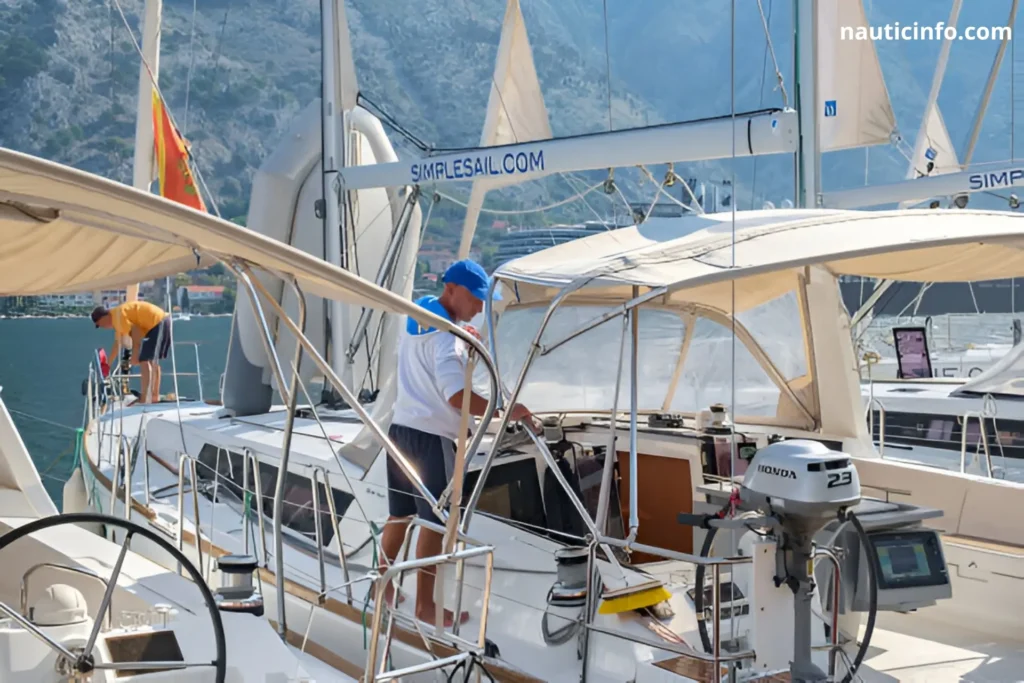
Now that you know how to find your way around, it’s time to name the equipment you’ll be handling. Knowing the names for the different parts of the rigging (the system of masts, sails, and lines) is indispensable.
4. The Mainsail
This is the primary, and usually largest, sail, located behind the mast. It is attached to the mast on its front edge (the luff) and to the boom on its bottom edge (the foot). It is the main engine of the sailboat.
On board: “We’re going to put a reef in the mainsail; the wind is picking up.”
5. The Jib or Genoa
This is the sail located at the front of the mast. It’s called a jib if it’s a smaller sail whose back corner doesn’t extend past the mast, and a genoa if it’s a larger sail that overlaps the mainsail. For simplicity, beginners can just think of it as the “front sail.”
On board: “The genoa isn’t trimmed right; it’s luffing at the top.”
6. The Boom
This is the horizontal pole that extends from the base of the mast, to which the bottom of the mainsail is attached. It is a particularly dangerous piece of equipment during maneuvers like tacking and, especially, jibing, as it can swing across the cockpit with tremendous force. The most important rule to remember is: “Watch the boom!”
On board: “Heads down, we’re about to jibe, watch the boom!”
7. The Mast
This is the tall vertical pole that holds up the sails. On most cruising sailboats, it’s made of aluminum. It is held in place by wires called shrouds (on the sides) and stays (front and back).
On board: “Look at the top of the mast; the wind vane shows the wind has shifted.”
8. The Helm
This is the “steering wheel” of the boat. It can be a large wheel (a wheel helm) or a single long lever (a tiller). It is connected to the rudder, the submerged fin at the stern that steers the boat. The person steering is the helmsman or helmsperson.
On board: “Take the helm for a minute, I need to go to the bow.”
9. The Winch
This is a powerful manual crank-like device that multiplies your strength to tighten lines (sheets, halyards). You operate it with a winch handle. It’s a powerful tool that requires caution to avoid catching your fingers.
On board: “Use the genoa winch to sheet in, I don’t have enough strength.”
A critical vocabulary: More on these sailing terms for gear
Every piece of equipment has a specific function. Using the correct term for the right object avoids mistakes that can range from a simple loss of performance to equipment failure.
Ropes Have Names: Essential Sailing Terms for Lines
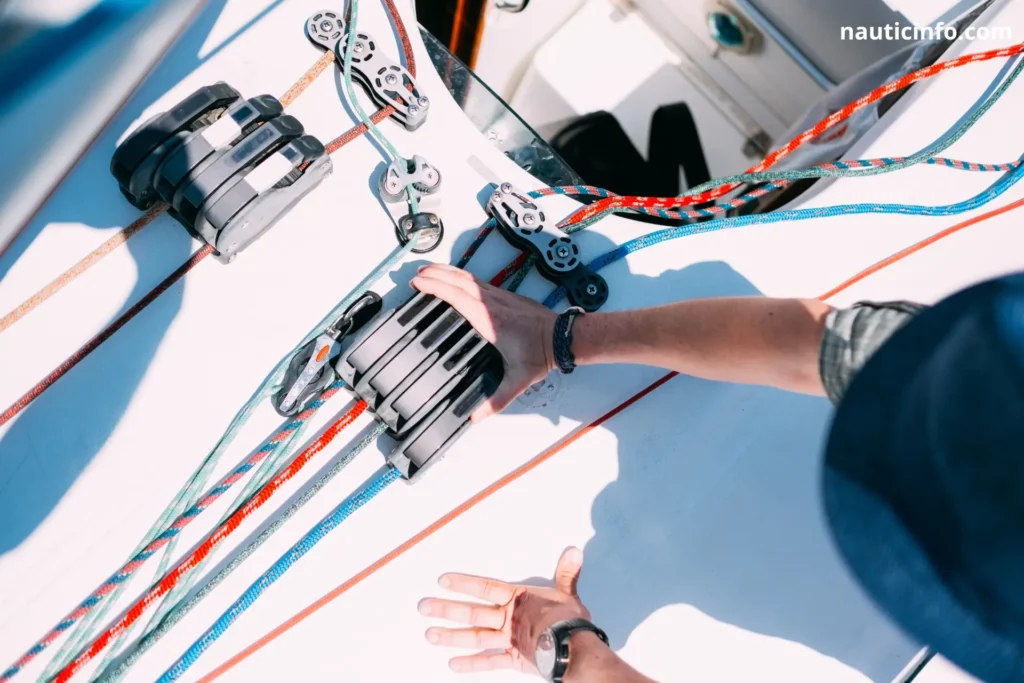
The “ropes” on a boat almost all have specific names and functions. Calling a line a “rope” is a classic rookie mistake. In general, a rope on a boat is called a line.
10. A Halyard
A halyard is a line used to hoist (raise) a sail. Each sail has its own halyard: the mainsail halyard, the jib halyard, the spinnaker halyard. They run from the deck, up to the top of the mast (the masthead), and back down.
On board: “Get ready to hoist the mainsail, take the main halyard in hand.”
11. A Sheet
A sheet is a line used to trim (adjust) the angle of a sail relative to the wind. Unlike a halyard, which is generally set once the sail is up, a sheet is constantly adjusted to optimize performance. There is a mainsail sheet and typically two jib sheets (one for each side of the boat).
On board: “Ease the jib sheet a little, we’re heeling too much.”
12. A Mooring Line and A Cleat
This isn’t one line, but a system. A mooring line is the line used to tie the boat to a dock. That line is secured on the boat to a cleat, a T-shaped piece of hardware designed to secure a line with a special knot called a cleat hitch.
On board: “Secure the bow line to the forward cleat.”
Action Verbs: Essential Sailing Terms for Maneuvers

Now that you know the parts, you need to learn the verbs that tell you what to do with them. These commands are short and must be understood instantly.
13. To Hoist and To Douse
- To Hoist: The action of raising a sail (or a flag) using a halyard.
- To Douse (or Lower): The opposite action, to bring a sail down. This is an important term, as you often need to act quickly if the wind suddenly picks up.
On board: “A squall is coming! Douse the genoa immediately!”
14. To Sheet In and To Ease
You’ll probably use these two verbs the most frequently on board. They relate to adjusting the sails using the sheets.
- To Sheet In (or Trim In): The action of pulling a sheet tighter. Sheeting in brings the sail closer to the boat’s centerline. You do this to ‘flatten’ the sail for sailing closer to the wind or to power it up.
- To Ease: The action of letting tension out of a sheet. Easing allows the sail to move away from the boat’s centerline. Sailors do this to ‘open’ the sail for sailing on a downwind course or to decrease its power.
On board: “The wind is picking up, you can sheet in the mainsail to accelerate.” Or, “Big puff! Ease the sheet now!”
15. To Tack
This is the maneuver of changing direction by turning the bow of the boat through the wind. It’s a very common and safe maneuver. Sailors ritualize the process with clear commands: ‘Prepare to tack?’ – ‘Ready!’ – ‘Tacking!’ (or the more traditional ‘Helms a-lee!’).
On board: “We’re getting close to the rocks, get ready, we’re going to tack.”
16. To Jibe (or Gybe)
This is the other way to change direction, but this time by turning the stern of the boat through the wind. This maneuver is more technical and potentially more dangerous because the boom swings across the boat with greater speed and force than during a tack.
On board: “The wind is steady, we can jibe to get on the direct course.”
The dynamics of commands and their sailing terms
Understanding these action verbs is what turns a passenger into a crewmate. The command “Sheet in the starboard jib sheet” becomes perfectly clear: you need to pull the adjustment line for the front sail, located on the right side of the boat.
States and Conditions: The Final Essential Sailing Terms
Finally, a few terms describe the state or behavior of the boat and the wind.
17. Heeling
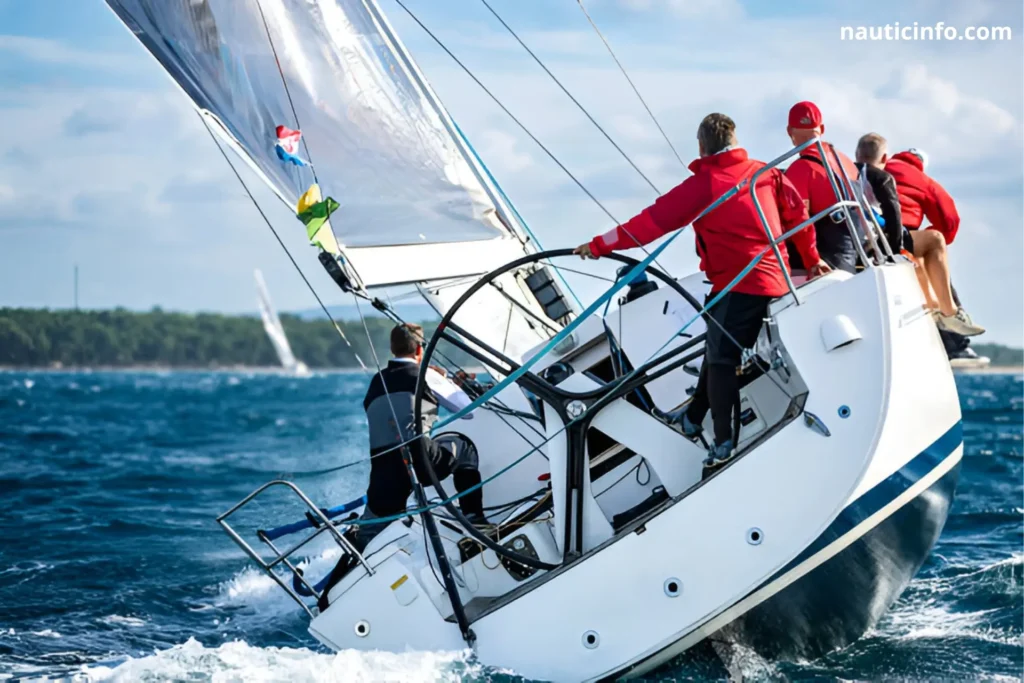
Heeling is the term for the boat leaning over under the force of the wind in the sails. A slight heel is normal and even efficient for performance. Too much heeling makes sailing uncomfortable and shows that the boat is overpowered, meaning it’s time to reduce the sail area.
On board: “This boat handles the heel very well; it’s quite comfortable.”
18. Apparent Wind
This is a slightly more complex but essential concept. The wind you feel on a moving sailboat is not the true wind (the wind an immobile observer would feel). It’s the apparent wind, which is the combination of the true wind and the “wind” created by the boat’s own forward motion. You always trim your sails based on the apparent wind.
On board: “It feels like the wind is coming more from the front, but that’s normal; it’s the apparent wind increasing with our speed.”
19. Anchorage
Anchorage doesn’t just refer to the act of dropping the anchor, but also the place where you stop at sea, sheltered from waves, using an anchor. You don’t say “we’re going to park here for the night,” but rather “we’ll spend the night at anchor.”
On board: “This anchorage protects us well from the swell; we’ll have a good night.”
20. To Luff
A sail starts luffing and flapping along its leading edge when the sailor points it too close to the wind or doesn’t sheet it in tightly enough. When it flaps uncontrollably, it floggs. The sound of a luffing sail is distinctive and signals a loss of power.
On board: “Sheet in a little, the top of the jib is luffing.”
Conclusion: More Than Words, a New Language
You now have the 20 most fundamental essential sailing terms at your fingertips. Of course, this vocabulary is much richer, but these first words are the key to unlocking active and safe participation on board. Don’t be afraid to make mistakes at first; sailors are often excellent teachers, happy to share their passion and knowledge.
Ultimately, learning this language is like learning a new culture. Each word carries centuries of tradition, technique, and adventure. By using them, you will not only communicate more effectively but also connect with the vast community of people who love the sea. So, on your next trip out on the water, listen carefully, dare to ask questions, and give it a try. You’ll soon find that “sheeting in the starboard genoa while keeping an eye on the boom” becomes second nature. Fair winds and following seas!