
The Comprehensive Guide to Used Boat Paperwork & Title Transfer: Navigating the Administrative Seas
Acquiring a pre-owned vessel represents a significant financial and emotional investment, yet the exhilaration of ownership often overshadows the critical administrative due diligence required to secure the asset legally. This exhaustive report serves as the definitive manual for navigating the labyrinth of Used Boat Paperwork & Title Transfer, dissecting the nuances between federal documentation and state titling, the mechanics of lien releases, and the specific statutory requirements across various US jurisdictions. Furthermore, we provide expert analysis on avoiding title fraud and ensuring that your transition to captaincy is defined by maritime freedom rather than bureaucratic entanglement.
The Dual Regime: Federal Documentation vs. State Titling
The United States operates under a bifurcated system for vessel registration, creating a complex landscape for Used Boat Paperwork & Title Transfer. Understanding the distinction between United States Coast Guard (USCG) documentation and state-level titling is not merely a matter of preference; it is a fundamental legal determination that impacts financing, international travel, and the very nature of ownership evidence.
The Historical and Legal Framework of USCG Documentation
Vessel documentation is a national form of registration and one of the oldest functions of the U.S. Government, dating back to the 11th Act of the First Congress in 1790. Consequently, it carries a level of legal weight superior to state registration. Managed by the National Vessel Documentation Center (NVDC), a branch of the USCG, federal documentation serves as conclusive evidence of nationality for international purposes.
To qualify for this federal status, a vessel must measure at least five net tons. It is imperative to understand that “net tonnage” in a maritime context is a measurement of volume, not weight. Specifically, it represents the internal volume of the vessel available for cargo or passengers, with one net ton equaling 100 cubic feet of capacity. As a general rule of thumb, most recreational vessels 25 feet or longer will meet this volumetric requirement. Additionally, the owner must be a United States citizen to hold a Certificate of Documentation (COD).
The Privileges of the Purple Water
The benefits of federal documentation extend beyond the prestige of flying the US flag.
- International Recognition: A USCG COD is globally recognized, facilitating entry into foreign ports and streamlining customs procedures in the Bahamas, Mexico, and beyond.
- Preferred Ship Mortgages: For buyers financing their purchase, documentation is often mandatory. It allows lenders to file a “Preferred Ship Mortgage” with the Coast Guard. This federal lien takes precedence over most other claims and offers lenders superior security compared to a state-level Uniform Commercial Code (UCC) filing.
- Aesthetic Considerations: Documented vessels are exempt from displaying state registration numbers (e.g., “FL 1234 AB”) on the bow. Instead, they must display the vessel name and hailing port on the hull, and the Official Number must be permanently affixed to the interior structure.
State Titling: The Local Standard
Conversely, state titling mirrors the automotive system. For vessels under the five-net-ton threshold—such as tenders, personal watercraft, and smaller runabouts—state titling is the only option. However, the interaction between state and federal systems is where Used Boat Paperwork & Title Transfer becomes complicated.
The Mutual Exclusivity and Concurrent Registration Paradox
Generally, a vessel cannot hold a federal Certificate of Documentation and a state Title simultaneously; it is an “either-or” proposition regarding the primary evidence of ownership. However, this does not exempt documented vessels from state taxation or registration fees.
Most states, including Florida and Maryland, require documented vessels to be “registered” (issuing a decal) if they are used principally in state waters for a certain period (often 60 to 90 days), even though they are not “titled” by the state. Consequently, a documented vessel owner often carries a federal COD (proof of ownership) and a state registration card (proof of tax payment and usage rights).
Table 1: Federal Documentation vs. State Titling Comparison
| Feature | USCG Documentation | State Titling |
| Jurisdiction | Federal (National Vessel Documentation Center) | State Agency (DNR, DMV, or Tax Collector) |
| Eligibility | 5 Net Tons (approx. 25+ ft) & US Citizenship | Varies, usually all motorized vessels |
| Proof of Ownership | Certificate of Documentation (COD) | Certificate of Title |
| Lien Recording | Preferred Ship Mortgage (Federal) | UCC Lien or Title Notation |
| Cost | Higher initial filing fees ($100+) | Generally lower, varies by state |
| Markings | Name & Hailing Port on Hull; Official # Interior | Registration Numbers on Bow (e.g., FL 1234 AB) |
| International Status | Recognized proof of nationality | Often requires additional paperwork/not recognized |
The Deletion Process: A Critical Transition
One of the most friction-heavy aspects of Used Boat Paperwork & Title Transfer occurs when a buyer wishes to convert a documented vessel to a state-titled vessel. This requires the “deletion” of the vessel from the federal registry using USCG Form CG-4593.
- The Trap: You cannot obtain a state title until the USCG issues a Letter of Deletion.
- The Delay: The NVDC can take weeks to process this request.
- The Solution: Sellers should apply for deletion immediately upon sale if the buyer intends to state-title the boat. Buyers must present the Letter of Deletion to the state agency to prove the federal record is closed.
The Bill of Sale: The DNA of Used Boat Paperwork & Title Transfer
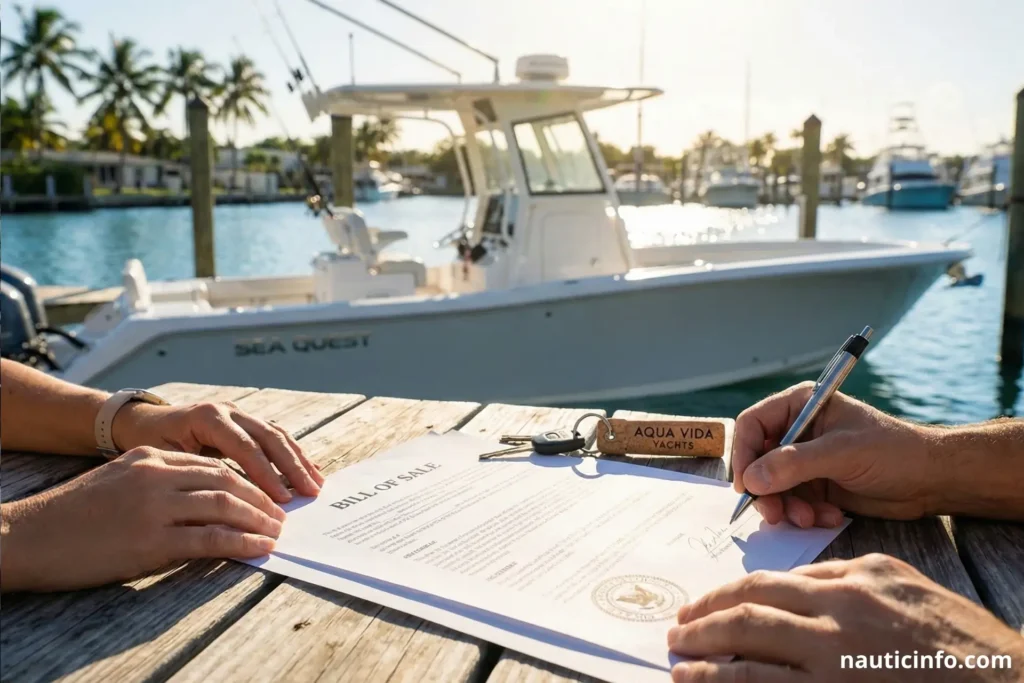
The Bill of Sale (BOS) is the cornerstone of the transaction, serving as the primary evidence of the transfer of equity. While it may appear to be a simple receipt, its format and content are strictly regulated, particularly for documented vessels. A generic napkin scribble will not suffice in the high-stakes environment of marine commerce.
Essential Elements of a Valid Bill of Sale
Regardless of the vessel’s size, every Bill of Sale acts as a contract. To withstand legal scrutiny and satisfy registration clerks, it must contain specific data points:
- Parties Involved: The full legal names and physical addresses of all sellers and buyers must be listed. If the boat is owned by a trust or LLC, the entity name must be used.
- Vessel Description: This is critical for Used Boat Paperwork & Title Transfer. It must include the Make, Model, Year, Hull Identification Number (HIN), and for documented vessels, the Official Number.
- Consideration: The exact purchase price must be stated. While some attempt to list “One Dollar” to avoid taxes, state agencies routinely reject this or use “Fair Market Value” tables to assess tax, potentially flagging the transaction for audit.
- Date of Sale: This date triggers the countdown for registration deadlines (often 30 days) before penalties accrue.
- Signatures: All owners listed on the current title or COD must sign. If the title lists “John AND Mary,” both must sign. If it says “John OR Mary,” one signature suffices.
The USCG Bill of Sale (Form CG-1340)
For documented vessels, the standard state Bill of Sale is often insufficient. The USCG mandates the use of Form CG-1340 or a document that strictly adheres to the requirements of 46 CFR 67.220.
- Mandatory Notarization: Unlike many state-level transfers, the seller’s signature on a CG-1340 must be notarized. This is a federal requirement to prevent fraud in the national registry.
- Interest Specification: The form requires the specification of the interest transferred (e.g., “100%”). This precision allows for complex fractional ownership structures common in yachting.
State-Specific Notarization Rules
Beyond the federal requirements, Used Boat Paperwork & Title Transfer is governed by a patchwork of state laws regarding notarization.
- Mandatory Notary States: In states such as Louisiana, Nebraska, Montana, and West Virginia, the Bill of Sale must be notarized to be valid for titling.
- Conditional Requirements: In South Carolina, if the back of the title has a space for a notary, it must be notarized. Submitting a non-notarized title in such cases will result in immediate rejection.
- Risk Mitigation: Even in states where it is not strictly required (like Florida for private sales), having the Bill of Sale notarized is a prudent “Pro Tip” to prevent future claims of forgery or theft.
Proof of Ownership: Navigating Title vs. Non-Title States
One of the most confusing aspects of Used Boat Paperwork & Title Transfer is the disparity in how states evidence ownership. Unlike automobiles, which are titled in all 50 states, boats face a fragmented system.
Title Issuing States
The majority of states, including Florida, Texas, New York, and California, issue physical Certificates of Title. In these jurisdictions, the “Golden Rule” is possession of the paper title.
- The Transfer Mechanism: The seller acts as the grantor, signing the “Transfer of Title” section on the reverse of the certificate. They must certify the sale price and date.
- The Buyer’s Duty: The buyer presents this signed title to the tax collector or DMV, pays the sales tax, and receives a new title in their name.
- Lost Titles: If a seller in a title state cannot produce the title, they must apply for a duplicate before selling the boat. A buyer cannot easily apply for a title on a boat they do not legally own yet.
Non-Title (Registration Only) States
A significant minority of states—including Tennessee, Alabama, Georgia (mostly), Arkansas, and Mississippi—do not issue titles for boats. In these “Registration Only” states, the proof of ownership is the Registration Card combined with a Bill of Sale.
- The Transfer Challenge: When a buyer from a title state (e.g., Florida) purchases a boat from a non-title state (e.g., Alabama), the Florida DMV will demand a title that does not exist.
- The Workaround: To satisfy the title state’s requirements, the buyer must present the seller’s current Alabama registration card and a detailed, notarized Bill of Sale. This establishes the chain of ownership in the absence of a title document.
- Alabama’s 2024 Shift: Notably, Alabama has begun a transition. Effective January 1, 2024, vessels constructed after 2023 or principally used in Alabama must be titled, marking a shift away from the “registration only” model for newer boats.
The Manufacturer’s Statement of Origin (MSO)
For new boats that have never been titled or documented, the proof of ownership is the Manufacturer’s Statement of Origin (MSO) or Manufacturer’s Certificate of Origin (MCO).
- Function: This document acts as the vessel’s “birth certificate.” It is issued by the builder to the dealer and then assigned to the first retail purchaser.
- Criticality: You cannot title or document a new boat without the original MSO. Photocopies are generally rejected.
Table 2: Title vs. Non-Title State Matrix
| State | Issues Titles? | Used Boat Paperwork & Title Transfer Implications |
| Florida | YES | Mandatory for all motorized vessels. Strict proof required. |
| Tennessee | NO | Registration Card + Bill of Sale = Proof of Ownership. |
| Alabama | HYBRID | No titles for older boats; Titles required for post-2024 boats. |
| South Carolina | YES | Title required. Strict “Max Tax” implications. |
| Maryland | YES | Title required. Excise tax capped at ~$15,900. |
| New York | YES | Title required for vessels > 14 feet. |
| Rhode Island | YES | Title required, but no sales tax on boats (verify current laws). |
Financial Forensics: Liens, Mortgages, and the Abstract of Title
A boat is a mobile asset that can cross jurisdictional lines easily, making it a prime candidate for hidden financial encumbrances. A critical failure point in Used Boat Paperwork & Title Transfer is the discovery—often post-closing—that the vessel is collateral for someone else’s debt.
The Abstract of Title: The USCG “Credit Report”
For documented vessels, the Abstract of Title is the single most important document for due diligence.
- What it Reveals: It provides a chronological history of the vessel’s ownership, name changes, and most importantly, all filed mortgages and claims of lien.
- Preferred Ship Mortgages: If a lender holds a Preferred Ship Mortgage, the lien is recorded federally. This debt attaches to the vessel, not the owner. If you purchase a boat with an unsatisfied mortgage, the lender has the right to arrest (seize) the vessel to satisfy the debt, regardless of who currently owns it.
- Obtaining the Abstract: Buyers can request this document (Form CG-7043) from the NVDC for a fee of approximately $75. It is a small price to pay for verifying a clean title.
UCC Searches and State Liens
For state-titled boats, liens are typically recorded via the Uniform Commercial Code (UCC) with the Secretary of State or annotated directly on the face of the title.
- Conducting the Search: Buyers should perform a UCC lien search on the Secretary of State’s website in the seller’s state, searching by the debtor’s (seller’s) name.
- Search Logic Nuances: Search algorithms vary. Some states use “exact match” logic, meaning a search for “Robert Smith” might miss a lien filed under “Bob Smith.” It is advisable to search multiple variations of the seller’s name.
- Physical Title Inspection: On a state title, the “Lienholder” section on the front must be scrutinized. If a bank is listed, the “Lien Release” section must be signed and stamped “PAID,” or a separate “Satisfaction of Lien” document must accompany the title.
The Satisfaction of Mortgage
When a loan is paid off, the lender is legally required to issue a release. However, in Used Boat Paperwork & Title Transfer, it is often the buyer’s responsibility to ensure this document is properly filed.
- USCG Filing: For documented vessels, a “Satisfaction of Mortgage” must be filed with the NVDC to legally remove the encumbrance from the Abstract of Title. Simply paying off the loan does not automatically clear the record; the paperwork must be processed.
- State Filing: In states like Florida, Form HSMV 82260 (Lien Satisfaction) is used. The lienholder signs this form, which the owner then presents to the tax collector to issue a clear title.
Pro Tip: The “Hidden” Mechanic’s Lien
Unlike bank mortgages, mechanic’s liens (for unpaid repairs or storage) might not appear on a standard title search immediately. Always ask for recent maintenance invoices and call the marina or yard where the boat is stored to confirm their accounts are current. A marina often has a possessory lien on the vessel for unpaid slip fees.
Vessel Identity: The Hull Identification Number (HIN)
The Hull Identification Number (HIN) is the vessel’s fingerprint, equivalent to a VIN on a car. Validating the HIN is a non-negotiable step in Used Boat Paperwork & Title Transfer to prevent fraud and ensure accurate registration.
Decoding the HIN Structure
Since November 1, 1972, all boats manufactured for the U.S. market must bear a 12-character HIN. Understanding the format allows a buyer to verify the boat’s age and origin.
- Straight Year Format (1972-1984):
- Example:
ABC 12345 1273 ABC: Manufacturer Identification Code (MIC).12345: Serial Number.1273: Date of manufacture (December 1973).
- Example:
- Model Year Format (1972-1984):
- Example:
ABC 12345 M84E M: Designator for Model Year format.84: Model Year (1984).E: Certification Month (December).
- Example:
- Current Format (Post-August 1984):
- Example:
SER 12345 C607 SER: MIC (e.g., Sea Ray).12345: Serial Number.C: Month of Manufacture (A=Jan, B=Feb, C=March).6: Year of Manufacture (last digit, e.g., 2006).07: Model Year (2007).
- Example:
HIN Fraud: Cloning and Title Washing
Criminal enterprises utilize HIN Cloning to sell stolen vessels. They pry off the HIN plate of a stolen boat and replace it with a counterfeit plate bearing the HIN of a legitimate, similar vessel.
- Detection: Inspect the HIN plate on the starboard transom. Look for scratches, non-factory rivets, or mismatched gel coat, which suggest tampering.
- The Hidden HIN: Manufacturers are required to place a second “hidden” HIN in an unexposed location (e.g., under a gunwale or behind a dashboard). If the transom HIN looks suspicious, a surveyor can cross-reference it with the hidden HIN.
The Tax Landscape: Sales Tax, Use Tax, and Caps
Taxes often represent the single largest closing cost in Used Boat Paperwork & Title Transfer. However, statutory “caps” in certain states can result in massive savings for savvy buyers.
Strategic Tax Caps
Several states have implemented caps on the maximum sales tax collected on a single vessel transaction, designed to attract the yachting industry.
- South Carolina: Imposes a “Max Tax” of 5%, but capped at $500 for the hull. Note that propulsion units (outboards) and trailers may be taxed separately, but the savings on the hull are substantial.
- Florida: The state sales tax is 6%. While there is a cap of $18,000 on the total tax mentioned in some industry summaries, the specific law often applies a discretionary sales surtax cap on the first $5,000 of the purchase price. (Note: Always verify the current legislative cap as these statutes are subject to frequent amendment).
- Maryland: The vessel excise tax is 5%, but strictly capped at $15,900 (as of July 2024), making it an attractive registry for mid-sized yachts.
- North Carolina: A 3% tax rate capped at $1,500 makes it one of the most cost-effective states for registration.
- Virginia: A 2% tax rate capped at $2,000.
Use Tax and the “State of Principal Use”
Buyers often mistakenly believe they owe tax to the state where they bought the boat. In reality, Used Boat Paperwork & Title Transfer dictates that tax is generally due to the state of principal use.
- Scenario: If you buy a boat in Florida (6% tax) but immediately transport it to Georgia (state of use) within a specific window (often 10-90 days), you may file for a “removal affidavit” to avoid Florida tax. You will then pay Georgia use tax upon registration.
- Reciprocity: Most states offer credit for sales tax paid to other jurisdictions. If you paid 6% in Florida and move the boat to a state with a 7% rate, you typically only owe the 1% difference.
Warranties and Post-Sale Support
A transferable warranty is a significant value multiplier in Used Boat Paperwork & Title Transfer. However, these warranties rarely transfer automatically; specific administrative steps must be taken.
Engine Warranties: The Crown Jewel
Engine manufacturers like Mercury, Yamaha, and Volvo Penta generally allow the transfer of the remaining factory warranty to a second owner, but the process is strict.
- Mercury Marine: Requires a completed transfer form and a copy of the Bill of Sale. There is typically no charge for the standard limited warranty transfer, although extended “Product Protection” plans may incur a fee.
- Yamaha: Often requires an inspection by an authorized dealer to verify the engine’s condition before the transfer is approved. This request must be made within 10 days of the sale.
- Volvo Penta: The warranty is transferable at no charge. The owner must submit a “Product Registration Update Form” to update the ownership record.
Hull Warranties
Hull warranties are more restrictive. Many manufacturers offer a “Lifetime Hull Warranty” only to the original owner. For the second owner, this may downgrade to a 10-year transferable warranty.
- Example: Sea Hunt allows the transfer of the 10-year hull warranty if a transfer form is filed, ensuring structural coverage continues.
Scams and Fraud Prevention
The digital age has introduced sophisticated scams to the Used Boat Paperwork & Title Transfer ecosystem.
The “Phantom Boat”
Sellers list a high-value boat at a significantly reduced price, claiming they are deployed military personnel or selling for a deceased relative. They refuse in-person inspections and demand payment via wire transfer or “escrow” services that are actually fake websites controlled by the scammer.
- Defense: Never purchase a vessel without a physical inspection or a survey by an accredited marine surveyor. If the seller refuses access, it is a scam.
Title Washing
Scammers purchase “Salvage” or “Total Loss” boats (often hurricane-damaged) cheaply. They repair them cosmetically and then retitle them in a state that does not recognize or carry over the “Salvage” brand from the previous jurisdiction. They then resell the boat with a “clean” title.
- Defense: Run a history report using the HIN to check for insurance claims or salvage auctions in the boat’s history.
The NauticInfo Verdict
Successfully executing Used Boat Paperwork & Title Transfer requires a blend of legal knowledge, financial caution, and administrative precision.
- Documentation Decision: For vessels over 25 feet, USCG documentation is the superior choice for resale value and financing security.
- Verification is Vital: Never rely on the seller’s word regarding liens. Perform your own Abstract of Title or UCC search.
- HIN Integrity: The Hull Identification Number is the boat’s true identity. Any sign of tampering is a deal-breaker.
- Tax Strategy: Utilizing tax caps in states like South Carolina or Maryland can yield savings that significantly offset ownership costs.
By adhering to this rigorous framework, you ensure that your entry into the boating lifestyle is built on a foundation of security and legality, leaving the turbulent waters of bureaucracy behind you.