
Fixed vs. Portable VHF? The Complete Guide to Staying Connected and Safe on the Water
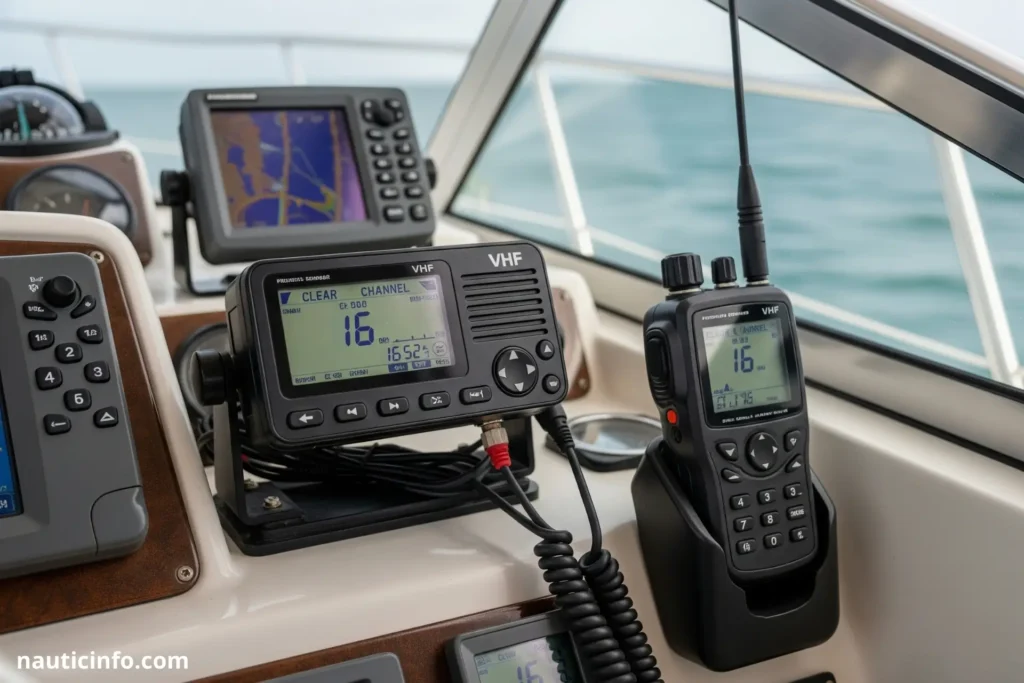
Safety on the water is every boater’s number one priority. At the heart of this imperative lies an essential, often mandatory. But always indispensable piece of equipment: the VHF (Very High Frequency) radio. As your true lifeline to shore and other vessels, it is the guarantor of your peace of mind. However, a fundamental question arises for many boaters. From long-distance sailors to coastal day-trippers: should you choose a Fixed vs. Portable VHF?
This choice, far from being trivial, directly impacts your safety, convenience, and how you communicate. Each system has its own strengths and weaknesses, tailored to different types of boating. Furthermore, technology has evolved considerably. Today, we’re not just talking about voice communication, but also active safety through features like DSC (Digital Selective Calling) and deep integration with your boat’s other electronic instruments.
This article aims to be your ultimate guide in choosing between a Fixed vs. Portable VHF. We will thoroughly break down the pros and cons of each solution, explore the latest standards governing their use, and demystify technologies like DSC. Ultimately, you will have all the information you need to make an informed choice suited to your boating style and your vessel, allowing you to navigate with complete confidence.
Fixed vs. Portable VHF: The Head-to-Head Comparison
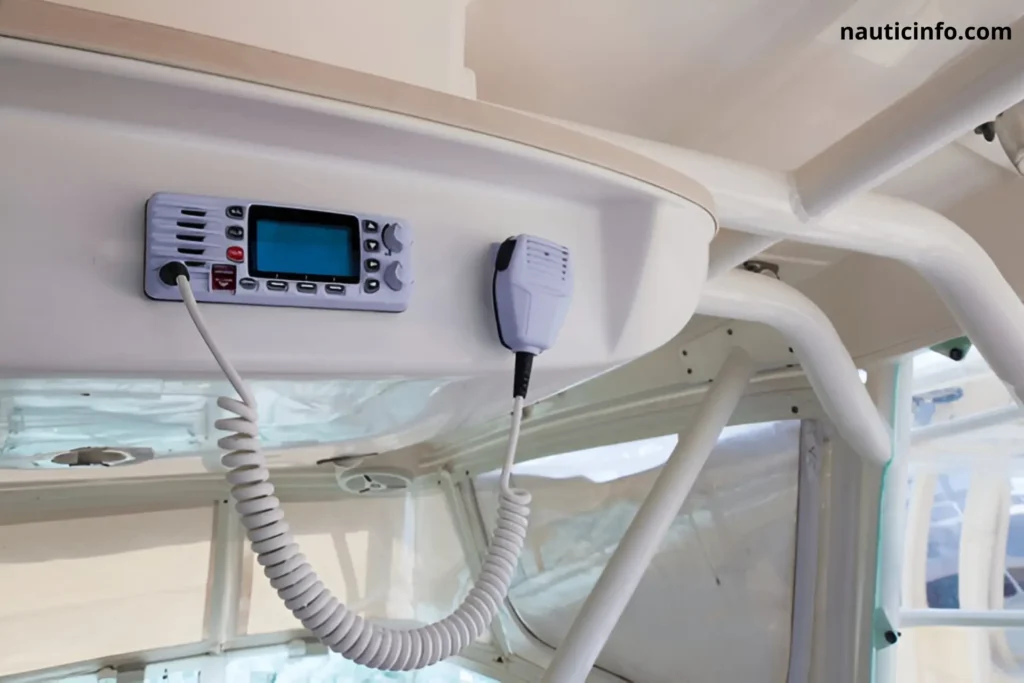
The choice between a fixed-mount installation and a handheld model primarily depends on your boating plans and the size of your vessel. To clarify, let’s analyze the characteristics of each system point by point.
Power and Range: The Undeniable Advantage of the Fixed-Mount VHF
The most critical differentiator between a Fixed vs. Portable VHF is undoubtedly the transmission power, which directly determines the range of your communications.
- The Fixed-Mount VHF: Power on Demand. A fixed-mount VHF connects directly to the boat’s battery system. Consequently, this allows it to transmit at the maximum legal power of 25 Watts. When paired with an antenna mounted at the top of a mast or another high point on the boat, its theoretical range can reach 20 to 25 nautical miles, or even more depending on weather conditions and antenna height. Therefore, for offshore or coastal cruising, a fixed VHF is not an option but an absolute necessity to ensure a reliable link with U.S. Coast Guard stations, other vessels, and marine services.
- The Portable VHF: Close-Quarters Communication. In contrast, a portable VHF runs on its own battery. To conserve power, regulations legally limit its transmission output, generally to between 5 and 6 Watts. Its range is therefore inherently shorter, typically around 3 to 8 nautical miles. As a result, it excels at short-distance communications: between crew members during maneuvers, from a dinghy to the mother ship, or for near-shore boating on smaller vessels like kayaks, tenders, or small sailboats.
Battery Life and Reliability: Safety First
The power source is another crucial factor that radically separates the two systems.
- Fixed-Mount VHF: Reliability and Endurance. Connected to the vessel’s battery bank, the fixed VHF boasts a very long operational life, limited only by your battery capacity and your means of recharging (engine alternator, solar panels, etc.). This is a major safety asset, as it will remain operational as long as the boat has power. In addition, its construction is generally more robust, designed to withstand the harsh marine environment over the long term.
- Portable VHF: Mobility at a Price. The portable VHF, on the other hand, relies on its internal rechargeable battery. Although modern models offer decent battery life (often 8 to 12 hours on standby), intensive use for transmitting will drain it quickly. It is therefore imperative to manage its charge carefully. For offshore passages, it can in no way substitute for a fixed VHF in terms of long-term reliability. However, its greatest advantage is that it remains functional even during a complete power failure on board, making it a first-rate secondary safety device.
DSC (Digital Selective Calling): A Revolution in Safety

Whether you’re debating a Fixed vs. Portable VHF, one feature has become absolutely essential: DSC, or Digital Selective Calling. Now standard on all new fixed-mount VHFs and included on nearly all portable models, this technology has transformed the radio into a true life-saving tool.
Understanding How DSC Works on Your Fixed vs. Portable VHF
DSC is a system that allows for the transmission of pre-formatted digital messages automatically. Each vessel receives a unique 9-digit number, the MMSI (Maritime Mobile Service Identity), which is essentially its digital license plate.
The most important and well-known function of DSC is the “Distress” button. In a life-threatening emergency, a single, sustained press of this button (often protected by a red flip-cover) sends a standardized distress message on channel 70, a channel exclusively reserved for DSC alerts. This message contains:
- Your MMSI number.
- Your GPS position (if the VHF is connected to a GPS).
- The nature of the distress (if it has been entered).
All DSC-equipped vessels and shore stations within range, including the U.S. Coast Guard, receive this alert. Coast Guard, immediately notifying them of your situation with your precise location. This allows the Coast Guard to initiate rescue operations much more quickly and effectively than a traditional voice mayday call on channel 16.
Other DSC Features
Beyond the distress function, DSC greatly simplifies routine communications. It allows you to selectively “call” another vessel without broadcasting to everyone on channel 16. You can:
- Initiate a routine call to another boat by entering its MMSI. Their VHF will then ring, much like a telephone, and you can agree on a working channel (e.g., 68, 69, 72) to talk.
- Send safety calls (e.g., to report a hazard to navigation like a floating container) or urgency calls (for a major breakdown that is not immediately life-threatening).
- Participate in group calls to communicate with a fleet or flotilla.
When considering a Fixed vs. Portable VHF, the presence of DSC is a non-negotiable feature for safety.
Integration and Connectivity: The Brain of Your Navigation System
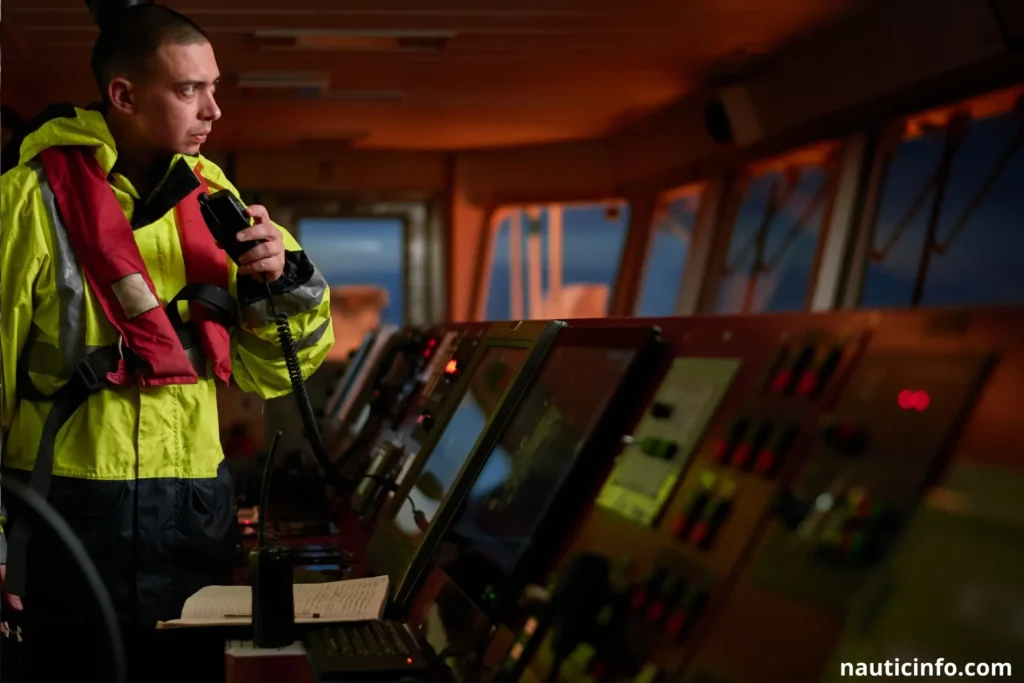
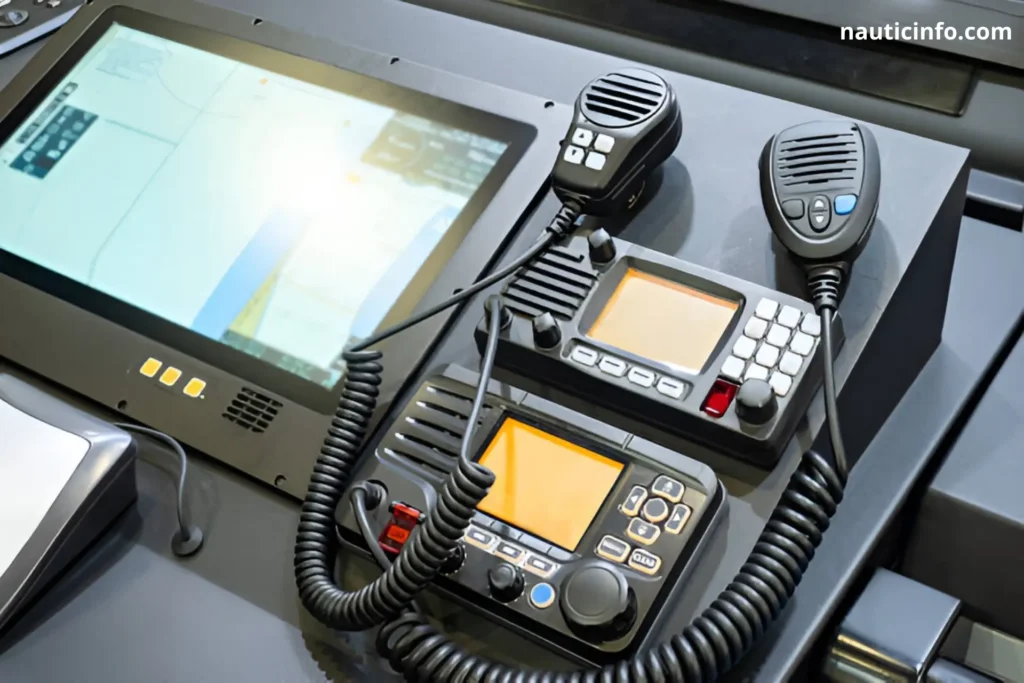
Here, the difference between a Fixed vs. Portable VHF is immense. While the portable VHF is a standalone tool, the fixed-mount VHF integrates directly into the heart of your boat’s electronics.
Marrying the Fixed VHF with GPS: A DSC Necessity
As we’ve seen, for the DSC distress function to be fully effective, the VHF must know and transmit your position. This is where interfacing with a GPS comes in. There are two primary ways to make this connection:
- Via NMEA 0183 or NMEA 2000 Network: This is the most common solution. The VHF is connected to the boat’s data network. It continuously receives position, speed over ground (SOG), and course over ground (COG) information from the GPS or chartplotter. This is the most reliable and comprehensive setup.
- Using a Built-in GPS: Some models of fixed-mount VHFs have their own integrated GPS receiver and antenna. This is an excellent solution for boats without a complex electronics network, ensuring that the DSC function will always have a position to transmit, independent of other instruments.
AIS: See and Be Seen
The integration doesn’t stop there. Many modern fixed-mount VHFs also incorporate an AIS (Automatic Identification System) receiver or even a transponder.
- VHF with AIS Receiver: Your VHF receives signals from vessels equipped with an AIS transmitter in your vicinity. It can then display the position, course, speed, and name of these other boats on its own screen or, even better, overlay them on your chartplotter display. This is a fantastic tool for collision avoidance, especially at night or in reduced visibility.
- VHF with AIS Transponder (Class B): Not only do you see others, but others also see you. The VHF transmits your own vessel’s information, making you visible on the screens of commercial ships, ferries, and other recreational boaters with AIS. This is a significant leap forward for active safety.
This capacity for integration makes the fixed-mount VHF the true nerve center for safety and communication on board—a role the portable VHF simply cannot fill.
Regulations and Recommendations: What Does the Law Say?
In the United States, the requirement to carry a VHF radio is governed by the U.S. Coast Guard (USCG) and the Federal Communications Commission (FCC). For most recreational boaters, the rules are straightforward.
- When is a VHF Radio Required? For recreational vessels operating in U.S. domestic waters, a VHF radio is not legally required on boats under 65.5 feet (20 meters) in length, as long as you are not carrying passengers for hire. However, the USCG highly recommends that all boaters have a VHF radio on board for safety. A VHF is mandatory on:
- Vessels 65.5 feet or longer.
- Vessels carrying more than six passengers for hire.
- Most commercial vessels.
- Radio Licenses:
- Station License: If you are a recreational boater and you stay within U.S. waters, you are not required to have an FCC ship station license. This is known as “licensed by rule.”
- Operator License: Similarly, you are not required to have an operator’s license (like the Restricted Radiotelephone Operator Permit) to use a VHF radio in U.S. waters. However, an operator license is required if you plan to dock in a foreign port (including Canada, Mexico, and the Bahamas) or communicate with foreign-flagged vessels or shore stations.
Even when not legally mandated, having a reliable means of communication is a core tenet of responsible seamanship.
Conclusion: So, Fixed vs. Portable VHF? The Answer is… Both!
After this detailed analysis, it becomes clear that the question is not so much about choosing between a Fixed vs. Portable VHF, but rather understanding their complementary roles.
The fixed-mount VHF is the pillar of your safety. Its power, range, reliability, and integration with GPS and AIS make it the primary and irreplaceable communication device for any boating that takes you more than a stone’s throw from shore. It is your best assurance of being able to send an effective alert and be heard from a distance.
The portable VHF, on the other hand, is the Swiss Army knife of communication and close-range safety. It is perfect for use in the cockpit, for taking in the dinghy, for crew communication, or as the ultimate backup device to keep in your ditch bag in case you have to abandon ship. Its independence from the boat’s power and its mobility are its greatest assets.
Ultimately, for the coastal or offshore boater, the ideal combination is unequivocally to have both. A DSC-equipped fixed-mount VHF, interfaced with your chartplotter, forms the core of the system. This should be supplemented by one or two waterproof, floating portable VHFs—ideally with their own built-in GPS and DSC capabilities—for close-quarters use and redundant safety. By investing in this duo, you give yourself the best possible chance for serene, connected, and, above all, safer voyages.