

Rubber vs. Breathable Sailing Boots (Gore-Tex): What to Choose for Your Budget?
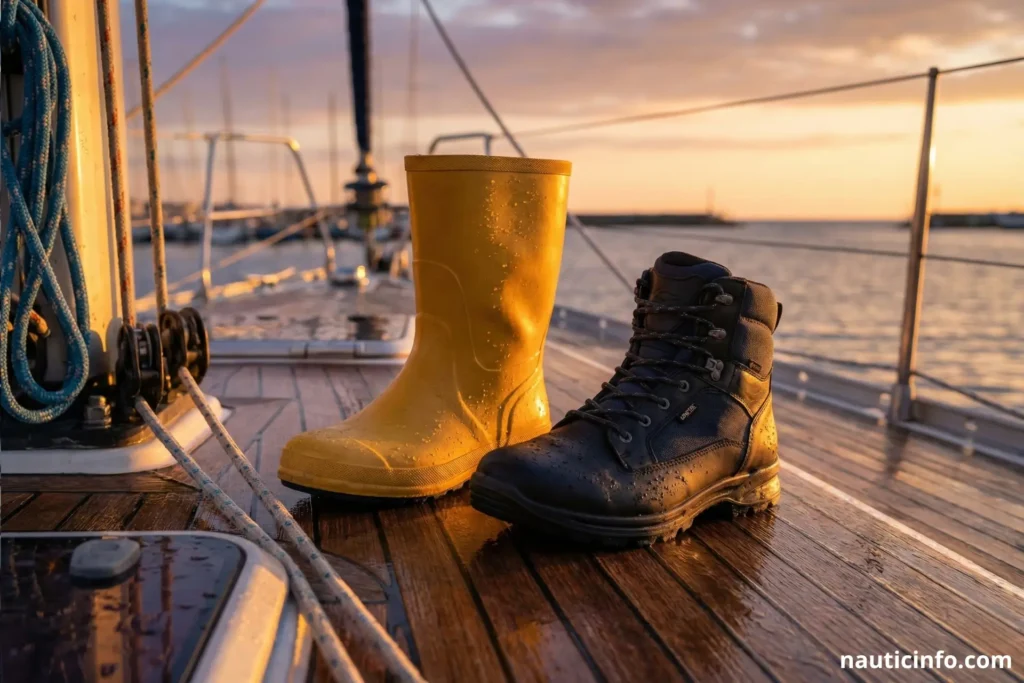
Nothing ruins a day on the water faster than cold, wet feet. Whether you are battling a nor’easter off the coast of Maine or cruising the calm waters of the Florida Keys, your choice of footwear is arguably the most critical gear decision you will make after your life jacket. For decades, the debate has raged on docks from Newport to San Diego: Rubber vs. Breathable Sailing Boots. Is the old-school reliability of rubber enough, or should you drop significant cash on high-tech Gore-Tex® membranes?
In this deep-dive guide, we are going to break down everything you need to know. We will analyze the tech, the durability, and most importantly, the value for your money. So, grab a coffee, sit back, and let’s find the perfect boots for your next adventure.
The Classic Contender: Rubber Sailing Boots

The “Old Faithful” of the Marine World
Let’s start with the basics. Rubber boots (often called “Wellies” across the pond, but let’s stick to “deck boots” here) are the workhorses of the industry. Brands like Xtratuf and Gill have built empires on these molded rubber marvels.
How They Work
Rubber boots are 100% waterproof from the outside in. They are essentially a seamless barrier. If you step in a puddle that is 6 inches deep, and your boot is 10 inches high, your foot stays dry. Period.
Pros & Cons of Rubber Boots
| Feature | The Good (Pros) | The Bad (Cons) |
| Waterproofing | Absolute. Unless there is a hole, water isn’t getting in. | Zero breathability. Sweat stays trapped inside. |
| Maintenance | Hose them down. That’s it. | Hard to dry out if the inside gets wet. |
| Durability | High abrasion resistance against barnacles and non-skid decks. | Rubber can crack over time if exposed to too much UV. |
| Price | Very Wallet-Friendly ($50 – $150). | cheap models lack arch support. |
Who is this for?
Consequently, rubber boots are the undisputed king of day sailing and warm-weather fishing. If you are out for a few hours and head back to the dock before sunset, the lack of breathability won’t bother you much. They are also perfect for “dirty jobs”—scrubbing the deck, working the bilge, or launching the tender.
The High-Tech Challenger: Breathable (Gore-Tex) Boots

Performance Meets Comfort
On the other side of the ring, we have breathable boots, often championed by premium brands like Dubarry of Ireland, Musto, and Zhik. These aren’t just boots; they are pieces of engineering.
The Science of Breathability
The magic lies in the membrane (often Gore-Tex® or a proprietary equivalent). This membrane has microscopic pores that are 20,000 times smaller than a water droplet but 700 times larger than a water vapor molecule.
This means ocean spray stays out, but the pint of sweat your feet produce during a hard day of grinding winches can escape. The result? Your feet stay dry and warm.
Pros & Cons of Breathable Boots
| Feature | The Good (Pros) | The Bad (Cons) |
| Climate Control | Regulates temperature. Warmer in winter, cooler in summer. | Requires periodic re-proofing (DWR sprays). |
| Comfort | Often built with premium leather and ergonomic footbeds. | Heavier when wet (outer leather can soak up water). |
| Style | Looks good at the yacht club bar. | Salt crystals can clog the breathable pores. |
| Price | Significant Investment ($250 – $500+). | Expensive to replace if damaged. |
Who is this for?
Therefore, breathable boots are essential for offshore cruisers and serious racers. If you are doing a multi-day passage where you will be wearing your boots for 12+ hours straight, rubber boots will leave your feet macerated and freezing from your own sweat. Breathable boots are a safety factor here—dry feet are warm feet.
Rubber vs. Breathable Sailing Boots: The Budget Breakdown
Now, let’s talk dollars and cents. The price gap between these two categories is massive. Is the upgrade worth it?
Entry Level: Under $100
- The Choice: Basic Rubber / PVC.
- What you get: A waterproof bucket for your foot.
- Verdict: Great for guests or occasional weekenders. However, expect zero arch support and cold toes in November.
Mid-Range: $100 – $200
- The Choice: Premium Rubber (Neoprene lined) or Hybrid.
- What you get: This is the sweet spot for many. Boots like the Xtratuf Legacy sit here. You get excellent non-slip soles (essential for safety) and potentially a neoprene lining for warmth.
- Verdict: The best value for coastal sailors and fishermen.
High-End: $300 – $500+
- The Choice: Full Leather with Gore-Tex (e.g., Dubarry Ultima).
- What you get: Incredible longevity (if cared for), unmatched comfort, and style.
- Verdict: If you live on your boat or sail more than 30 days a year, the “cost per wear” actually makes these affordable in the long run. A good pair of Dubarrys can last 10 years; you might burn through three pairs of cheap rubber boots in that time.
Rubber vs. Breathable Sailing Boots: Decision Matrix, which Boot Fits Your Profile?
To make this easy, use this table to find your match.
| If you are… | Recommended Material | Estimated Budget | Why? |
| Weekend Warrior (Summer) | Short Rubber Ankle Boot | $80 – $110 | Easy on/off, cool enough, waterproof for splashes. |
| Coastal Cruiser (Spring/Fall) | Tall Rubber with Neoprene | $120 – $160 | Neoprene adds insulation; tall shaft handles chop. |
| Offshore Sailor / Ocean Crossing | High-Performance Breathable | $350+ | Breathability is non-negotiable for long shifts. |
| Liveaboard | Leather Breathable | $300+ | You wear them everyday; comfort is king. |
| Dinghy Sailor | Neoprene Booties (Not boots) | $60 – $100 | You need flexibility and warmth when wet, not dry boots. |
Practical Maintenance: Make Your Gear Last
Whether you spend $100 or $400, your gear is useless if you don’t maintain it. Salt is the enemy of all footwear.
For Rubber Boots
- Fresh Water Rinse: After every trip. Salt dries and cracks rubber.
- UV Protection: Store them in a dark locker. Sun turns rubber brittle.
- Silicone Spray: Once a season, spray them with a rubber conditioner to keep them supple.
For Breathable/Leather Boots
- Rinse & Scrub: Use a soft brush to remove salt from the leather pores. If the pores are clogged with salt, the boot stops breathing.
- Dry Naturally: NEVER put leather boots near a heater or engine block. The leather will dry out and crack. Stuff them with newspaper to absorb internal moisture.
- Condition: Use a leather cream recommended by the manufacturer (like Dubarry’s cream).
- DWR Spray: If water stops beading on the surface, apply a DWR (Durable Water Repellent) spray to the textile parts.
Rubber vs. Breathable Sailing Boots: Our Top Picks for the US Market
Based on current performance reviews and popularity in US marinas:
Rubber Boot: Xtratuf Legacy 15″
- Why: Known as the “Alaskan Sneaker.” Incredibly grippy on wet fiberglass, flexible, and chemically resistant.
- Price: Approx. $145.
Breathable Boot: Dubarry Ultima
- Why: The gold standard. Classic look, Gore-Tex lining, and a sole that sticks like glue but won’t mark your deck.
- Price: Approx. $399.
Hybrid/Value: Gill Offshore Boot
- Why: It uses a proprietary breathable membrane (not Gore-Tex brand, but similar) at a lower price point. Integrated gaiters prevent water coming in the top.
- Price: Approx. $200.
Conclusion : Rubber vs. Breathable Sailing Boots
Ultimately, the battle of Rubber vs. Breathable Sailing Boots comes down to the duration of your exposure.
If you are sprinting around the buoys on a Wednesday night, grab the rubber boots. They are tough, cheap, and get the job done. However, if you are pointing your bow toward the horizon for a 3-day passage, invest in breathable footwear. Your feet are your connection to the boat; treat them well, and they will keep you standing when the seas get rough.