
The “Strait of Bonifacio Week”: Navigating Between Bonifacio and the Maddalena Archipelago (Sardinia)

Imagine a tumultuous strait, framed by majestic limestone cliffs and an archipelago of turquoise waters. This is the spectacular setting that awaits you between Corsica and Sardinia: the Strait of Bonifacio. This area, a true mecca for Mediterranean navigation, promises unforgettable stopovers but also conceals formidable technical challenges. This article is your ultimate guide to turning your “Strait of Bonifacio Week” into a successful adventure, emphasizing the beauty, the paradisiacal anchorages, but above all, the technical and regulatory aspects, along with the best tips for successful Bonifacio Maddalena Sailing.
Preparing for Bonifacio Maddalena Sailing: Essential Tips and Charting
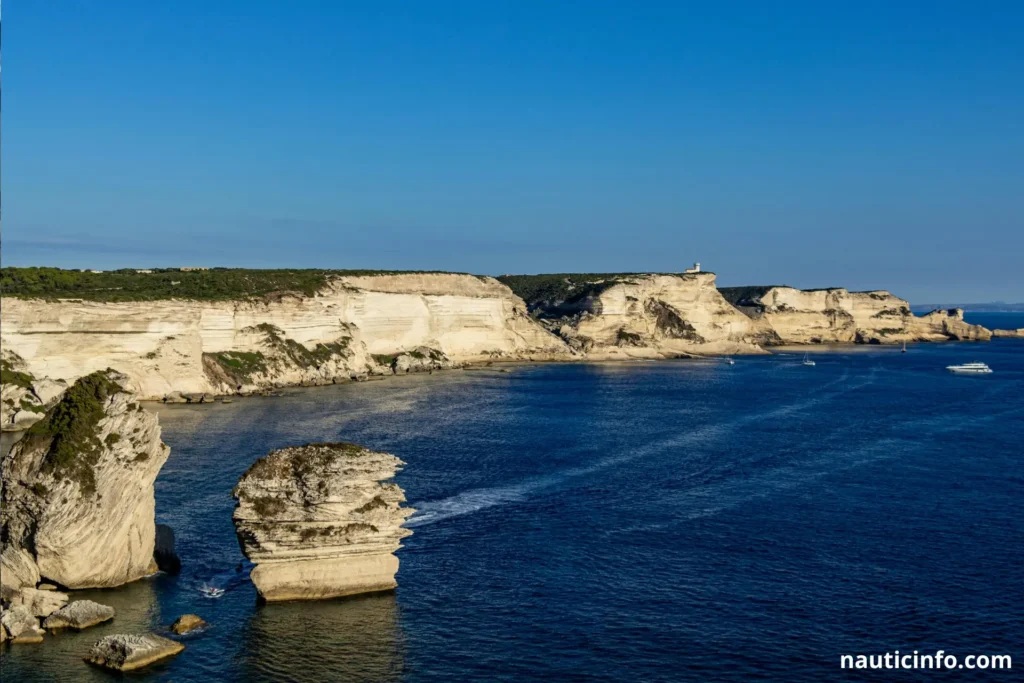
Crossing the strait and exploring the Maddalena Archipelago is not something to improvise. First and foremost, a thorough understanding of the geographical and meteorological specificities is crucial. Furthermore, this area is a protected marine park that imposes strict rules.
The Geographical Challenge is palpable. The strait measures only 11 nautical miles wide between Cap Pertusato (Corsica) and Asinara Island (Sardinia). Depths are generally significant, but the presence of isolated shoals requires constant vigilance. Consequently, planning your route must be a priority.
The Mythical Strait: A Challenge for Bonifacio Maddalena Sailing Tips
The passage between Corsica and Sardinia acts as a funnel for prevailing winds. This particularity, known as the Venturi effect, is the main concern for navigators. Indeed, a moderate wind can turn into a violent gale over a short distance.
This is why meticulous documentation preparation is indispensable.
Mandatory Charting and Documents for Bonifacio Maddalena Sailing
Also, navigation in an area subject to strict regulations and changing conditions requires careful preparation.
- Up-to-date Charts: Have the latest marine charts from SHOM (France) and/or IIM (Italy), especially detailed charts of the passages between the Maddalena islands (Spargi, Budelli, Caprera). Moreover, electronic charts should be cross-referenced with paper charts for complex areas.
- Park Regulations: Be equipped with the complete regulations for the Strait of Bonifacio Nature Reserve (French side) and the Maddalena Archipelago National Park (Italian side). Therefore, you will avoid costly fines and contribute to environmental protection.
Mastering the Elements: Winds, Currents, and Safety
Managing Weather Conditions for Optimal Bonifacio Maddalena Sailing
The reputation of the Strait of Bonifacio is well-deserved. However, with good preparation, a potentially difficult navigation can be transformed into an exhilarating cruise. The secret lies in anticipation and knowledge of local winds.
Prevailing Winds: The Venturi Effect Trap
- The Mistral (NW): The most feared wind. It significantly accelerates when crossing the strait, creating short, choppy seas. For example, it can easily reach Force 8, even if forecasts are more moderate outside the strait.
- The Libeccio (SW): Frequent and strong, it also brings significant swell into the strait, making anchorages open to the west untenable.
- The Levant and the Grec (E and NE): Less frequent, they nonetheless make the west coast of La Maddalena and the south coast of Corsica agitated.
Practical Wind Tip: Thus, always check local forecasts (such as those from Port-Vendres or Naval Aeronautics) in addition to synoptic charts. If Mistral is forecast above 4 Beaufort, consider postponing the strait crossing, or navigate early in the morning before the thermal effect adds to the pressure.
| Indicator | Wind Force (Beaufort) | Risk | Navigation Advice |
| Light | 1 to 3 | None | Ideal for sailing and anchoring. |
| Moderate | 4 to 5 | Short swell possible | Pleasant sailing. Favor sheltered anchorages (e.g., South Maddalena). |
| Strong | 6 and + | Danger (Increased Venturi Effect) | Crossing the strait is not recommended. Wait in Bonifacio or Porto Cervo. |
| Very Strong | 8 and + | No-Sail Zone | Absolute safety. Stay in port or a perfectly sheltered area. |
Currents, Swell, and Short Waves: The Danger of Opposition for Bonifacio Maddalena Sailing
Nonetheless, wind is not the only factor to consider. The topography of the seabed and the confluence of Atlantic and Mediterranean water masses create significant currents.
- The Main Current: A dominant current flows from West to East, with speeds that can reach 2 knots, particularly near Cap Pertusato.
- Swell/Current Interaction: This is where the real danger lies. For instance, when the Mistral (westerly wind) opposes the current (easterly), the sea quickly builds, and waves become extremely short and steep. This configuration can be dangerous for small boats and makes navigation very uncomfortable, especially as the boat struggles to cut through these short waves.
Regulations and Marine Park Protection
The Rules of the Game: Regulations and Protection of the Maddalena National Park for Bonifacio Maddalena Sailing
The Strait area, especially on the Italian side, is a classified ecological treasure. That is why respecting the rules is not an option, but an obligation for the preservation of this unique environment.
The Maddalena Archipelago National Park (PNAM, Italy) is the most strictly regulated. It is divided into zones A, B, C, and D with very specific rules for anchoring, navigation, and fishing.
| PNAM Zone | Description | Navigation | Anchoring | Penalties |
| Zone A (Integral Reserve) | Budelli’s Pink Beach | Strictly Prohibited | Strictly Prohibited | Very heavy fines and possible confiscation. |
| Zone B (General) | Most famous coves | Authorized (speed limited) | Mandatory on buoy (in season) | Heavy fine if anchoring on Posidonia. |
| Zone C (Partial) | Some peripheral areas | Authorized | Anchoring allowed on sand | Increased surveillance. |
It should be noted that these rules are rigorously enforced by the coast guard and park police. Ignorance of the regulations is not an excuse.
H3 : Posidonia: The Lungs of the Mediterranean and Its Protection, Vital for Bonifacio Maddalena Sailing
Furthermore, Posidonia oceanica, this endemic marine plant, is vital for the ecosystem. Its seagrass beds serve as nurseries for fish, oxygenate the water, and stabilize the seabed.
- The Danger of Anchors: A dragging anchor destroys these seagrass beds in minutes, leaving an environmental scar that will take decades to heal.
- Practical Anchoring Tip: Use mapping applications (like Navily or others) that clearly indicate Posidonia areas. Consequently, you must imperatively drop anchor on white sand. If in doubt, use a National Park buoy. If no buoy is available and you only find seagrass, find another anchorage.
Must-Visit Stops on the Strait of Bonifacio Week
The Most Beautiful Anchorages for Enjoyable Bonifacio Maddalena Sailing
After the vigilance of the strait, comes the reward: coves with Caribbean-like colors.
Corsican Side: Majesty and Contrasts
- Bonifacio: The marina, nestled at the foot of the cliffs, is mythical but expensive and often full. Approach must be done cautiously in westerly winds (beware of backwash at the entrance). However, the spectacle of entering this town is unparalleled.
- Lavezzi Islands: A magical anchorage (Zone C) but often overcrowded in high season. Moreover, watch out for submerged rocks and residual swell.
La Maddalena Side (Sardinia): The Sanctuary
- Spargi: Cala Corsara or Cala Granara. Sublime landscapes of sculpted rocks. Nevertheless, very exposed to the Libeccio.
- Caprera: Cala Coticcio (Tahiti). A jewel with incredibly clear waters. Anchoring is mandatory on a buoy in season. Very protected from West/North-West winds. Ultimately, it is one of the best shelters in the area.
- Budelli: The Pink Beach. It is a symbol of protection. However, the approach is very regulated (Zone A). Admiring it from outside the zone is sufficient privilege.
The Responsible Boater’s Etiquette for Bonifacio Maddalena Sailing
In addition, adopting respectful behavior is essential to maintain the delicate balance of this ecosystem.
- Speed: Limit speed to 10 knots near the coast and within the archipelago to avoid disturbing wildlife and causing shoreline erosion.
- Waste: Never discharge pollutants or waste into the sea. Indeed, it is recommended to bring all your trash back to port.
- Vigilance: Be attentive to other navigators, especially in narrow passages and buoyed areas.
Conclusion: Ready for Departure
The “Strait of Bonifacio Week” is much more than just a crossing. It is an immersion in an exceptional environment that demands as much respect as technical mastery. The juxtaposition of the raw beauty of Bonifacio’s cliffs and the serenity of the Maddalena islands creates an unparalleled sailing experience.
In conclusion, by carefully planning your itinerary, checking local forecasts hourly, and respecting the strict regulations of the marine parks, you will ensure a memorable cruise. The satisfaction of taming the Mistral and reaching these pristine anchorages is the true reward. Therefore, prepare your lines, check your anchor, and set off: the adventure of Bonifacio Maddalena Sailing Tips awaits you.