

How to Anchor a Boat: The Steps for a Serene Arrival

The sun is dipping toward the horizon, a gentle sea breeze cools your face, and a secluded cove beckons. It’s the perfect picture of a day on the water, but one crucial maneuver still separates you from that moment of tranquility: anchoring. For many boaters, especially beginners, the act of dropping anchor can be a source of real anxiety. And yet, with proper preparation and a methodical approach, this operation can become as natural as hoisting the sails. This practical guide details, step-by-step. How to anchor a boat: the steps for a serene arrival, from approaching the spot to verifying the anchor’s hold. Come aboard with us to transform this intimidating maneuver into a simple formality.
The Importance of Good Preparation Before Anchoring

Before you even think about dropping the hook, a meticulous preparation phase is absolutely essential. Indeed, a serene arrival at an anchorage depends largely on anticipating the conditions and checking your equipment. This preliminary step is the foundation of your safety and the safety of other boaters around you.
Analyzing the Anchorage Area
Choosing the right spot is arguably the most critical element for successful anchoring. It’s not enough to find a beautiful location; above all, you must ensure it is safe. Firstly, consult your marine charts, whether they are paper or electronic (like NOAA charts). These will provide vital information about the nature of the seabed. Ideally, you should look for bottoms of sand or mud, as they offer excellent holding power for most types of anchors. On the other hand, avoid rocky bottoms that can easily snag an anchor. You must also take care to preserve grassy areas, especially protected seagrass beds.
Secondly, analyzing the weather is just as fundamental. Check the wind forecast for the next 24 hours, or even longer if you plan an extended stay. A cove that is perfectly sheltered from a west wind can quickly turn into a dangerous trap if the wind shifts to the north during the night. Consequently, you must choose a spot that will protect you from the predicted prevailing winds. In addition, you need to account for currents and tides. The water depth at low tide must be sufficient to prevent grounding, and your boat’s swing circle (the area in which it will pivot around its anchor) must remain clear of all obstacles.
Checking Your Anchoring Gear
Once a potential anchorage area is identified, it’s time to prepare your gear. Equipment in good working order is a non-negotiable prerequisite. Begin by visually inspecting your anchor. Make sure it is not damaged and that its parts are moving freely. Next, examine the anchor rode, whether it’s an all-chain rode or a combination of rope and chain. For a chain, check for any corroded or deformed links. If you are using a rope rode, look for signs of wear or chafing.
The windlass, whether electric or manual, is your most valuable ally during this maneuver. Therefore, you should test that it’s working correctly before every trip. Make sure the chain or rope is clear and can run out smoothly without kinking or knotting in the anchor locker. You should also get any helpful accessories ready, such as a snubber or bridle to take the load off the windlass once the anchor is set, and a trip line, which is a small line with a buoy attached that marks your anchor’s position and helps free it more easily if it becomes fouled.
The Approach and Positioning: A Precision Maneuver
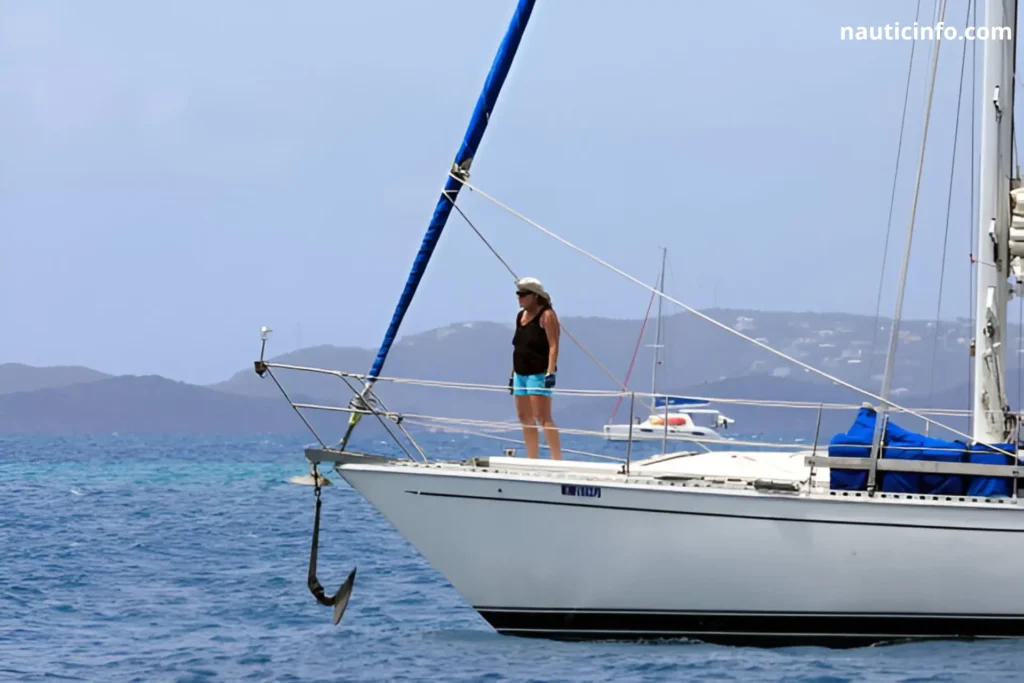
Approaching your chosen anchoring spot is a delicate phase that requires calm and precision. It is at this moment that you will apply your prior analysis and communicate effectively with your crew to ensure everything goes smoothly.
How to anchor a boat: steps for a serene arrival during the approach
The golden rule is to approach heading into the wind or the current, whichever is stronger. This technique helps to naturally slow the boat down and stabilize it, thus giving you better control. Moreover, it positions the boat in the same orientation it will have once at anchor, which makes estimating distances much easier. You should proceed slowly, at a speed that allows you to remain maneuverable without creating a significant wake. Use this approach to perform a final visual survey of the area. Confirm that the depth shown on your depth sounder matches the indications on the chart. Also, observe other boats already at anchor; their orientation gives you an excellent indication of the wind or current direction.
Crew communication for how to anchor a boat: steps for a serene arrival
Clear and concise communication is essential. Before beginning the maneuver, you must define everyone’s roles. Typically, one person is at the helm, managing the engine and the boat’s direction, while a crew member is positioned at the bow, ready to handle the anchor. You should establish simple, unambiguous communication signals. Hand signals are often more effective than words, which can be lost in the noise of the wind or engine. The crew member at the bow needs to be able to indicate the depth, the anchor’s status, and the moment it touches the bottom. The skipper, in turn, should announce their intentions, especially changes in speed or direction. This coordination is a key factor in how to anchor a boat: the steps for a serene arrival.
The Anchoring Maneuver in Detail

Here we are at the heart of the action. The boat is positioned, and the crew is ready. Now it’s time to let the anchor go and ensure it digs firmly into the seabed.
Calculating the Right Scope
The question of how much chain or rope to let out—known as scope—is crucial. An insufficient scope will cause your anchor to drag; conversely, an excessive scope will make your swing circle too large, increasing the risk of collision with other boats or obstacles. The basic rule of thumb is to use a scope of 3:1 to 5:1, meaning you let out 3 to 5 feet of rode for every foot of water depth. This water depth isn’t just the reading on your sounder. You must add the distance from the waterline to your bow (your freeboard) and, very importantly, account for the high tide if you are in a tidal area.
For example, let’s say the depth sounder reads 30 feet, your freeboard is 5 feet, and the tide will rise another 5 feet. The total depth to consider is 40 feet. In calm weather, a 3:1 scope might suffice, which means 120 feet of rode. However, if the wind is expected to pick up, you shouldn’t hesitate to increase the scope to 5:1 (200 feet), or even 7:1 (280 feet) in stronger conditions. Ultimately, the more rode you have out, the more horizontal the pull on the anchor will be, resulting in better holding power.
How to anchor a boat: steps for a serene arrival – Dropping the Anchor
The boat is almost at a standstill, facing the wind, at the precise spot where you want your anchor to rest. The bow crew, on the skipper’s command, begins to lower the anchor. It is generally better to let it run out quickly but under control, rather than letting it free-fall, which could cause the chain to pile up on top of the anchor itself. As soon as the anchor touches the bottom, which the crew member announces to the skipper, the skipper engages the engine in a very slow reverse. The boat will then begin to back away from the drop point. Meanwhile, the crew member at the bow continues to pay out the rode, keeping it just taut enough to prevent it from piling up on the seabed.
How to anchor a boat: steps for a serene arrival – Setting the Anchor
Once the desired length of rode is out, the crew member secures it on the windlass or a cleat. The rode will then gradually tighten. This is the critical moment when the anchor is supposed to dig into the bottom. To ensure it has “set” properly, the skipper can apply a short burst of reverse power from the engine, just enough to make the rode very taut. You must then observe the boat’s behavior carefully. If it comes to a firm stop and the rode vibrates slightly under the tension, that’s an excellent sign. Your anchor is likely well-dug in. If, on the contrary, the boat continues to move backward in jerks, it means the anchor is dragging. In that case, there is no other solution but to raise the anchor and start the entire maneuver over, perhaps choosing a slightly different spot.
Verifying and Securing the Anchorage

Your anchor is down, the rode is taut, and the boat appears to be stationary. However, your work is not yet finished. A final phase of verification and securing is necessary to ensure a peaceful day or night.
Checking the Anchor is Holding
The first check involves taking visual cues from the shore. Choose two fixed landmarks that you can line up (for instance, a distant tower and a prominent rock), creating a “range.” Watch this alignment for several minutes. If it doesn’t change, your anchorage is stable. If the two landmarks begin to shift their alignment, it means your boat is dragging. Another, more modern method is to use the “anchor alarm” function on your GPS. You can set a virtual security circle around your anchor’s position. If the boat moves outside this circle, an alarm will sound. This is a particularly reassuring tool, especially for an overnight stay. Also, if conditions permit, don’t hesitate to dive on the anchor to visually check how well it is buried. This is, without a doubt, the most reliable way to gain peace of mind.
Setting Up Safety Measures
Once you are certain that your anchor is holding fast, it’s time to secure it for the duration. To do this, you should use a snubber or a bridle. This device is a length of nylon rope that attaches to the anchor chain with a special hook and is then tied off to two bow cleats. By tensioning the snubber, you take the entire load off the windlass, thereby preserving its mechanism. It also acts as a shock absorber, cushioning the jerking motion from waves or wind, which makes the anchorage more comfortable and quieter.
Finally, remember to signal your presence. During the day, you must hoist a black anchor ball. At night, you must turn on your anchor light, which is an all-around white light visible for 360 degrees. This is a regulatory requirement that ensures other vessels can see you and plot a course to avoid you.
By scrupulously following these steps, from advance preparation to the final securing checks, you will quickly master the art of anchoring. Each successful maneuver will build your confidence and allow you to fully enjoy the pleasures of boating. How to anchor a boat: the steps for a serene arrival is ultimately just a matter of method, practice, and a healthy dose of good seamanship. So, the next time you spot that dream cove, don’t hesitate: you now have all the keys to drop your anchor there in complete serenity.