
The Definitive Analysis of Sailboat Keel Types: Optimizing Performance and Shoal Draft Capability for the North American Cruiser
Sailboat Keel Types, I present this exhaustive technical dossier examining the hydrodynamic, structural, and operational distinctions between Fin Keels, Centerboards, and Twin Keels. Designed specifically for the US-based audience. From the shoal-water gunkholers of the Chesapeake and Bahamas to the offshore voyagers of the Pacific Northwest. This report synthesizes naval architecture principles with practical seamanship to guide your vessel selection.
Sailboat Keel Types : The Hydrodynamic Imperative in Yacht Design
The selection of Sailboat Keel Types remains the single most consequential decision in the acquisition of a sailing vessel. Dictating not only the yacht’s upwind efficiency and stability but also its access to cruising grounds and survivability in extreme conditions. Historically, the American market has been dominated by a binary choice: the deep Fin Keel (Quillard) for performance and the Centerboard (Dériveur) for shoal draft versatility. However, the emergence of modern hydrodynamic modeling has revitalized a third option the Twin Keel (Biquille). Transforming it from a perceived oddity into a legitimate contender for the serious cruiser. Consequently, understanding the nuanced interplay between lift, drag, righting moment, and structural integrity is essential for the informed buyer.
Furthermore, the terminology surrounding Sailboat Keel Types often suffers from ambiguity, particularly when translating European innovations for the US market. This report will rigorously define and deconstruct these configurations. We will explore how the high-aspect Fin Keel has evolved through lift-drag optimization; how the Centerboard utilizes dynamic stability to survive heavy weather; and how the Twin Keel employs asymmetric foils to generate “turbo-charged” lift upwind. Specifically, we will ground this analysis in the practical realities of American waters, addressing the unique challenges of the Intracoastal Waterway (ICW), the thin waters of the Florida Keys, and the crossing to the Bahamas.
Sailboat Keel Types, The Fin Keel (Quillard): The Benchmark of Hydrodynamic Efficiency
The Physics of the Fixed Foil
The Fin Keel stands as the archetype of modern performance, representing the standard against which all other Sailboat Keel Types are measured. Structurally, it consists of a single, deep appendage fixed to the hull’s centerline, acting simultaneously as a hydrofoil to generate lift and a cantilever to carry ballast. Modern naval architecture treats the fin keel as an underwater wing; as the vessel makes leeway, the water strikes the keel at an angle of attack, creating a pressure differential between the windward (low pressure) and leeward (high pressure) sides. This pressure gradient generates a lift force acting to windward, counteracting the aerodynamic side force of the sails.
However, the efficiency of a Fin Keel is inextricably linked to its Aspect Ratio (AR)—the ratio of the span (depth) to the chord (width). High-aspect fins, common on performance cruisers like the Beneteau First or J/Boats series, generate maximum lift with minimal induced drag, allowing pointing angles of 35-40 degrees to the true wind. Conversely, this performance comes at the cost of draft; a deep fin necessary for upwind work often draws 6 to 9 feet, imposing severe restrictions on cruising grounds in the Eastern US.
Material Science: Lead vs. Cast Iron Ballast
A critical variable in the performance of Sailboat Keel Types is the density of the ballast material.
- Lead Antimony: With a density of approximately 708 lbs/ft³, lead allows designers to concentrate mass at the very bottom of the fin (often in a bulb), significantly lowering the Center of Gravity (CG) and maximizing the Righting Moment (RM) for a given weight. This “stiffness” allows the vessel to carry more canvas in high winds. Lead is also ductile; in a hard grounding, it tends to dent or deform, absorbing impact energy and potentially sparing the hull-to-keel joint from catastrophic failure.
- Cast Iron: Significantly less dense at roughly 450 lbs/ft³, cast iron requires a larger volume to achieve the same ballast weight. This increased volume results in a thicker foil section, increasing form drag and wetted surface area. Furthermore, iron is brittle; impact energy is transmitted directly to the keel bolts and hull grid, increasing the risk of structural delamination. Iron is also prone to relentless corrosion, requiring diligent maintenance of epoxy barrier coats to prevent the “weeping rust” that plagues many production boats.
Structural Integrity: The “Keel Smile” and Grid Systems
The connection between a high-aspect Fin Keel and the hull is a focal point of stress. The immense leverage exerted by a deep keel creates significant bending moments at the root. A common pathology in aging fiberglass vessels is the “keel smile”—a transverse crack at the leading or trailing edge of the keel-to-hull joint.
- Diagnosis: While a hairline crack in the fairing compound may be cosmetic, a widening gap or the presence of rust weeping (“crying”) from the joint indicates movement. This suggests that the keel bolts may be loose, corroded, or that the internal structural grid (the “floors”) has debonded from the hull skin.
- Implications: In extreme cases, such as the tragedy of the Cheeki Rafiki, unrecognized structural fatigue can lead to total keel loss and capsize. Consequently, buyers of deep Fin Keel yachts must prioritize a thorough survey of the bilge grid and keel bolts.
Pro Tip: Keel Bolt Inspection
When inspecting a used vessel, check the bilge water. If the water is salty and rust-stained near the keel bolts, be alarmed. Stainless steel bolts suffering from crevice corrosion can fail without warning. Additionally, tap the hull area around the keel stub with a phenolic hammer; a dull thud may indicate water intrusion or delamination of the grid.
The Heavy Weather Liability: “Tripping”
While Fin Keels excel in generating righting moment, they present a distinct hazard in survival conditions known as “tripping.” When a vessel with a deep, high-lateral-resistance fin surfs down the face of a steep wave and broaches (turns broadside), the keel acts as a pivot point. The momentum of the hull combined with the breaking wave pushing the topsides can cause the boat to “trip” over its own keel, leading to a violent knockdown or capsize. This dynamic instability is a key argument used by proponents of centerboards and heavy displacement hulls for high-latitude voyaging.
Table 1: Fin Keel Material Comparison
| Feature | Lead Ballast | Cast Iron Ballast |
| Density | High (708 lbs/ft³) – Compact Bulb | Moderate (450 lbs/ft³) – Larger Foil |
| Impact Physics | Ductile (Absorbs shock, deforms) | Brittle (Transmits shock to hull grid) |
| Corrosion | Oxidizes to stable powder (Low maintenance) | Rusts expansively (High maintenance) |
| Cost | Expensive (Premium yachts) | Economical (Mass production) |
| Repair | Can be reshaped/filled easily | Requires grinding/sealing/fairing |
Sailboat Keel Types, The Centerboard (Dériveur): The US East Coast Solution
Taxonomy: Centerboard vs. Lifting Keel vs. Swing Keel
To accurately discuss Sailboat Keel Types, we must disambiguate the terminology, as “centerboard” is often used loosely in the US market to describe any retractable appendage.
- True Centerboard (Dériveur Lesté): The ballast is encapsulated within the hull or a shallow fixed keel stub. The board itself is a lightweight foil (fiberglass, wood, or light metal) that provides lateral resistance (preventing leeway) but minimal righting moment. Examples include the classic Hinckley Bermuda 40 or the Tartan 37.
- Lifting Keel / Swing Keel (Quillard Relevable): The appendage itself contains a significant portion of the vessel’s ballast. When raised, the Center of Gravity (CG) rises significantly, reducing stability. This design is common in trailer sailers (Catalina 22) and high-performance cruisers (Southerly, Pogo).
The Shoal Draft Imperative
For the American sailor based on the East Coast, the geography dictates the vessel design. The Intracoastal Waterway (ICW) nominally guarantees 10-12 feet of depth, but shoaling frequently reduces this to 5-6 feet in critical passes. Similarly, the Bahamas banks and the Florida Keys are littered with thin water.
- Operational Advantage: A Centerboard vessel like the Tartan 37 draws only 4-5 feet with the board up, allowing access to protected anchorages and ICW fuel docks that are off-limits to deep fin keelers. Yet, with the board down, draft increases to 8-9 feet, providing the high-aspect foil shape necessary for upwind performance in the Gulf Stream.
- Versatility: This duality makes the Centerboard one of the most versatile Sailboat Keel Types for the mixed-use cruiser who splits time between coastal gunkholing and offshore passages.
Dynamic Stability: The “Sliding” Effect
One of the most profound, yet underappreciated, advantages of the Centerboard in heavy weather is the ability to manipulate lateral resistance.
- The Mechanism: In survival storm conditions with breaking waves, a deep keel anchors the boat to the water, creating a fulcrum for capsize. A centerboarder can raise the board, effectively removing this fulcrum.
- The Result: When struck by a breaking wave beam-on, the hull “slides” sideways (sideslips) rather than tripping. This dissipates the wave’s energy into leeway rather than roll, significantly reducing the likelihood of a catastrophic capsize. This “safety valve” feature is a core philosophy behind French aluminum expedition yachts like the Alubat Ovni.
Maintenance Complexities: The Achilles Heel
The mechanical complexity of retractable Sailboat Keel Types introduces failure points absent in fixed keels.
- Cable Fatigue: The lifting pennant, typically stainless steel wire or Dyneema, is subject to cyclic loading and chafe. A snapped cable can leave the board swinging wildly, potentially damaging the hull trunk or jamming in the down position, creating a draft hazard.
- Pivot Pin Wear: The pivot pin is submerged and often inaccessible without a haul-out. Wear in the pin or the bushing leads to a “clunking” sound at anchor as the board shifts laterally. Over time, crevice corrosion can weaken the pin, leading to loss of the board.
- Trunk Issues: The centerboard trunk is a dark, damp cavity ideal for barnacle growth. In tropical waters like Florida, marine growth can seize the board. Furthermore, the trunk itself can be difficult to paint and inspect, often requiring the boat to be lifted high in travelift straps to drop the board completely.
Sailboat Keel Types, The Twin Keel (Biquille): The Asymmetric Renaissance
Dispelling the Drag Myth
In the United States, the Twin Keel is frequently misunderstood, often associated with the “bilge keels” of 1970s British cruisers like the Westerly Centaur—sturdy but perceived as sluggish and unable to point. However, contemporary naval architecture has revolutionized this category. Modern Twin Keels, championed by designers like Lord Riverdale and Patrick Bray, are not simply two fins attached to a hull; they are sophisticated, asymmetric hydrofoils.
- Asymmetric Foils: Unlike a symmetrical fin keel, modern twin keels are shaped like airplane wings flat on the outer face and curved on the inner face. This asymmetry generates lift to windward even at low speeds.
- Toe-In Angle: The keels are often “toed-in” (angled slightly towards the bow). This alignment accounts for the flow of water around the hull, minimizing drag and ensuring the keels operate at optimal angles of attack.
The “Turbo” Effect: Upwind Dynamics
The performance argument for modern Twin Keels centers on heeled hydrodynamics.
- Vertical Leeward Foil: As the boat heels 15-20 degrees, the leeward keel rotates into a vertical position. A vertical foil is hydrodynamically superior to a slanted one (as happens to a single fin when heeled), penetrating deeper into undisturbed water and generating maximum lift.
- Reduced Drag: Simultaneously, the windward keel is lifted partially out of the water, reducing wetted surface area. Furthermore, the windward keel acts somewhat horizontally, generating a downward force vector that contributes to righting moment, effectively “holding” the boat up against the wind.
- Result: Comparative tests indicate that a well-designed modern twin keel can match the upwind pointing ability of a standard cruising fin keel, while offering superior directional stability (tracking) downwind.
The Ultimate Maintenance Hack: Drying Out
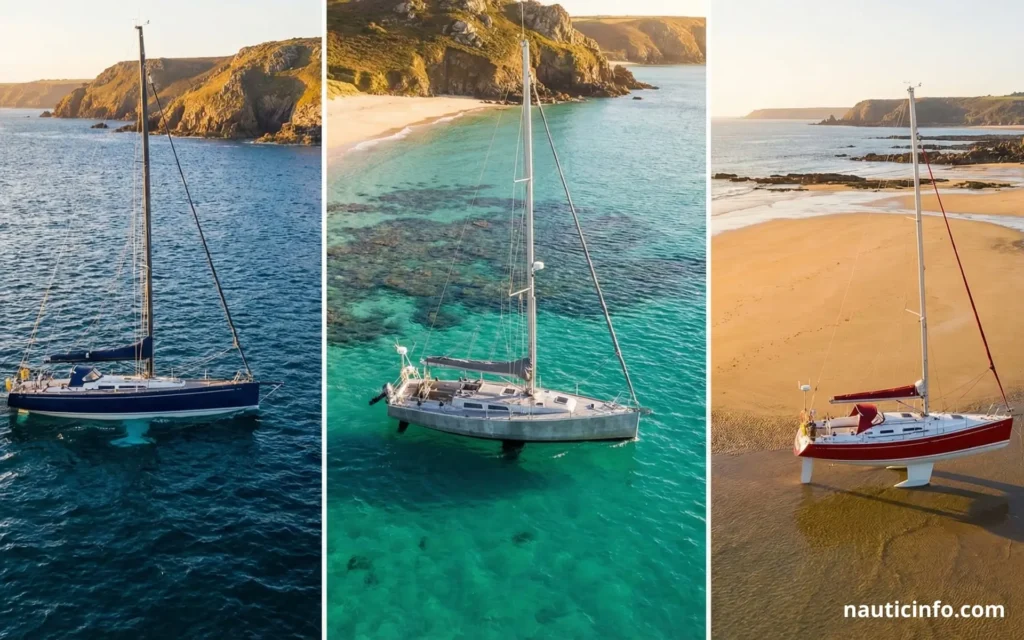
For the self-sufficient cruiser, the Twin Keel offers a capability unmatched by other Sailboat Keel Types: the ability to “take the ground” upright.
- Tidal Maintenance: In regions with significant tides (like Maine or the UK), a twin-keeler can be beached on a sandbar or grid at high tide. As the water recedes, the boat sits stable on its two keels. This allows the owner to scrub the bottom, change zinc anodes, or inspect the prop without the cost and scheduling hassle of a travelift haul-out.
- Bahamian Strategy: In the Bahamas, where boatyards are scarce and expensive, this ability is a logistical game-changer. One can careen the vessel on a sandbank in the Exumas for emergency repairs.
- Structural Note: However, repeated grounding puts stress on the hull-to-keel joint. Older designs often suffered from “splaying,” where the hull would flex, causing the keels to spread apart. Modern designs like the Sirius or RM Yachts utilize massive internal structural frames to handle these loads rigidly.
Table 2: Mechanism and Capability Comparison
| Feature | Fin Keel (Quillard) | Centerboard (Dériveur) | Twin Keel (Biquille) |
| Draft | Fixed Deep (6-9 ft) | Variable (3-9 ft) | Fixed Shoal (3-5 ft) |
| Upwind Performance | Excellent (High AR) | Good (High AR Board) | Good (Vertical Leeward Foil) |
| Downwind Tracking | Moderate (Can broach) | Variable (Board Up helps) | Excellent (Rails in water) |
| Grounding Recovery | Hard (Heel to free) | Easy (Lift board) | Hard (Cannot heel) |
| Maintenance | Bolt/Joint check | Cable/Winch/Pivot | Toe-in/Splay check |
| Drying Out | Impossible (Need legs) | Unstable (Tips over) | Excellent (Stable tripod) |
Sailboat Keel Types Stability Analysis: Comparing GZ Curves and Safety Indices
The GZ Curve and Righting Moment
The GZ curve plots the vessel’s Righting Arm (GZ) against the angle of heel, providing a fingerprint of its stability profile.
- Fin Keel Stability: Typically characterized by a high Angle of Vanishing Stability (AVS), often exceeding 120-130 degrees. The deep lead bulb provides a massive righting lever at extreme angles, ensuring the boat self-rights quickly after a knockdown.
- Twin Keel Stability: Often exhibits higher initial stability (stiffness) than a fin keel due to the lateral spacing of the ballast. While the AVS might be slightly lower than a deep fin due to the higher Center of Gravity (CG) of the shoal draft keels, modern designs achieve Class A Ocean certification with AVS values comparable to fin keelers (e.g., RM Yachts).
- Centerboard Stability: This is the most complex profile. If the ballast is internal (in the bilge), the boat relies on form stability (beam) for initial stiffness. The AVS can be lower (110-120 degrees) compared to a deep fin boat. However, the dynamic stability benefits (sliding in waves) often outweigh the static AVS reduction for experienced voyagers.
Capsize Screening Formula (CSF)
The US sailing community frequently utilizes the Capsize Screening Formula (CSF) to assess offshore suitability: $CSF = Beam / (Displacement/64)^{0.333}$. A value lower than 2.0 is generally considered desirable for ocean passages.
- Fin Keelers: Usually score well (low CSF) due to narrower beams and heavy ballast ratios.
- Centerboarders: Often feature wider beams to compensate for the higher ballast CG, which can result in higher CSF numbers (approaching 2.0). However, heavy displacement centerboarders (like the Island Packet or classic Mason) still achieve excellent safety scores due to their sheer mass.
- Twin Keelers: Modern twin keelers tend to be beamy to support the twin foils, but their ballast efficiency keeps them within safe offshore limits.
Sailboat Keel Types Practical Cruising Scenarios: The American Waterscape
The Intracoastal Waterway (ICW)
The ICW is the arterial highway for the East Coast snowbird migration.
- The Fin Keel Reality: Navigating a 6-foot draft vessel in the ICW is a high-stress exercise. You are confined to the center of the channel, vulnerable to passing commercial traffic, and excluded from many secure anchorages. Grounding is not a matter of if, but when.
- The Centerboard Advantage: With the board up, drawing 4 feet, the ICW becomes a playground. You can cut corners, enter silted marinas, and anchor in shallow creeks away from the wake of passing tugs. If you touch bottom, the board simply pivots up—a “sounding” device that prevents hard grounding.
The Bahamas and Florida Keys
The shallow banks of the Bahamas define the cruising parameters for Sailboat Keel Types.
- Anchoring Limitations: A deep fin keel boat must anchor far offshore in rolling roadsteads, exposing the crew to uncomfortable swells and long, wet dinghy rides.
- Shoal Access: A Twin Keel or Centerboard vessel can cross the shallow “cuts” between islands at mid-tide and anchor in calm, 5-foot water close to the beach. This proximity improves safety, comfort, and the overall cruising experience.
- Specific Regulation: In the Florida Keys, damaging coral or seagrass during a grounding incurs massive fines. A shoal draft vessel significantly reduces this liability.
Grounding Recovery Tactics
- Fin Keel: If you run hard aground, you can try to “kedge” off by deploying an anchor abeam and using a halyard to heel the boat over, reducing its draft.
- Centerboard: The easiest recovery. Simply winch the board up to reduce draft by several feet and motor away.
- Twin Keel: The most challenging. You cannot heel the boat to reduce draft because heeling depresses the leeward keel deeper. If you run aground, you are often stuck until the tide rises. The strategy is to kedge off directly astern, retracing your entry path exactly.
Pro Tip: The Twin Keel “Kedge”
If grounded in a Twin Keel boat, do not attempt to turn the boat around. The keels track straight. Set a kedge anchor directly off the stern and use the primary winches to pull the boat backward into deeper water.
Sailboat Keel Types Comparison of Ownership: Maintenance, Resale, and Insurance
Routine Maintenance Costs
- Fin Keel: Moderate. Main costs involve zinc replacement and periodic re-torquing of keel bolts. If the “smile” appears, re-bedding the keel is a labor-intensive yard job.
- Centerboard: High. The lifting mechanism requires constant vigilance. Cables must be replaced every 5-7 years. The trunk requires antifouling, which often involves a “hang” fee in the yard to lower the board fully. Pivot pin replacement can be a major surgical procedure involving fiberglass work.
- Twin Keel: Low to Moderate. Simply having two keels doubles the surface area for bottom painting, but the ability to dry out for maintenance can save thousands in haul-out fees over the vessel’s life.
US Market Resale and Liquidity
- Fin Keel: High liquidity. This is the standard configuration; surveyors, brokers, and buyers understand it.
- Centerboard: Niche but strong. There is a dedicated cult following for quality centerboarders (Tartan, Hinckley, Southerly) on the East Coast. They often command a premium due to their suitability for local waters.
- Twin Keel: Low liquidity. In the US, Twin Keels are often viewed with skepticism or confused with “bilge keels” from the 70s. Selling a twin keel boat may take longer, as the pool of educated buyers is smaller. However, for the right buyer, they are highly prized.
Insurance Considerations
- Fin Keel: Standard. No specific exclusions.
- Centerboard: Insurers may require specific inspection of the pivot pin and cable, given the risk of the board dropping or jamming.
- Twin Keel: Generally standard, though some insurers may ask for a survey of the hull reinforcement grid to ensure no fatigue from drying out.
Sailboat Keel Types : NauticInfo Verdict
The choice of Sailboat Keel Types is not a search for the “best” keel, but rather the most appropriate tool for your specific cruising geography and sailing philosophy.
- For the Performance Purist (West Coast / Northeast): The Fin Keel remains the undisputed king. If your sailing involves deep waters, racing, or windward performance is your primary joy, the simplicity and efficiency of a lead fin cannot be beaten. The maintenance is predictable, and the sailing dynamics are crisp and responsive.
- For the East Coast Gunkholer (Chesapeake / Florida / Bahamas): The Centerboard is the superior choice. The ability to shave draft for the ICW and then drop a deep foil for Gulf Stream crossings offers an unmatched operational envelope. The maintenance of the lifting system is the “tax” you pay for the privilege of accessing the best anchorages.
- For the Practical Voyager (Budget / Self-Sufficiency): The Twin Keel is the sleeper hit. If you can overcome the US market stigma and find a modern design (or a solid British classic), you gain a vessel that is tough, stable, and uniquely capable of self-maintenance in remote areas. It is the ultimate configuration for the sailor who values independence over fleeting upwind speed.
Final Recommendation:
Before purchasing, realistically map your cruising grounds. If 80% of your desired anchorages are less than 6 feet deep, a deep fin keel will be a source of constant anxiety. Choose the keel that fits the water you sail in, not the water you sail over.