
Navigating Arcachon Bay the Inland Sea: The Definitive Skipper’s Guide
For the American yachtsman accustomed to the deep-water approaches of New England or the predictable tides of the Chesapeake, Navigating Arcachon Bay, the French Atlantic coast presents a complex and captivating paradox. Nowhere is this duality of maritime sophistication and raw, untamed nature more evident than in Le Bassin d’Arcachon (Navigating Arcachon Bay). Unlike the open Atlantic, this is a semi-sheltered lagoon, unlike a placid lake, it breathes with the powerful, rhythmic heave of the ocean tides. It is a destination where navigation is not merely a science but an art form a place where the hydrography is alive, the heritage is crafted from Landes pine, and the culinary rewards are harvested directly from the waters beneath your keel. This comprehensive dossier serves as the ultimate operating manual for the US-based boater, translating the intricate local hydrography, strict regulations, and rich heritage of the Bassin into actionable, expert intelligence.
Navigating Arcachon Bay : The Hydrographic Theater
Navigating Arcachon Bay is not a static body of water; it is a dynamic geologic entity that defies standard cartographic permanence. Covering approximately 58 square miles (150 square kilometers) at high tide, the basin undergoes a dramatic metamorphosis every six hours, shrinking to a mere 15 square miles (40 square kilometers) at low tide. This massive tidal exchange—a “tidal prism” of hundreds of millions of cubic meters—reveals a labyrinth of deep channels, locally known as esteys, and vast, glistening mudflats that define the region’s navigational reality. For the visiting captain, a nuanced understanding of this shifting hydrography is the absolute prerequisite for safe and successful passage.
The Gatekeepers: Navigating “Les Passes”
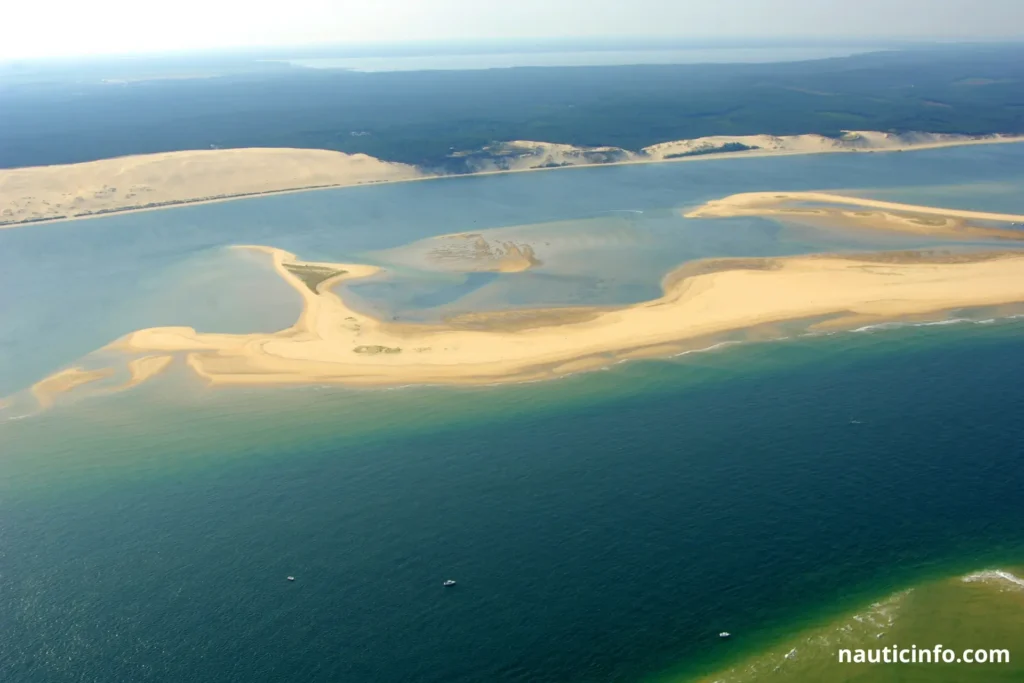
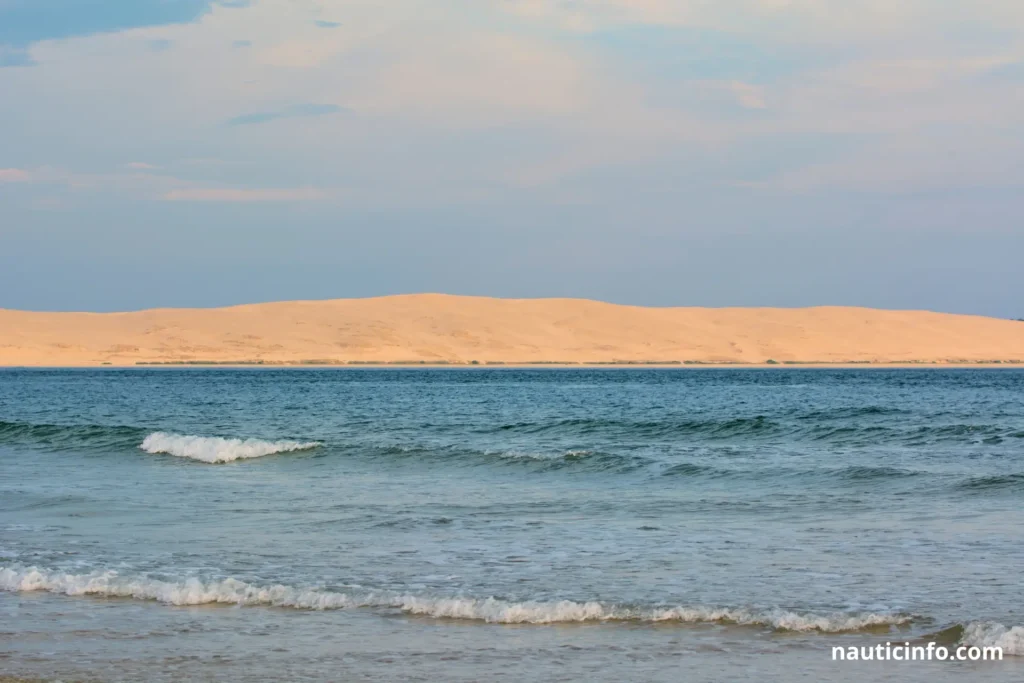
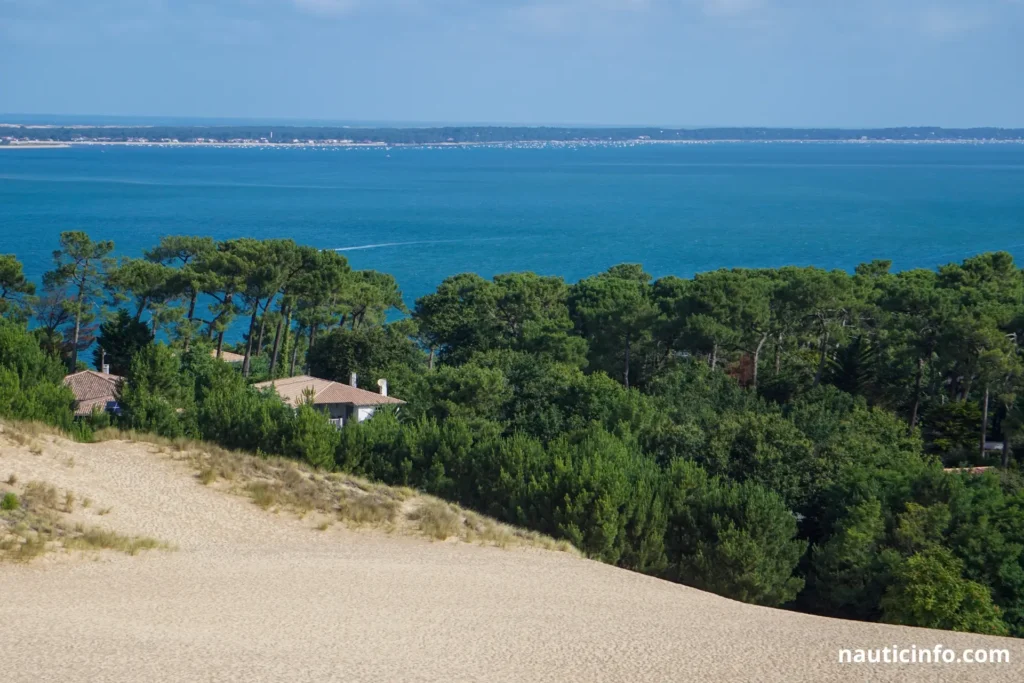
Mariners widely regard the entry into the Bassin d’Arcachon as one of the most technical and potentially hazardous approaches on the entire French Atlantic coast. Two imposing geographical features separate the lagoon from the open fury of the Atlantic Ocean: the Cap Ferret peninsula to the west, a narrow spit of land protecting the interior, and the Dune du Pilat to the east, the tallest sand dune in Europe.
Between these two sentinels lie “Les Passes” the narrow, turbulent channels where the ocean pours in and out with relentless force.
The Dynamics of Sediment and Sand
The navigational challenge at the entrance is driven primarily by sand. The interactions between the north-to-south coastal drift, the outflow of the Leyre River from within the basin, and the relentless pounding of the Atlantic swell create a highly volatile seabed that is in a state of constant flux.
- Shifting Bathymetry: Charts of the entrance are often outdated before they are even printed. The sandbanks, particularly the Banc d’Arguin and the Banc du Toulinguet, migrate constantly due to the combined pressures of wind, waves, and tidal currents.
- Erosion and Morphology: Recent aerial surveys and satellite data from 2024 have indicated spectacular and rapid erosion at the southern tip of the Banc d’Arguin. This shift has been significant enough to bury dozens of oyster farming concessions under tons of displaced sand and radically alter the geometry of the channels.
- Pilotage Implications: For the modern navigator relying on electronic chart plotters (GPS), the Bassin presents a unique danger: “chart reliability” is low in the passes. A track that was safe six months ago may now lead directly onto a shoal. Visual navigation—reading the water surface and adhering strictly to the most recent physical buoyage—is critical. The local maritime authorities frequently move the buoys to match the shifting deep-water channel, meaning the physical markers on the water take precedence over any digital display.
The Phenomenon of Breaking Seas
The entrance is subject to a terrifying phenomenon known as “breaking seas” or brisants. This occurs when a strong ebb tide (current flowing out of the basin) meets a westerly swell (wind and waves pushing in from the Atlantic).
- The “Bar” Effect: The sandbars create shallow shelves where the incoming ocean swell feels the bottom and steepens rapidly. When this steepening wave meets the opposing force of the outgoing tidal current, the result is a standing wave that can break with tremendous violence.
- Catastrophic Potential: These conditions can be catastrophic for small to medium-sized recreational vessels, leading to capsizing or swamping.
- Access Windows: Because of these dynamics, mariners generally restrict navigation through the passes to specific timeframes. Prudent seamanship mandates entering only during slack water periods or the flood tide, specifically the two hours preceding high water, when the current direction aligns with the swell or velocity is minimal.
Communication and Safety Protocols
- The Semaphore: It is standard protocol, and often a safety requirement during marginal conditions, to contact the Cap Ferret Semaphore (Coast Guard) on VHF Channel 16 before attempting entry. The Semaphore has a commanding view of the passes and can provide real-time information on the state of the sea.
- Status Indicators: If the semaphore declares the “Passes Impracticable,” entry is strictly forbidden. Ignorance of this status is not a valid defense in the eyes of the Gendarmerie Maritime.
The Banc d’Arguin: A Moving Archipelago
Located immediately inside the entrance, effectively acting as a massive breakwater for the interior of the basin, lies the Banc d’Arguin. This is not merely a navigational hazard; it is a destination of immense beauty and a rigorously protected nature reserve.
- Physical Dimensions: At low tide, this immense sandbank stretches approximately 2.5 miles (4 km) in length and 1.2 miles (2 km) in width. However, these dimensions are fluid; the bank “breathes,” expanding and contracting with the seasonal sediment cycles.
- Ecological Status: Designated as a National Nature Reserve (Réserve Naturelle Nationale) since 1972, the Banc d’Arguin is a critical nesting ground for seabirds, particularly the Sandwich tern (Sterne caugek) and the Oystercatcher (Huîtrier pie). The protection of these species drives the boating regulations in the area.
- Boating Restrictions:
- Speed Zones: n the ‘Passe Sud’ (the channel running between the Banc d’Arguin and the Dune du Pilat), mariners must strictly limit speed to minimize wake impact. Vessels transiting through the center of the pass must not exceed 10 knots (approx. 11.5 mph). However, within 300 meters (984 feet) of the shore, you must strictly limit speed to 5 knots (approx. 5.7 mph).
- Landing Zones: Mariners may land a boat on the Banc d’Arguin only outside the protection perimeters, which wooden stakes and signage clearly indicate.
- Prohibitions: To protect the delicate dune ecosystem, regulations strictly forbid dogs, camping, and staying overnight (defined as mooring from sunset to sunrise). They also strictly prohibit lighting fires and flying drones.
Tidal Regimes and Currents
The lifeblood of the Bassin d’Arcachon is the tide (la marée). The volume of water exchanged during a single tidal cycle is immense, creating powerful currents that dictate the movement of every vessel, from the smallest kayak to the largest yacht.
Tidal Coefficients and Ranges
France uses a “tidal coefficient” system to describe the magnitude of the tide, ranging from 20 (lowest) to 120 (highest).
- Spring Tides (Vives-eaux): When the coefficient exceeds 95, the basin experiences high-amplitude tides. The tidal range can reach up to 13 feet (4 meters). During these periods, the currents in the passes are at their strongest, potentially exceeding 4 to 5 knots. The risk of standing waves at the mouth is highest during spring tides.
- Neap Tides (Mortes-eaux): When the coefficient is below 45, the tidal range is minimal, perhaps only 6.5 feet (2 meters). While the currents are weaker, the high tide mark is significantly lower, which can make accessing shallow marinas or oyster ports difficult or impossible for deep-draft vessels.
- Slack Water (L’étale): The brief moment when the tide reverses direction. This is the only safe window for calm anchoring in high-current areas or for conducting diving operations.
The Rule of Twelfth
American boaters used to the minimal tidal ranges of the Gulf of Mexico or the moderate tides of the Chesapeake Bay must adjust their planning significantly. The water does not rise linearly.
- The Surge: The flow is strongest during the 3rd and 4th hours of the tide (the “mid-tide” period).
- Implication: The rising mid-tide will rapidly refloat a vessel grounded on a sandbank, whereas the falling mid-tide will leave it high and dry in minutes. The depth can change by several feet in a single hour, transforming a navigable channel into a mudflat with alarming speed.
Current Velocities
- The Passes: As noted, currents can exceed 4 to 5 knots, creating a “treadmill” effect for underpowered vessels.
- Internal Channels: Inside the basin, in the esteys, currents generally run between 1.5 and 2.5 knots depending on the width of the channel and the tidal coefficient.
Navigating Arcachon Bay : The Art of Precision Navigation
Once a vessel has successfully navigated the passes and entered the Bassin, the challenge shifts from combating ocean swells to executing intricate, precision pilotage. Deep veins of water crisscross the interior of the Bassin—essentially a submerged plateau—and thousands of submerged obstacles dot the area.
The “Estey” System and Buoyage
The channels, or esteys, are the highways of the Bassin. Straying from them is not merely an inconvenience, it almost guarantees grounding on a sandbank or, far worse, impaling the hull on a steel oyster table.
IALA Region A
Visiting US boaters must remember that France operates under IALA Region A, which is the opposite of the US system (Region B).
- The Rule: “Red to Port, Green to Starboard” when entering from the sea (returning to port).
- Confusion: Inside the Bassin, the “direction of sea” can be confusing as channels wind around islands and sandbanks. Skipper must constantly orient themselves relative to the “upstream” flow (towards the interior of the basin or the ports).
The “Pignots”: The Visual Language of the Bassin
The most distinct and critical visual feature of navigation in Arcachon is the pignot.
- Definition: Oyster farmers drive these tall wooden stakes into the seabed. Originally fashioned from local pine (pin)—hence the name—durable oak, chestnut, or even plastic markers now often replace them.
- Function: They mark the boundaries of the oyster farming concessions (parcs à huîtres).
- Visual Identification: A row of pignots indicates the edge of a “field.”
- The Hazard: Between these stakes lie the oyster tables—steel or iron racks standing about 1.5 to 2.5 feet off the bottom, holding the mesh bags of oysters.
- The Golden Rule: Never cross a line of pignots. Never cross a line of pignots. Treat the space between them as a rigid “No Go Zone” regardless of the tide height. Even if a shallow-draft boat floats over them at high water, you risk snagging a propeller or tearing out a rudder. Only flat-bottomed oyster barges (plates) and locals with intimate knowledge of the specific park layout navigate through the pignots.
Reading the Water Colors
In the shifting sands of Arcachon, where charts may lag behind reality, the color of the water is often the most reliable depth sounder. The US skipper must develop a “tropical” eye for depth, despite the Atlantic latitude.
- Deep Blue / Dark Green: Safe water. This indicates the deep channels (chenaux or esteys). This is where the keelboat belongs.
- Light Green / Turquoise: Shoaling water. This indicates the edges of sandbanks or shallower shelves. Caution is required; check the depth sounder immediately.
- Yellow / Brown: Danger. This indicates sandbanks near the surface. Depending on the tide, this water may be only inches deep.
- Rippled / Turbulent Water:
- In a channel: This suggests strong current, which is normal.
- Over a flat area: This often indicates shallow water flowing over an obstruction, such as an oyster table or a sandbar. If you see a “boiler” or a patch of confused water in an otherwise calm area, steer clear immediately.
Speed Limits and ZMEL Zones
Authorities heavily regulate the Bassin to protect the shoreline, the oyster beds, and the safety of diverse user groups (kayakers, swimmers, fishermen).
- General Speed Limit: In the open areas of the Bassin (more than 300 meters from shore), the maximum speed is 20 knots (approx. 23 mph).
- The 300-Meter Zone: Within 300 meters (984 feet) of the shore—or the limit of the oyster parks—you must strictly limit speed to 5 knots (approx. 5.7 mph). This rule applies to almost all approaches to ports and anchorages.
- Specific Restricted Zones:
- Passe Sud: As mentioned, max 10 knots in transit.
- Banc d’Arguin: Strict speed controls to protect the reserve.
- ZMEL (Zones de Mouillages et d’Équipements Légers): These are organized mooring fields. Mariners must limit speed within these zones to 3 knots to prevent wake damage to moored vessels.
Navigating Arcachon Bay : The Flotilla – Vessels of the Basin
Navigating Arcachon Bay is travel through maritime history. The vessels seen here are not just generic fiberglass cruisers, many are unique to this lagoon, evolved over centuries to cope with the specific constraints of shallow water and oyster farming.
The Pinasse: The Gondola of the Atlantic
The Pinasse is the soul of the Bassin d’Arcachon. Originally a humble working boat, it has evolved into the region’s premier pleasure craft and a symbol of local identity.
History and Evolution
The term ‘pinasse’ derives from the maritime pine (pin maritime) of the Landes forest, the material boatbuilders used to hew the original hulls.
- Working Origins: Historically, these were sail-and-oar powered vessels used by fishermen for sardine fishing and by oyster farmers to tend their beds. Their flat bottoms allowed them to beach easily on the sandbanks or navigate the shallowest esteys.
- The Motor Age: With the advent of engines, fishermen largely abandoned the sailing rig (though it is making a comeback in regattas), and the pinasse became the workhorse of the oyster industry.
- The Pleasure Era: In the 20th century, as tourism blossomed, the “Pinasse de Plaisance” (pleasure pinasse) emerged. These vessels retained the traditional hull form but featured comfortable seating, sunshades, and varnished decks, becoming the ‘gondolas’ of the basin for wealthy summer visitors.
Construction and Design Specs
- Hull Geometry: The pinasse features a long, narrow hull with a flat bottom. This minimizes draft (often drawing less than 2 feet), while the high, raked bow slices through the choppy ‘basin chop’ and the surf of the passes.
- Materials:
- Traditional: Built from Landes Pine for the hull planking and oak for the frames. These boats require significant maintenance but offer a unique, soft ride.
- Modern: Builders construct contemporary ‘composite’ pinasses from fiberglass or epoxy-wood laminates to reduce maintenance while retaining the classic aesthetic. High-end models feature extensive use of exotic woods like teak and mahogany for the brightwork.
- Propulsion: Today, diesel inboards power almost all of them, though enthusiast associations preserve the ‘Pinasse à Voile’ (sailing pinasse) and race them fiercely in local regattas.
The Historic Shipyards
The preservation of the Pinasse is maintained by legendary local shipyards (chantiers navals).
- Chantier Dubourdieu: Located in Port de Larros (Gujan-Mestras), this is one of the oldest operating shipyards in France (est. 1800s). They craft high-end, custom wooden picnic boats and luxury pinasses that rival the American Hinckley in craftsmanship and prestige.
- Chantier Bonnin and Chantier Bossuet: These yards are custodians of the tradition, continuing to build and restore these iconic vessels using skills passed down through six generations.
Modern Fleets and Rentals
- Oyster Barges (Plates): The ubiquitous aluminum flat-bottomed scows seen zooming around are the “tractors” of the sea. They are strictly functional, designed to carry tons of oyster bags and withstand grounding on the hard sand.
- Rental Market: For the US visitor without their own boat, renting a pinasse (with or without a skipper) is the quintessential Arcachon experience. “Code Pinasse” and other operators offer these vessels for day charters, allowing a slow-paced exploration of the oyster villages and islands.
Navigating Arcachon Bay : Port Infrastructure and Anchorages
The infrastructure of the Bassin d’Arcachon caters to a spectrum of vessels, from 80-foot superyachts to 15-foot skiffs. However, unlike the deep-water ports of the Mediterranean, availability here depends entirely on tide and draft.
Port d’Arcachon (The Deep Water Hub)
Located on the southern shore of the basin, adjacent to the town of Arcachon itself, this is the primary marina for visiting yachts and practically the only deep-water port accessible at all tide states.
- Capacity: It is a massive facility, the second-largest marina on the French Atlantic coast, boasting 2,600 berths (rings).
- Guest Dockage: Approximately 250 berths are reserved specifically for visitors (passagers). It is advisable to book in advance during the peak summer season (July-August).
- Technical Specifications:
- Max Length: The port can accommodate vessels up to 65 feet (20 meters).
- Max Draft: The official draft is approximately 8.2 feet (2.5 meters). However, navigational forums suggest a conservative limit of 5 feet (1.5 meters) for certain docks, particularly at low spring tides. It is critical to consult the Capitainerie regarding the depth of your assigned slip.
- VHF: The port operates on VHF Channel 9.
- Amenities: The port offers full service standards expected by US boaters, fuel (Diesel and Gasoline/Petrol), potable water, shore power (220V – US boats may need transformers), Wi-Fi, and sanitary facilities.
- Logistics: The guest docks are often located on the northeast side of the marina. This is a significant distance from the town center and restaurants. Visitors often use bicycles or the port’s electric shuttle to commute to the downtown area.
Port de la Vigne (The Exclusive Enclave)
Situated on the Cap Ferret peninsula (the northern shore), facing south into the Bassin, Port de la Vigne is a world apart from the commercial bustle of Arcachon.
- Character: This is a private, upscale marina, known for its proximity to the luxury villas of Cap Ferret and its vibrant nightlife (restaurants and clubs right on the quay). It is the place to see and be seen.
- Availability: Securing a transient berth here in summer is notoriously difficult; one review notes it is unlikely “unless a miracle occurs”.
- Access Constraints:
- Tide Dependent: Unlike Arcachon, access to La Vigne is tidal. The approach channel is shallow, and a significant sandbar traverses the harbor entrance. This bar dries out completely at low tide.
- The Trap: Ignorance of this sandbar is a common cause of embarrassment for visiting skippers, who may find themselves stranded just yards from the dock for a 6-hour wait. Vessels with any significant draft generally access the area only during the period 2 hours before and after high tide.
- Services: The port features a fuel dock (highly rated for service), water, and a wide launching ramp (fee-based).
The Oyster Ports (Les Ports Ostréicoles)
Scattered along the coastline—at Gujan-Mestras, La Teste, Andernos, Arès, and L’Herbe—are the traditional oyster ports.
- Nature: These are not marinas in the recreational sense; they are working industrial zones designed for the flat-bottomed plates. They are characterized by a lack of floating docks; boats moor to poles or quays and settle into the mud at low tide.
- Recreational Use: These ports are generally accessible only to shallow-draft boats or those capable of “taking the ground” (beaching safely). For the keelboat owner, they are accessible only at high tide and often forbidden for overnight stays.
- Gujan-Mestras: Known as the capital of oyster farming, this town features seven distinct ports (e.g., Port de Larros, Port de la Hume). Port de la Hume is unique among them as it serves as a mixed marina/oyster port with a lock system that maintains water levels in a dedicated basin, making it accessible for small pleasure craft that cannot take the ground.
Anchoring and the Art of “Beaching”
- Beaching (Échouage): In the US, running aground is usually considered an accident or a failure of navigation. In the Bassin d’Arcachon, it is a deliberate and celebrated technique. Boats with lifting keels, centerboards, or flat bottoms (like the Pinasse) intentionally run onto the sandbanks (such as the Banc d’Arguin) on a falling tide. The crew then spends the low tide period picnicking on the sand, swimming, and exploring, waiting for the rising tide to float the vessel off.
- Key Anchorages:
- Île aux Oiseaux (Bird Island): Anchoring is popular around the perimeter of this island, particularly on the high tide, offering stunning views of the Cabanes Tchanquées.
- Banc d’Arguin: The prime spot for day anchoring. The water here is crystal clear, and the white sand gives it a Caribbean appearance. It is sheltered from the ocean swell by the bank itself, though the current can be strong.
- Le Mimbeau: A long natural sandspit protecting the village of Cap Ferret. The anchorage inside the spit is well-protected and offers a stunning backdrop of the Dune du Pilat across the water. It is a favorite spot for lunch “on the hook”.
Navigating Arcachon Bay : The Oyster Culture and Heritage
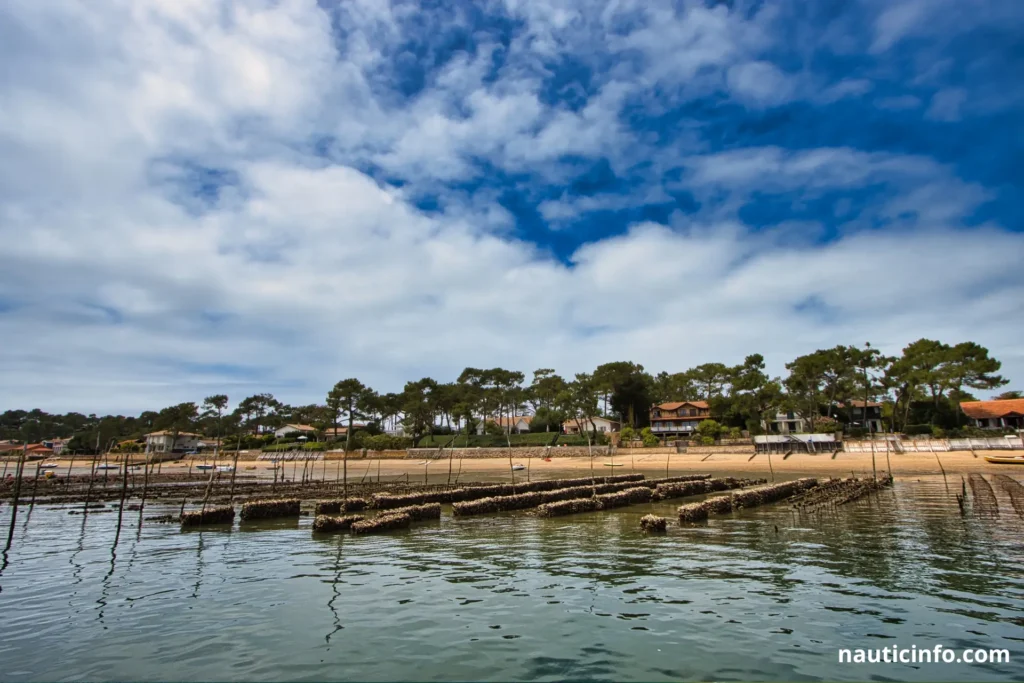
For the US visitor, understanding the product of the Bassin is as important as navigating its waters. The Arcachon oyster is not just a mollusk; it is the economic and cultural engine of the region.
History and Biology
The Bassin d’Arcachon is the primary nursery for oysters in France. It produces the vast majority of the “spat” (baby oysters) used by growers all over the country (in Brittany, Normandy, and the Mediterranean).
- The Imperial Origins: The modern industry traces its roots to Napoleon III, who visited the region in 1859. Seeing the depletion of natural wild oyster beds, he commissioned Victor Coste to develop methods for cultivating them. Coste created the first “Imperial Parks” (Parcs Impériaux).
- The Innovation: In 1865, a local mason named Jean Michelet developed the technique of “limewashing” tiles (chaulage). By coating roof tiles in a mixture of lime and sand, farmers could collect oyster larvae and then scrape them off without damaging the shell—a technique still used today.
The Farming Cycle
The oyster cycle is visible to the boater in every corner of the Bassin.
- Catching (Captage): In summer, larvae released by the breeding oysters attach themselves to the whitened tiles placed in the water (often seen stacked in wooden cages called “hives”).
- Scraping (Détroquage): After growing for several months, the baby oysters are scraped off the tiles.
- Growing (Élevage): They are placed in mesh bags (poches) which are laid out on the iron tables in the tidal zone.
- Turning: This is the labor-intensive part. Farmers must regularly turn the bags to ensure the oysters grow round and deep (a “meaty” oyster) rather than long and flat, and to prevent them from clumping together. This is why you see the flat boats working the beds at every low tide.
The “Cabane” Experience
The oyster villages are clusters of wooden cabins used by the farmers for their work.
- Regulation: Strict laws govern these cabins to preserve the maritime heritage. They must be built of wood and are generally not allowed to be converted into luxury holiday homes.
- Tasting (Dégustation): Many farmers open their cabins to the public for tastings.
- The Menu: By law, an oyster shack can serve only their own oysters, bread, butter, lemon, pâté, and wine. You cannot order a steak, french fries, or a coffee. This purity ensures the focus remains on the product.
- The Pairing: The traditional accompaniment is a chilled white wine from the nearby Entre-Deux-Mers or Graves regions, and a crépinette—a small, flat truffle sausage served warm. The combination of the cold, briny oyster and the warm, savory sausage is the signature flavor of the Bassin.
Navigating Arcachon Bay : The Icons – Les Cabanes Tchanquées
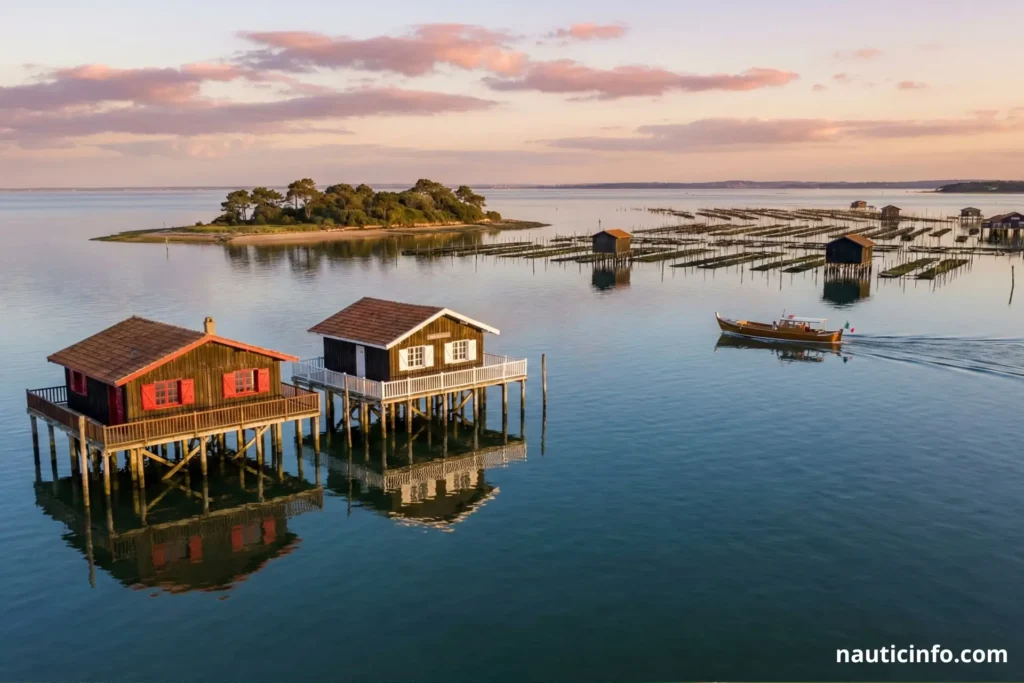
If the Eiffel Tower represents Paris, the Cabanes Tchanquées represent the Bassin d’Arcachon. These two stilted huts are the most photographed structures in the region and serve as critical waypoints for the navigator.
History and Function
- Etymology: The word “tchanquée” comes from the Gascon word chancas, meaning “stilts” or “mounted on stilts.”
- Original Purpose: The first cabin was built in 1883 by Martin Pivert, an oyster farm warden. The purpose was purely functional: to allow the watchman to stay out on the water to guard the oyster beds from theft and monitor the stock, regardless of the tide cycle. Without the stilts, the cabin would be flooded at high water.
- The Destruction: The original 1883 cabin, weakened by decades of salt and storms, was destroyed by a violent storm in 1943. Its foundations can still be seen at extreme low tide.
The Modern Sentinels
The two cabins standing today are not the originals but are historic in their own right.
- Cabane 53: Built in 1948 by Monsieur Longau, a carpenter and deputy mayor. It is distinguished by its white shutters and is often the more photographed of the two.
- Cabane 3: Built in 1945 by Monsieur Landry. It is distinguished by its red shutters and dark wood siding.
- Architecture: They are built of timber (pine and oak) and sit on concrete and wood pilings. They are located in the middle of the lagoon, off the Île aux Oiseaux.
- Access: They are not accessible by foot (except by trekking through deep mud at very low tide, which is discouraged for safety and ecological reasons). The interior is generally closed to the public. The best way to view them is by boat at high tide, drifting slowly past to admire their isolation and resilience.
Navigating Arcachon Bay : Practical Guide for the US Boater
Documentation and Regulations
- Licensing: France requires a boat license for any vessel with an engine over 6 horsepower (4.5 kW). US boaters should carry their state boating card. Ideally, obtaining an International Certificate of Competence (ICC) before traveling serves as the “Gold Standard” and avoids any friction with local rental agencies or maritime police.
- Safety Equipment: French maritime law (Division 240) is strict. You must carry life jackets for every person on board (and they must be worn by children), a distinct anchor line, towing gear, and flares.
- Fishing Regulations:
- Surfcasting: Fishing from the beach is popular but regulated near swimming zones.
- Boat Fishing: Fishing for Bass (Bar) is a local obsession. However, strict size limits and bag limits apply. For recreational anglers, catch-and-release is strongly encouraged.
- Shellfish: Gathering shellfish (cockles, clams) at low tide is permitted but subject to strict health warnings (check for “Sanitary Alerts” regarding algae blooms) and daily quantity limits.
Weather Patterns
- Summer (June-August): The season is dominated by thermal breezes. Mornings are typically calm and glassy—perfect for watersports. By 2:00 PM, a thermal wind from the Northwest (Force 3-4) usually kicks in, creating a “basin chop.” This is the sailing window.
- Shoulder Season: May and September are arguably the best months for the serious boater. The crowds have thinned, the water temperature is still pleasant (reaching nearly 70°F in late summer), and the marinas are more accessible.
- Hazards:
- Thunderstorms (Orages): In summer, violent thunderstorms can form rapidly in the late afternoon, sweeping in from the Bay of Biscay. They bring intense lightning and sudden gusts.
- Fog (Brume): Sea fog can roll in quickly, especially in spring, reducing visibility to zero in the intricate channels. Radar or a strict GPS/Compass watch is essential.
Boater’s Glossary: English to Arcachonnais
| English Term | Standard French | Local Arcachon Term | Context / Usage |
| Channel | Chenal | Estey / Craste | Estey is a tidal channel; Craste is a drainage ditch. |
| Stake / Marker | Piquet | Pignot / Balise | The wooden markers defining oyster parks. |
| Sandbank | Banc de sable | Banc | e.g., Banc d’Arguin. |
| High Tide | Marée Haute | Pleine Mer | Essential for crossing shallow areas. |
| Low Tide | Marée Basse | Basse Mer | Time for oyster farming access. |
| Traditional Boat | Bateau | Pinasse | The iconic flat-bottomed boat. |
| Oyster Farmer | Ostréiculteur | Paysan de la Mer | Literally “Peasant of the Sea.” |
Navigating Arcachon Bay : Conclusion
Navigating Arcachon Bay offers a boating experience that is technically demanding but spiritually rewarding. It is a place where the clock is replaced by the tide table, and the map is replaced by the reading of water colors. For the American yachtsman, navigating the Bassin is an exercise in precision, threading the needle between the pignots of the oyster farms and the shifting sands of Arguin. Yet, dropping anchor in the lee of the Île aux Oiseaux, with a plate of fresh Cap Ferret oysters and a glass of Bordeaux on the cockpit table, remains one of the premier maritime experiences in Europe. It is a reminder that the best navigation is not just about getting from point A to point B, but about understanding the living, breathing environment through which you travel.
Navigating Arcachon Bay – Quick Reference Data Table: Arcachon Basin Specs
| Feature | Specification (Imperial) | Specification (Metric) | Notes |
| Tidal Range (Max) | 13 ft | 4 m | Occurs during Spring Tides (Coeff > 95). |
| Max Speed (Open Basin) | 23 mph | 20 knots | Strictly enforced by Gendarmerie. |
| Max Speed (Shore Zone) | 5.7 mph | 5 knots | Within 300m of shore or oyster parks. |
| Port Arcachon Depth | ~8.2 ft | 2.5 m | Deepest all-tide port in the Basin. |
| VHF Channel (Port) | Channel 9 | Channel 9 | For marina operations. |
| VHF Channel (Emergency) | Channel 16 | Channel 16 | Contact for Semaphore/Coast Guard. |
| Emergency Phone | 196 | 196 | Direct line to CROSS (Rescue Center). |