
Marine Autopilot: Your Ultimate Co-Pilot at Sea. Which to Choose in 2025?
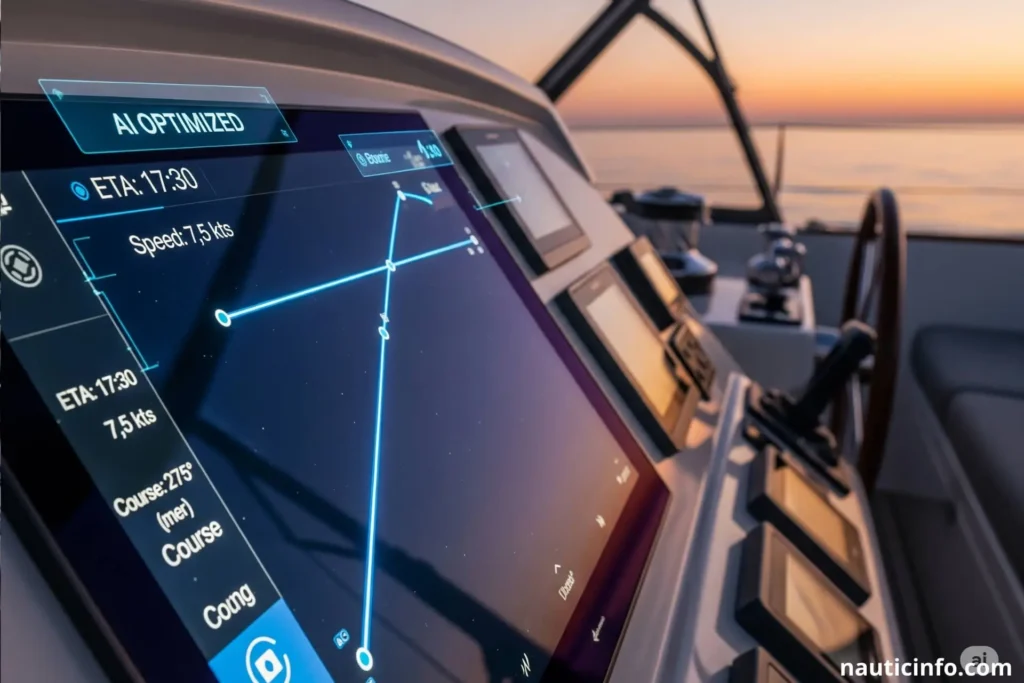
Whether sailing solo, cruising with a small crew, covering long distances without fatigue, optimizing fuel consumption, or securing your route, the promise of the marine autopilot has never been more appealing. Far from being a simple gadget, this electronic crewmate has become a central component of modern recreational boating. In 2025, thanks to the integration of artificial intelligence, autopilots are transcending their primary function to become true on-board brains, capable of learning, anticipating, and adapting. This comprehensive guide will immerse you in this revolution, demystify how autopilots work, and help you choose the best partner for your future voyages.
Long perceived as a luxury reserved for large yachts or offshore racers, the autopilot has now become widely accessible. Indeed, its usefulness is undeniable, whether for a simple day trip or a transatlantic crossing. By freeing the helmsman from the constant watch over the course, it allows the crew to focus on other essential tasks: monitoring the weather, trimming the sails, preparing a meal, or simply enjoying the view.
However, with an ever-growing market and constantly evolving technologies, choosing an autopilot can be a complex task. Between the different installation types, legacy brands, and new smart features, it’s easy to feel lost. This guide aims to enlighten you, providing all the keys to understanding and selecting the autopilot that will perfectly match your boat, your sailing plans, and your expectations for 2025.
Smart Autopilot 2025: Demystifying Your Essential Co-Pilot
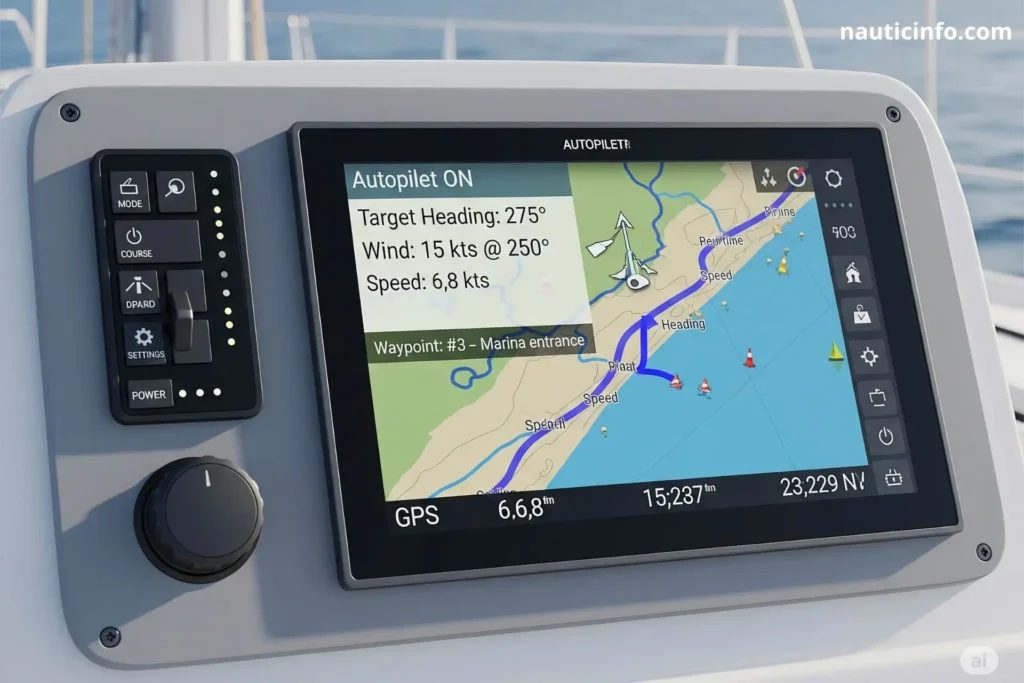
Before exploring the intricacies of the technology, it’s crucial to understand what an autopilot is and how it works. Fundamentally, an autopilot system consists of three main components: a computer (the brain), a heading sensor (the sense of direction), and a drive unit (the arms).
The heading sensor, whether a fluxgate compass or a solid-state gyroscopic sensor, continuously determines the boat’s heading. This information is sent to the computer, which compares it to the desired course set by the navigator. If a deviation is detected, the computer sends a command to the drive unit, which acts on the helm (tiller or wheel) to correct the trajectory. This process repeats several times per second, ensuring a level of course-keeping precision that is often superior to that of a human helmsman, especially over long periods.
The Different Operating Modes
A modern autopilot does more than just follow a compass heading. It typically offers several operating modes to adapt to all sailing and boating situations:
- Auto Mode (or Compass Mode): This is the basic mode. The pilot maintains a constant magnetic heading, regardless of wind or current. It’s the ideal mode for motoring in calm seas.
- Wind Mode: Essential for sailboats, this mode allows the boat to maintain a constant angle to the true or apparent wind. The pilot uses data from the masthead wind sensor to continuously adjust the heading as the wind shifts. This ensures optimal sail trim and more efficient progress.
- Navigation Mode (or Track Mode): This is the most advanced mode. When connected to a GPS or chartplotter, the pilot follows a predefined route composed of a series of waypoints. It automatically corrects for drift caused by wind and current to keep the boat on the ideal track. The latest systems can even automatically perform tacks and jibes as you approach a waypoint.
The evolution of these systems has been breathtaking. Today, autopilots are at the heart of a network of instruments connected via protocols like NMEA 2000, constantly exchanging data with the GPS, AIS, radar, and wind sensors for enhanced performance and safety.
Smart Autopilot 2025: Choosing the Right Type of Installation
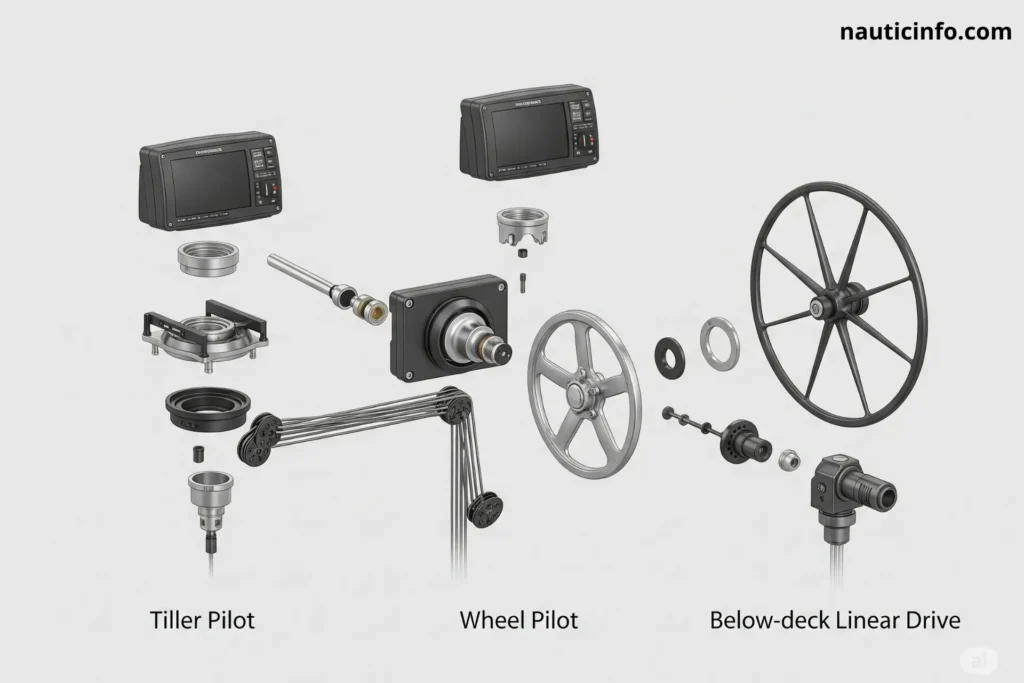
The choice of autopilot technology is intrinsically linked to your boat’s steering system and its displacement. There are three main families of autopilots.
Tiller Pilots: Simplicity for Smaller Boats
As the name suggests, the tiller pilot is designed for sailboats and small powerboats equipped with a tiller. It consists of an electric ram that attaches on one end to the tiller and on the other to a fixed point in the cockpit.
- Pros: Its main advantage is its simplicity of installation and use. It is also the most affordable type of pilot. Furthermore, its power consumption is generally moderate.
- Cons: Its power is limited, making it suitable for boats with a relatively low displacement (typically up to 6 or 7 tons). In heavy seas or on boats with significant weather helm, it may struggle to maintain course.
- Who is it for? It’s the ideal choice for owners of sailboats under 35-40 feet who engage in coastal cruising or day sailing.
Wheel Pilots: The Cruising Comfort Choice
For boats equipped with a steering wheel, a specific type of autopilot system is required. This consists of a power unit (often a toothed ring that fits onto the wheel) and an electric motor that drives the wheel.
- Pros: More powerful than a tiller pilot, it is suitable for a wider range of sailboats and powerboats (generally up to 15-20 tons of displacement). It offers an excellent compromise between performance, cost, and ease of installation.
- Cons: Its installation is a bit more complex than a tiller pilot’s and requires proper adaptation to the existing steering cable system. Power consumption is also higher.
- Who is it for? It caters to the vast majority of recreational boaters with cruising vessels from 35 to 50 feet.
Below-Deck Marine Autopilot : Power and Performance for Any Condition
The below-deck autopilot is the most robust and highest-performing solution. The drive unit (a hydraulic or electromechanical ram) is installed directly onto the rudder quadrant, below deck. This is the preferred system for large sailboats, large powerboats, and long-distance cruisers.
- Pros: Its power is substantial, allowing it to effectively steer heavy boats in difficult sea conditions. It is discreet (as it’s hidden) and extremely reliable. Its responsiveness and precision are unmatched.
- Cons: This is the most expensive system to purchase and the most complex to install. It often requires professional installation and a thorough assessment of the existing steering system. Its power consumption is the highest of the three types.
- Who is it for? For bluewater cruisers, owners of boats over 50 feet, and anyone who demands uncompromising reliability and performance, regardless of the sailing conditions.
The AI Revolution: The Dawn of the Predictive Marine Autopilot
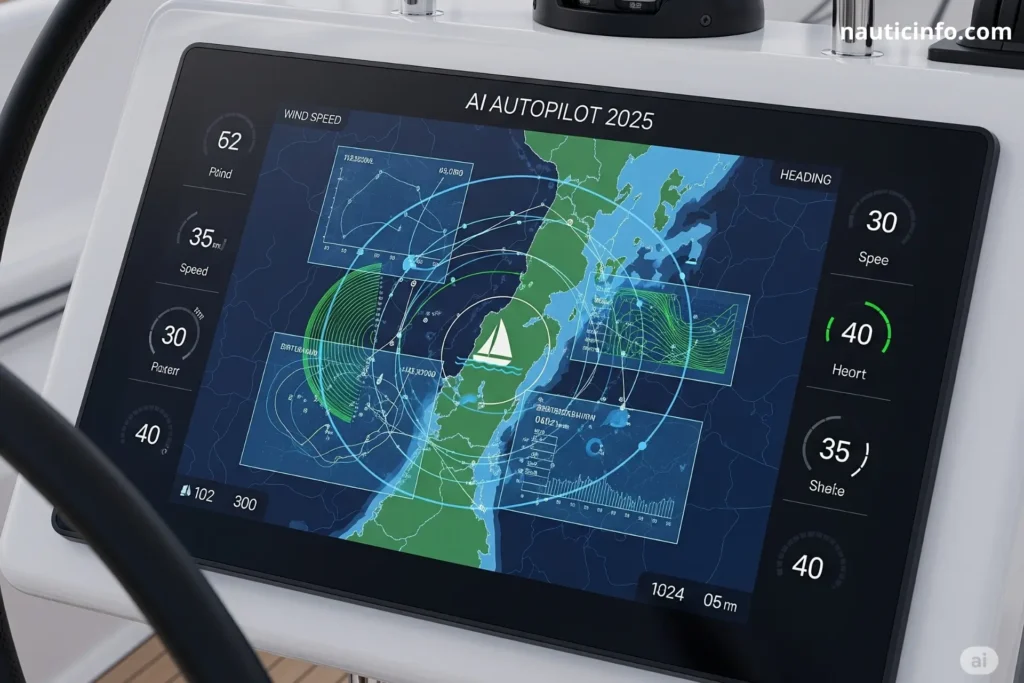
The real revolution of recent years, which is fully asserting itself in 2025, is the integration of artificial intelligence (AI) and machine learning into the core of autopilot computers. We are no longer just talking about automation, but about adaptive intelligence.
Marine Autopilot 2025: How AI is a Game-Changer
The “smart” autopilots of 2025 no longer just execute commands. They learn and adapt continuously. Thanks to increasingly sophisticated sensors (like 9-axis gyroscopic sensors that detect yaw, roll, and pitch), they analyze the boat’s behavior in real time.
This data is then processed by self-learning algorithms that allow the pilot to:
- Create a dynamic profile of the boat: The pilot learns your boat’s specific characteristics (its inertia, response to the helm, sensitivity to wind and sea) and refines its actions accordingly.
- Adapt to sea conditions: The pilot can differentiate between flat water, short chop, and long swells. It adjusts its steering behavior to avoid excessive and unnecessary rudder movements, resulting in a smoother ride and reduced energy consumption.
- Anticipate waves: The most advanced systems can anticipate the effect of waves on the course and act on the rudder proactively, rather than reactively. This allows for even more precise course holding and reduces wear and tear on the steering gear.
A More Precise Route and Optimized Consumption
One of the most tangible benefits of this onboard intelligence is the optimization of route and consumption. A classic autopilot, by constantly over-correcting, can cause the boat to travel a greater distance than the direct route, making a series of micro-S turns.
A smart pilot, on the other hand, steers with more finesse and anticipation. It intervenes only when necessary, limiting rudder movements and thus hydrodynamic drag. The result is twofold:
- Time and distance savings: By following a more direct route, the boat reaches its destination faster.
- Reduced consumption: For powerboats, fewer rudder corrections mean less work for the engines and therefore reduced fuel consumption, potentially by 5-10% depending on conditions. For sailboats, better course keeping allows for better sail efficiency and thus increased speed. The electrical consumption of the drive unit is also reduced.
Brands like Raymarine with its “Hydro-Balance” technology, B&G and Garmin with their sailing-specific algorithms, and Furuno with its adaptive learning “NAVpilot” system are at the forefront of this innovation, offering pilots that promise not only to get you to your destination but to do so in the most efficient way possible.
How to Choose Your Marine Autopilot in 2025: Key Criteria
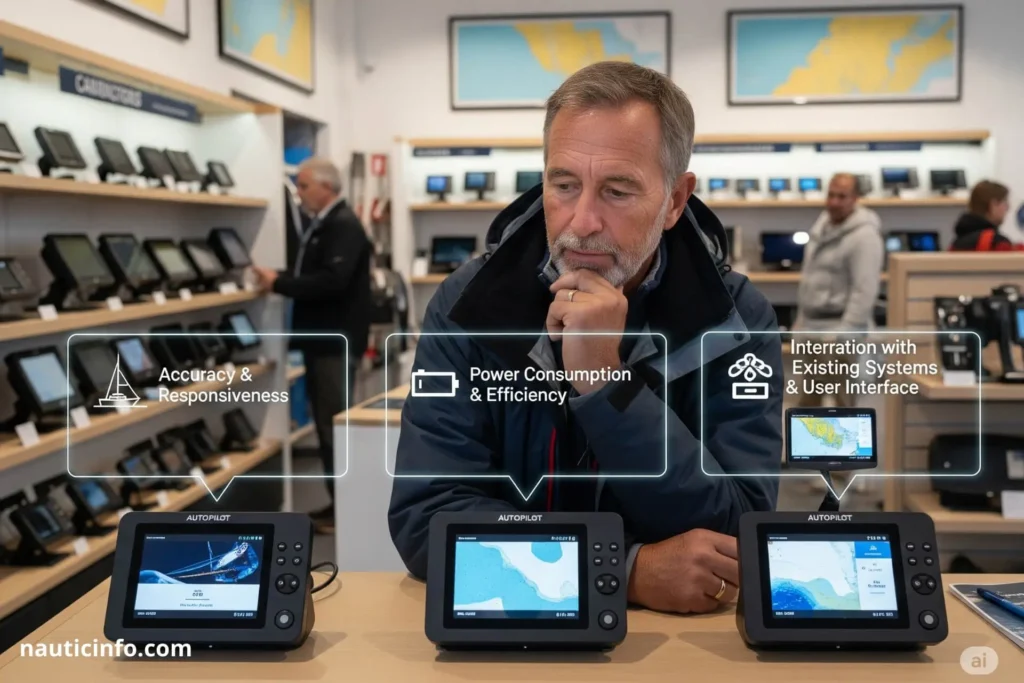
Now that we’ve explored the different facets of the autopilot, here is a methodology to guide you in your final choice.
1. Define Your Boating Style
This is the starting point of your reflection. Do you mainly do coastal day sailing? Are you planning offshore cruises lasting several weeks? Will your use be intensive or occasional? A coastal sailing program on a small sailboat can be served well by a tiller pilot, while a transatlantic crossing will demand the robustness of a below-deck system.
2. Know Your Boat Inside and Out
Your boat’s displacement is the number one technical criterion. Manufacturers always indicate the maximum displacement for which their pilots are designed. It is crucial to respect this recommendation and even to allow for a safety margin. Remember to consider your boat’s fully loaded weight (with full fuel, water, provisions, and crew), which can be much higher than its light displacement.
The type of steering (tiller or wheel) is, of course, decisive, as is the nature of your steering system (cables, hydraulic, etc.) for more complex installations.
3. Evaluate Your Budget
The price range is wide, from a few hundred dollars for an entry-level tiller pilot to several thousand dollars for a complete below-deck system with all the latest technologies. Set a realistic budget, including the cost of installation if you are not doing it yourself.
4. Think About Integration and Scalability
Your future autopilot must be able to integrate smoothly with the navigation electronics already on board, or that you plan to install. Check for compatibility with your chartplotter, GPS, and other instruments. A system communicating via the NMEA 2000 standard is almost a necessity today for simple and effective integration. Also, consider the scalability of your setup.
5. Don’t Overlook Power Consumption
The power consumption of the autopilot is not to be taken lightly, especially for sailboats and on long passages. Find out the average power draw of the unit when in operation. Pilots with power-saving features and intelligent algorithms are preferable for optimizing your energy balance.
In conclusion, the 2025 marine autopilot is much more than a simple electronic helmsman. It is a true navigational partner, intelligent and adaptive, that actively contributes to the safety, comfort, and performance of your boat. By taking the time to analyze your needs, your vessel’s characteristics, and the available technological advancements, you will make an informed choice that will permanently transform your experience at sea. So, are you ready to hand over the helm to your ultimate co-pilot?