

Managing Onboard Energy : The Smart Battery Monitor Guide
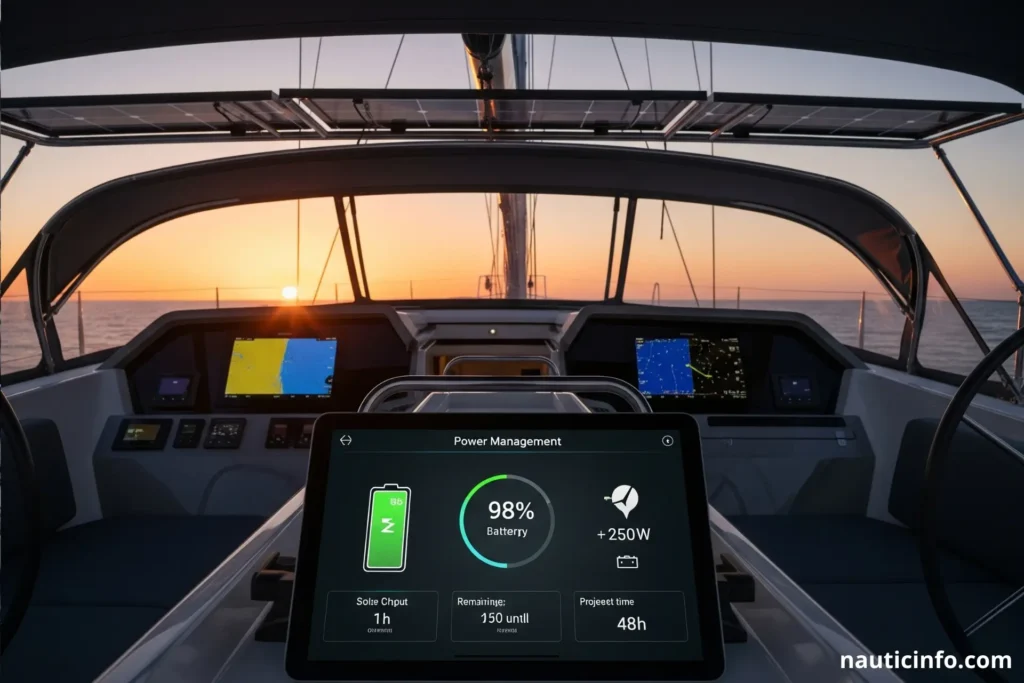
Modern boating has changed dramatically. Indeed, our vessels, whether sailboats for long voyages or powerboats for coastal getaways, have become true technological hubs. From advanced navigation systems to autopilots, and including watermakers, refrigerators, and our countless personal devices, the demand for energy has never been higher. Consequently, the simple “old-school” battery gauge is no longer sufficient. To navigate with complete peace of mind and autonomy, it has become essential to know precisely what is happening within our battery bank. This is precisely where the smart battery monitor comes in, an equipment now crucial for managing onboard energy. This comprehensive guide will explain in detail why and how this tool is revolutionizing electrical management on our boats.
Why Is It So Crucial to Manage Onboard Energy?
In the past, energy management on board was relatively simple: the engine ran, the batteries charged. However, with the evolution of our equipment, this approach has become not only obsolete but also dangerous for the longevity of our installations.
The Explosion of Onboard Energy Consumers
The list of electrical appliances on a modern boat is long and constantly growing. On the one hand, we have the non-negotiable safety and navigation equipment: VHF, AIS, GPS, radar, navigation lights. On the other hand, onboard comfort has taken a prominent place: refrigerator, freezer, heating, air conditioning, coffee maker, computers, tablets… Each of these devices draws from the battery bank, transforming it into a real energy heart that must be constantly monitored. Furthermore, this multiplication of consumers makes “eyeballing” energy consumption completely impossible. Without a clear vision, the risk of ending up with a dead battery bank, far from anything, is very real.
The Limitations of Traditional Voltmeters
For decades, the voltmeter was the only indicator available to boaters. However, this tool provides only very partial, even misleading, information. Indeed, a battery’s voltage does not drop linearly. It can remain relatively stable for a large part of its discharge before dropping abruptly. Therefore, a voltmeter displaying 12.5 volts might suggest that everything is fine, while the battery could be at only 50% of its actual capacity. Moreover, voltage is affected by ongoing charging and discharging. For example, when a powerful consumer like a windlass is activated, the voltage momentarily drops, which does not reflect the battery’s true state of charge. Thus, relying solely on a voltmeter to manage onboard energy is like navigating in a fog.
Managing Onboard Energy : The Smart Battery Monitor, your Energy Conductor
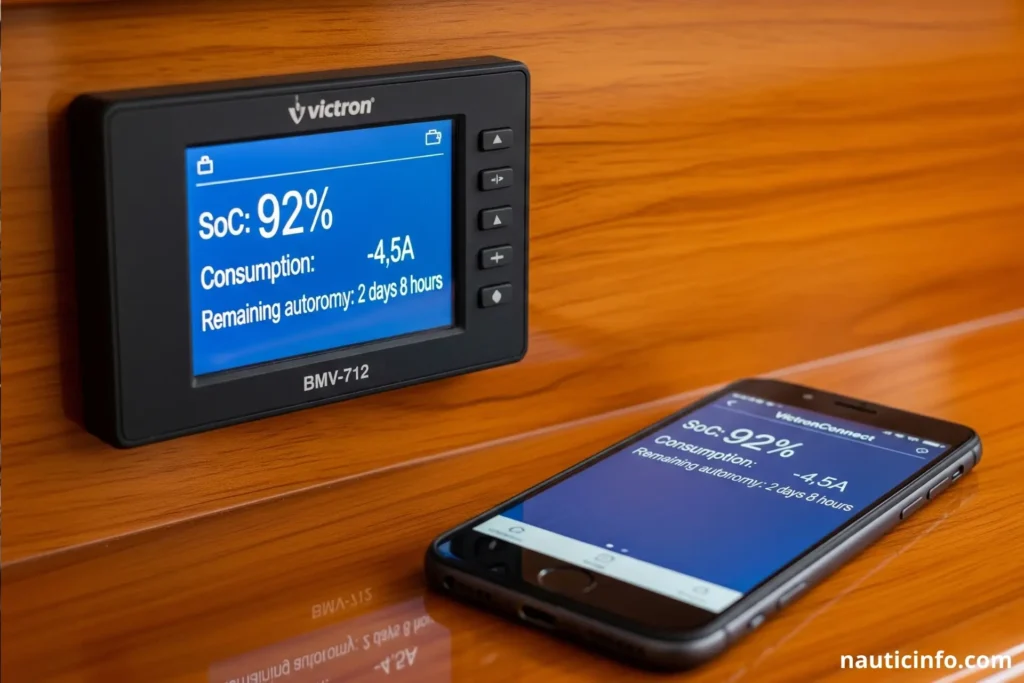
Given current challenges, the smart battery monitor, also known as a battery controller, is asserting itself as the go-to solution. Brands like Victron Energy, with its famous BMV (Battery Monitor Victron) series or its SmartShunt range, have popularized this technology. But how exactly does it work?
A smart battery monitor is much more than a simple voltmeter. Its operation is based on an essential component: the shunt. This is a very high-precision resistor installed on the negative pole of your service battery bank. All current entering or leaving your batteries must pass through this shunt. Thanks to this device, the monitor can measure the current intensity (in amperes) and its direction with remarkable accuracy.
By combining this precise measurement with voltage, the monitor calculates a multitude of crucial real-time information:
- State of Charge (SoC) in percentage: This is the most important information. Instead of an ambiguous voltage, you know exactly whether you have 95%, 60%, or 30% of energy left. It’s like having an accurate fuel gauge for your electricity.
- Instantaneous consumption (in Amps or Watts): You can see in real time how much energy your devices are consuming. Turn on the refrigerator, and you’ll immediately see the impact on your consumption. It’s a fantastic educational tool for understanding and controlling your energy expenditure.
- Remaining autonomy: Based on your average consumption, the monitor can estimate how long you can still last before needing to recharge your batteries. This is invaluable help for planning your anchorages and navigations.
- Data history: Modern monitors record vital information such as the deepest discharge, the number of charge/discharge cycles, overvoltages, etc. This data is fundamental for tracking the health of your battery bank and anticipating its replacement.
How a Smart Monitor Helps You Manage Onboard Energy
Installing a smart battery monitor radically transforms your approach to energy. First, it brings you unparalleled peace of mind. No more anxiety about running out of electricity. Second, it allows you to make informed decisions. For example, if you see your state of charge is at 70% and the sky is clouding over, you might decide to postpone using the watermaker until tomorrow. Third, and this is a crucial point, it protects your investment. A battery bank is expensive, and repeated deep discharges drastically reduce its lifespan. By alerting you when the state of charge drops below a critical threshold (generally 50% for lead-acid batteries), the monitor helps you preserve your battery capital.
Managing Onboard Energy : Integration with Renewable Energy Sources, the Winning Duo
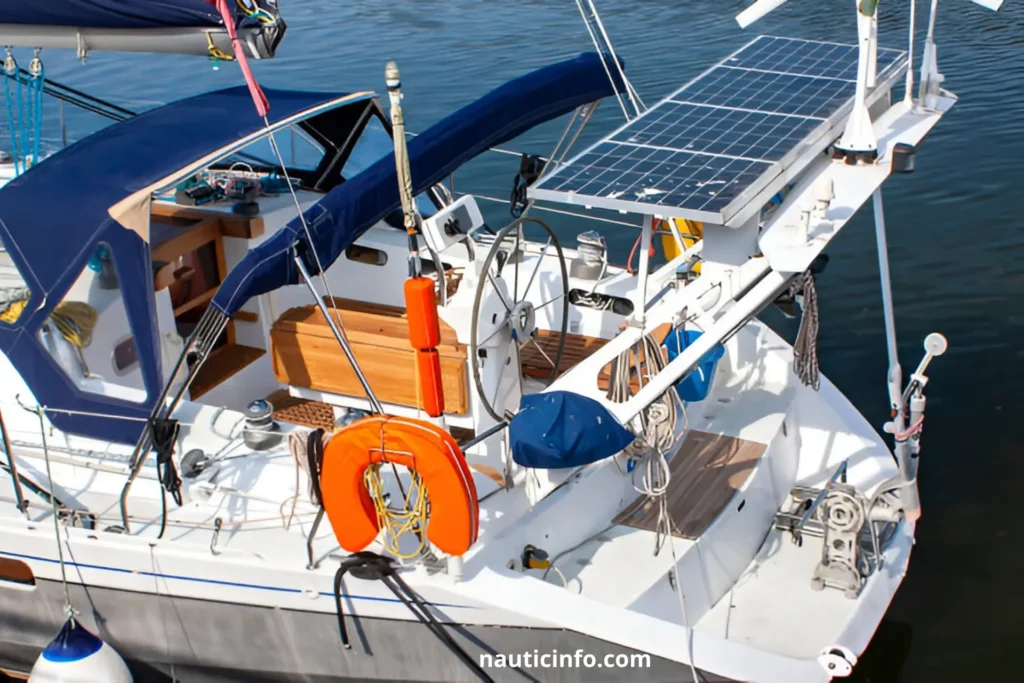
The true power of a battery monitor is revealed when it is coupled with renewable energy production sources, such as solar panels or hydrogenerators. It is in this configuration that you can truly manage onboard energy optimally and aim for autonomy.
Optimizing Solar Production to Better Manage Onboard Energy
Solar panels have become standard on most cruising boats. However, without a battery monitor, it’s difficult to know if their production is efficient. The monitor, on the other hand, shows you the incoming charge current (in positive amps) in real time. You can thus:
- Visualize instantaneous production: You immediately see the impact of a cloud or a sail’s shadow on your production. This encourages you to optimize panel orientation or adjust your anchorage for maximum sunlight.
- Quantify daily input: The monitor tells you precisely how many amp-hours (Ah) your panels have produced during the day. This information allows you to know if your production covers your daily consumption.
- Diagnose problems: If on a beautiful sunny day your production is abnormally low, it could indicate a problem with your installation (a dirty panel, a faulty connection, a poorly configured MPPT controller). The monitor is therefore your primary diagnostic tool.
In short, the association of the monitor and solar panels allows you to transform a passive energy source into an active and controlled system.
The Hydrogenerator: The Asset for Long Voyages
For long-distance sailors, the hydrogenerator is an increasingly popular solution. This device uses the boat’s speed to spin a submerged propeller and produce electricity. Just like with solar panels, the battery monitor is its indispensable complement.
When you are sailing, especially at night or in cloudy weather where solar doesn’t produce anything, the hydrogenerator takes over. The battery monitor then displays this incoming energy flow, confirming that even while underway, your energy balance is positive. You can thus operate the autopilot, navigation instruments, and even the watermaker without fear of draining your batteries. This is the key to serene and autonomous ocean crossings. The monitor allows you to verify that the hydrogenerator’s production is as expected at a given speed, and to ensure that your overall energy balance remains positive over 24 hours.
How to Choose and Install Your Battery Monitor?
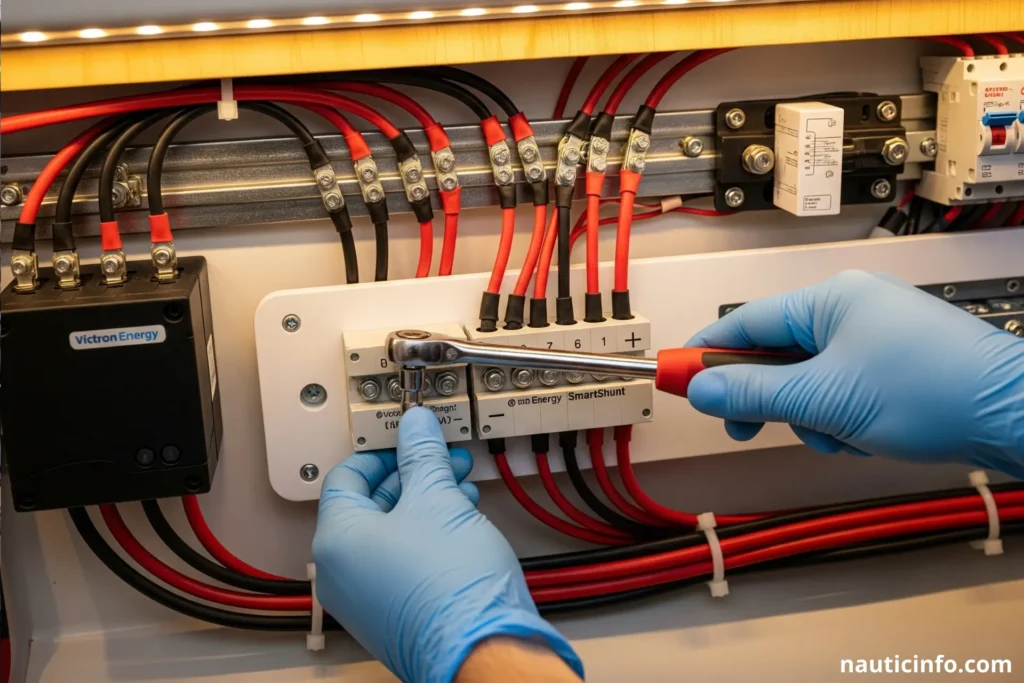
The market offers several options, but certain criteria are essential for making the right choice.
Selection Criteria for Effectively Managing Onboard Energy
- Shunt capacity: The shunt must be sized to handle the maximum current of your battery bank. For most recreational boats, a 500A shunt is a standard that covers the majority of needs, including the use of a windlass or a bow thruster.
- Connectivity: Modern monitors, like the Victron SmartShunt, integrate Bluetooth. This is an extremely practical feature that allows you to consult all information directly on your smartphone or tablet via a dedicated application (VictronConnect, for example). No more need to run cables for a display screen. You can monitor your energy from your cockpit or your bunk.
- Ecosystem: If you already have equipment from a certain brand (a Victron solar controller or charger, for example), choosing a monitor from the same brand can be wise. This often allows for better integration and visualization of all your data on a single interface, such as the Victron VRM (Victron Remote Management) portal.
- Advanced features: Some models offer additional functionalities, such as a second voltage measurement port (to monitor the starter battery in addition to the service bank) or a programmable relay to automatically start a generator when the state of charge is too low.
Key Installation Steps
Although installing a battery monitor is not extremely complex for someone with basic electrical knowledge, it requires rigor.
- Safety first: Always cut the main power to your battery bank before any intervention.
- Shunt placement: The shunt must be installed on the main negative cable, between the negative terminal of your battery bank and all consumers and chargers. Absolutely all current must pass through the shunt. There should be no other connections to the negative battery terminal.
- Wiring: The shunt is connected to the monitor (or Bluetooth dongle) by a data cable. You also need to connect a positive power wire from the monitor to the positive pole of your battery bank.
- Configuration (settings): This is a crucial step. You will need to enter the characteristics of your battery bank into the monitor’s application or screen, including its total capacity in amp-hours (Ah) and the battery type (AGM, Gel, Lithium, etc.). Incorrect settings will falsify all data. You then need to synchronize the monitor by fully charging the batteries until the charging current becomes very low. At this point, you tell the monitor that the battery is at 100%. From that moment on, it will precisely count every amp that enters and leaves.
In conclusion
The era of approximation in onboard energy management is over. Faced with the increasing sophistication of our equipment and our legitimate desire for comfort and safety, perfect mastery of our electrical resources has become an absolute necessity. The smart battery monitor is no longer a gadget for tech enthusiasts, but rather the cornerstone of a modern, reliable, and high-performance electrical system. By offering you a clear and precise vision of your state of charge, consumption, and production, it empowers you. It transforms uncertainty into certainty, allowing you to make the right decisions at the right time.
Whether you are equipped with solar panels, a hydrogenerator, or simply a shore charger, this tool will help you protect your battery bank, maximize your autonomy, and ultimately, navigate with a freer mind. Investing in a smart battery monitor is therefore investing in your peace of mind and the reliability of your boat. It is, without a doubt, the indispensable prerequisite for managing onboard energy and beyond.