
Carbon Monoxide on Board: The Silent Killer and the Connected Detectors That Can Save Your Life
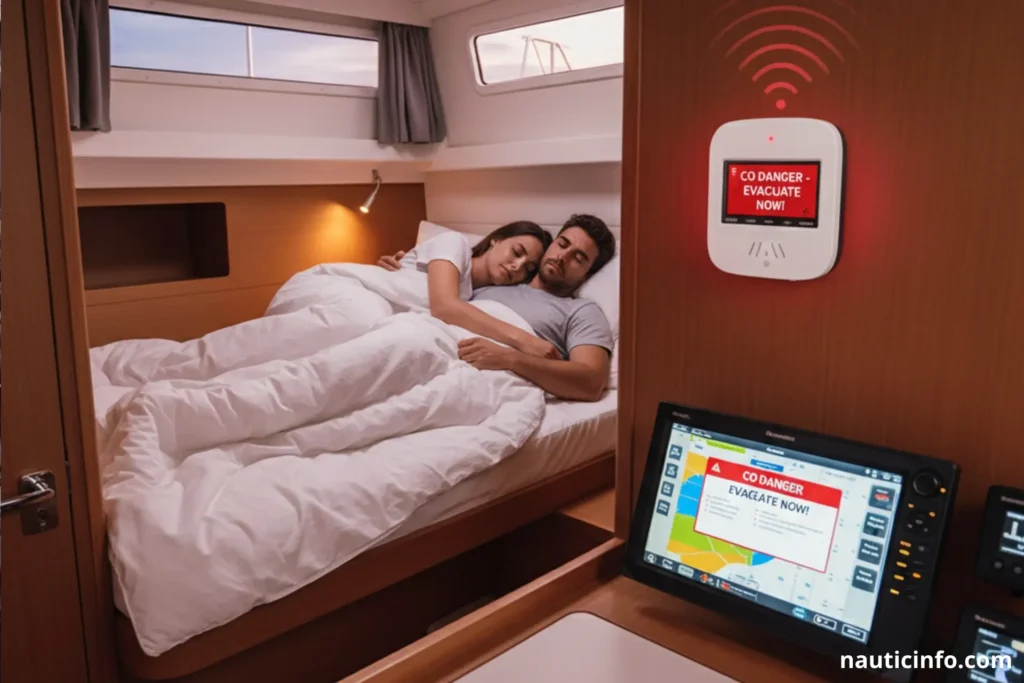
Picture the scene: a peaceful cove, the sun has just set after a perfect day on the water. The gentle lapping of waves against the hull is the only sound. Inside, the heater is running softly to ward off the evening chill. Everything seems perfect. And yet, an invisible, odorless, and deadly danger may be silently filling the cabin: carbon monoxide. To combat this silent killer, one piece of equipment has become essential for the safety of every crew: the Marine Carbon Monoxide Detector. Fortunately, this critical safety technology has evolved significantly. Indeed, moving beyond simple standalone alarms, a new generation of connected detectors integrated into your boat’s NMEA 2000 network now offers centralized and foolproof protection. This article aims to raise your awareness of this ever-present risk and introduce these new solutions that can, quite literally, save your life.
Why a Marine Carbon Monoxide Detector is Essential: Understanding the Invisible Danger
Before diving into the technology, it’s absolutely essential to understand the nature of the enemy. Carbon monoxide, or CO, is not an adversary you can see, smell, or taste. Consequently, detecting it without specialized equipment is completely impossible, making it extraordinarily dangerous in the confined environment of a boat.
What is carbon monoxide (CO), and why is it so dangerous?
Carbon monoxide (CO) is a toxic gas produced by the incomplete combustion of carbon-based fuels like gasoline, diesel, propane, charcoal, or wood. In other words, any appliance on your boat that burns fuel is a potential source of CO.
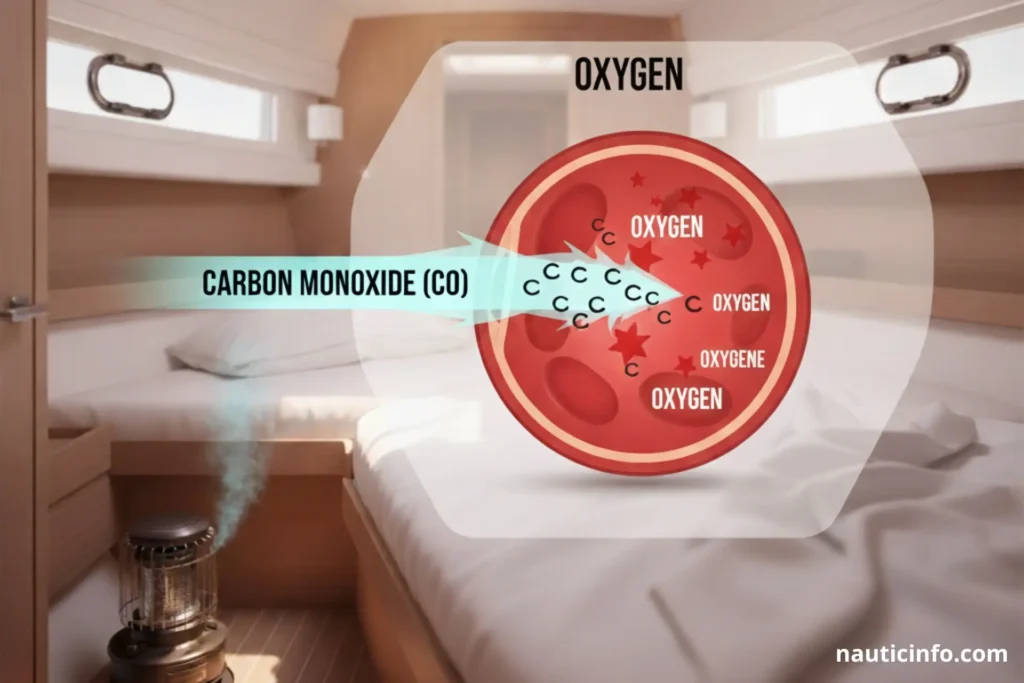
Its extreme danger comes from how it interacts with our bodies. When inhaled, CO enters the bloodstream and binds to hemoglobin, the protein in red blood cells that carries oxygen. The critical problem is that hemoglobin has an affinity for CO that is 200 to 300 times greater than its affinity for oxygen. As a result, even a low concentration of CO in the air can quickly starve vital organs—especially the heart and brain—of the oxygen they need to function. This process, known as hypoxia, leads to tissue damage, neurological impairment, and ultimately, death.
Common Sources of CO on a Recreational Boat
Life on a modern boat involves numerous appliances that, if poorly maintained or improperly used, can become deadly sources of CO. It is therefore crucial to identify them:
- Engines and Generators: Inboard engines, generators, and even outboard motors can release CO. Exhaust fumes can accumulate at the stern of the boat (a phenomenon known as the “station wagon effect”) and seep into the cabin through open portholes or hatches. Furthermore, a leak in an exhaust manifold can release the gas directly into the bilge.
- Heating Appliances: Forced-air heaters (diesel, gasoline) or portable propane heaters are notorious sources of CO, especially if they are old or poorly maintained.
- Stoves and Ovens: Gas-powered (propane, butane) or alcohol stoves and ovens, if used in a poorly ventilated space, can produce dangerous levels of CO.
- Water Heaters: Instantaneous gas water heaters are also a potential source.
- The External Environment: The danger doesn’t always come from your own boat. In fact, rafting up or being in a crowded marina can expose you to the exhaust fumes of a neighboring boat, particularly if their generator is running all night.
Symptoms of CO Poisoning: Recognizing Them in Time
One of the most treacherous aspects of CO poisoning is that its early symptoms are often vague and can be easily confused with other common ailments at sea, such as seasickness, the flu, or simple fatigue. This is why it is essential to know this list.
- Mild Symptoms: Dull headache, dizziness, nausea, vomiting, extreme fatigue, general weakness.
- Moderate Symptoms: Confusion, disorientation, blurred vision, loss of coordination, chest pain.
- Severe Symptoms: Loss of consciousness, seizures, coma, cardiac arrest, and death.
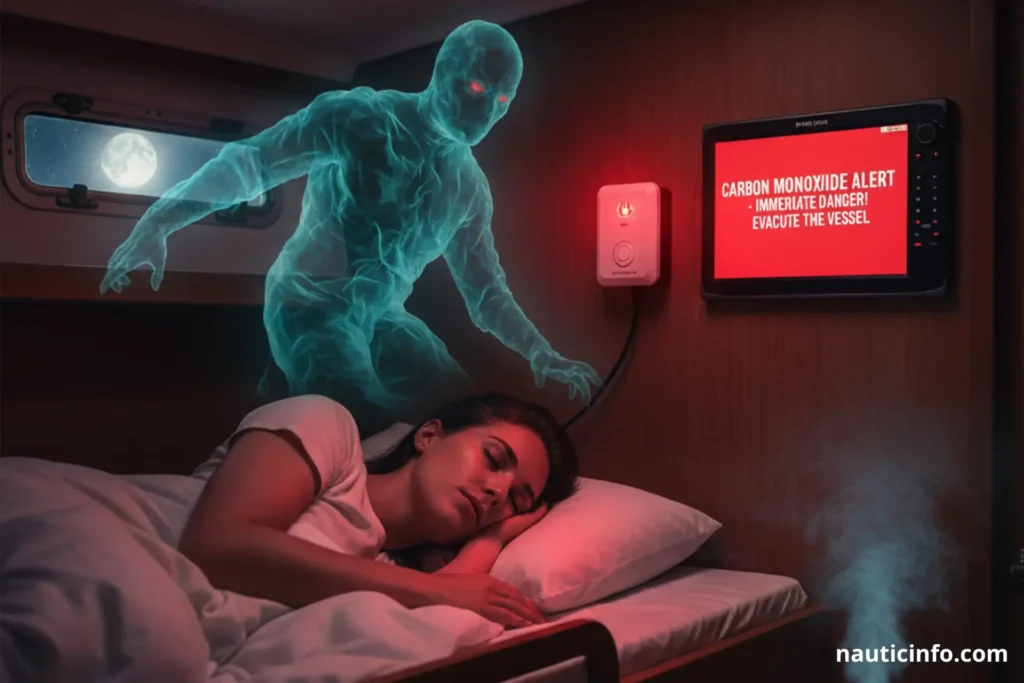
The greatest danger occurs during sleep. A sleeping person can transition from mild symptoms to a critical state without ever waking up. It is precisely in this scenario that a reliable detector makes the difference between life and death.
The Marine Carbon Monoxide Detector: The Connected Alert That Saves Lives – A New Generation of Safety
Faced with such a threat, the only effective defense is early detection. For years, boaters have relied on small, standalone, battery-operated detectors. While these devices have saved many lives and remain an essential first line of defense, they have significant limitations in a complex marine environment. This is where the connectivity revolution comes in.
Beyond the Isolated Beep: The Limits of Traditional Detectors
Classic CO detectors, similar to those found in homes, operate in isolation. When they detect a dangerous level of CO, they emit a shrill audible alarm. However, this approach has several drawbacks on a boat:
- Localized Alarm: If the detector goes off in an aft cabin while you’re at the helm in the cockpit, with the noise of the engine and the wind, there’s a good chance you won’t hear it.
- Power Management: They rely on batteries that must be remembered and replaced regularly. A weak battery can render the detector useless without you even knowing.
- Lack of Diagnostics: An “end-of-life” or “low-battery” chirp can be mistaken for another sound on board and ignored.
- No Visual Alert: In a noisy environment, a purely audible alert is less effective.
The NMEA 2000 Innovation: When Your Marine Carbon Monoxide Detector Communicates with the Entire Boat
To overcome these limitations, marine electronics manufacturers have developed a much smarter solution: the Marine Carbon Monoxide Detector integrated into the NMEA 2000 network.
As a reminder, NMEA 2000 is the communication standard that allows all of your boat’s electronic devices (GPS, depth sounder, autopilot, wind instrument, etc.) to speak the same language and exchange information over a unified network. By integrating a CO sensor into this network, you are no longer relying on a simple “beep.” You transform the detector into an intelligent component of the vessel’s overall safety system. Consequently, the “CO DANGER” information is no longer isolated but is instantly broadcast to all connected equipment.
The Advantages of a Centralized and Connected Alert
Integrating a Marine Carbon Monoxide Detector into the NMEA 2000 network offers considerable safety advantages:
- Multi-Platform Alerts: This is the most significant benefit. In the event of CO detection, the alert is no longer confined to the sound of the detector itself. Thus, it can be configured to trigger on:
- Your Multifunction Displays (MFDs): A bright red alarm pop-up can appear on your chartplotter with a clear message like “CARBON MONOXIDE ALERT – FORWARD CABIN.” It’s impossible to miss.
- Onboard Speakers: The boat’s stereo system or even the VHF radio can relay the alarm for maximum volume.
- Dedicated Displays: Small instrument displays (like a B&G Triton2 or Garmin GMI 20) can show the alert continuously.
- Reliable Power: The NMEA 2000 network directly powers the detector, and the boat’s house battery bank powers the network No more worries about changing batteries. Additionally, the system can alert you if the sensor itself fails.
- Remote Monitoring: If your boat has a remote monitoring system (via a 4G/5G gateway), the system can send you a CO alert directly via SMS or a push notification. This feature provides an added layer of security if, for example, a heater accidentally turns on while the boat is under its winter shrink-wrap.
- History and Diagnostics: The system can log CO levels, which can help identify intermittent problems (e.g., slight emissions only when the engine is running at a certain RPM).
How to Choose and Install Your Connected Marine Carbon Monoxide Detector
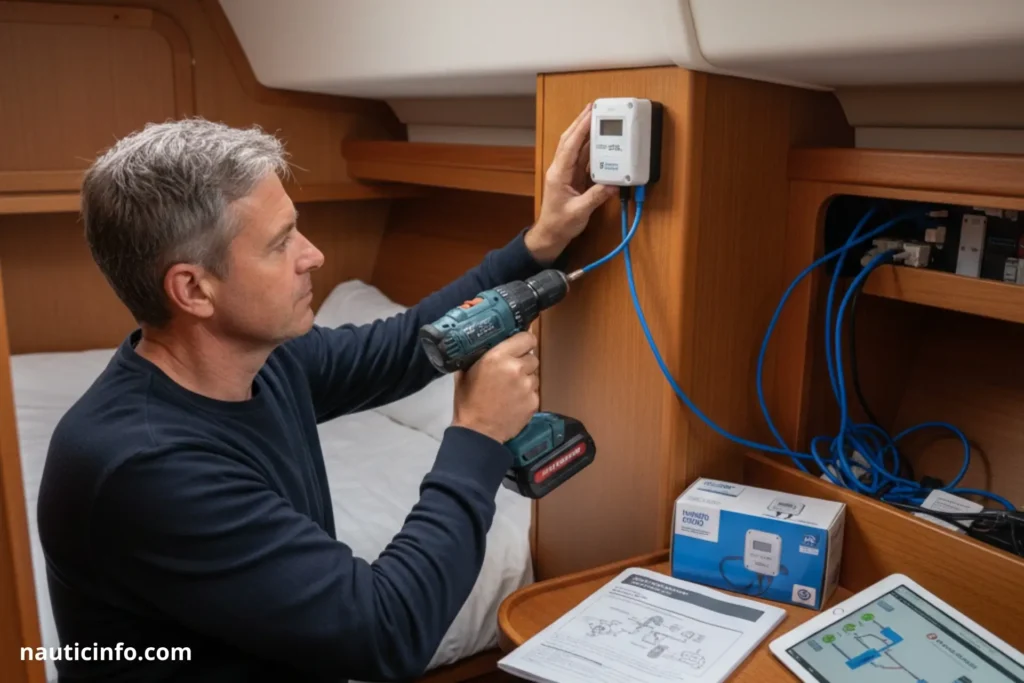
Adopting this technology is a major step forward for the safety of your crew. However, as with any safety equipment, the choice and installation must be done with the utmost care.
Selection Criteria for a NMEA 2000 Certified Marine Carbon Monoxide Detector
Not all detectors are created equal. Here are the points to check before making your choice:
- Marine Certification: Ensure the detector is specifically designed for the marine environment (resistant to moisture, salt, and vibration) and is certified to current standards, such as UL 2034 Marine. This certification is critical for safety and reliability.
- NMEA 2000 Certification: The “NMEA 2000 Certified” logo guarantees seamless interoperability with other equipment on your network.
- Sensor Type and Lifespan: Electrochemical sensors are the standard. Check their lifespan (typically between 5 and 10 years) and whether the sensor is replaceable or if the entire unit needs to be replaced.
- Power Consumption: On a sailboat looking to conserve energy, the sensor’s power draw (expressed as a LEN – Load Equivalency Number on an NMEA 2000 network) can be a factor.
- Ease of Configuration: Check how alerts are configured on your system. Reputable brands like Maretron, GOST (Global Ocean Security Technologies), and some integrated systems from Garmin, Raymarine, or Navico offer proven solutions.
Marine Carbon Monoxide Detector : The Golden Rules of Installation for Maximum Effectiveness
A great detector in the wrong place is a useless detector. Therefore, placement is absolutely critical.
- Install a Detector in Each Sleeping Area: Every enclosed cabin where people sleep must have its own detector. This is non-negotiable.
- Install a Detector in the Main Salon/Galley Area: This is the main living space where cooking and heating appliances are often located.
- Place it at the Correct Height: Contrary to popular belief, CO is not significantly heavier or lighter than air (its density is very similar). It mixes with the ambient air. Therefore, the recommendation is to place the detector at head height when sleeping, about 3-5 feet off the floor. Always follow the manufacturer’s specific instructions.
- Avoid Bad Locations:
- Do not install it directly above a cooking or heating appliance.
- Keep it away from high-humidity areas like heads (bathrooms).
- Do not place it near vents, fans, or hatches, as drafts could skew the readings.
- Never obstruct it with curtains, furniture, or equipment.
- Network Connection: Installation on the NMEA 2000 backbone is simple thanks to the “plug-and-play” system. Just connect the detector’s cable to an available T-connector on your network.
Prevention: Best Practices to Avoid CO Emissions On Board

A detector is your last line of defense. However, the best safety measure is always prevention. Adopting the right habits is just as important as having the right equipment.
Regular Maintenance of Combustion Appliances
Well-maintained equipment is safe equipment. Therefore, it is essential to perform, or have a professional perform:
- Annual inspection and maintenance of all engines, generators, and heating systems.
- Verification of the integrity of exhaust manifolds and hoses.
- Cleaning and adjustment of stove and water heater burners.
The Crucial Importance of Ventilation
A lack of fresh air is carbon monoxide’s best friend. Thus, you must:
- Never block the boat’s vents. They are designed to ensure continuous air circulation.
- Ensure active ventilation when using combustion appliances at the dock or at anchor (by leaving a hatch or porthole slightly open).
- Never use a stove to heat the cabin. This is an extremely dangerous practice.
- Be extremely cautious with winter shrink-wrap. Running an engine or heater under a sealed cover can turn the boat into a deadly trap in minutes.
Be Aware of Your Surroundings
Finally, be mindful of what is around you:
- When rafting up, be aware of your neighbor’s exhaust.
- In a calm, windless anchorage, fumes from a generator (yours or someone else’s) can linger around the hulls.
- Educate your entire crew, including children, about the dangers of CO and the symptoms to watch for.
Conclusion: Don’t Wait Until It’s Too Late
Carbon monoxide is a silent but very real threat in the boating world. To ignore this risk is to play Russian roulette with your life and the lives of your crew. Poisonings are not unavoidable accidents; they are the result of a lack of prevention and equipment.
Today, there is no excuse not to be protected. The advent of the connected Marine Carbon Monoxide Detector on the NMEA 2000 network represents a spectacular leap forward in safety. It transforms a simple local alarm into an intelligent, centralized, and impossible-to-ignore warning system. It is a modest investment considering the protection it provides.
So, don’t wait for a tragedy to happen. Starting today, inspect your systems, review your ventilation and maintenance habits, and most importantly, equip your boat with a reliable, modern CO detection system. Upgrading to a connected NMEA 2000 solution means giving your loved ones and yourself the peace of mind that comes from knowing that even while you sleep, your boat is actively watching over you. Your life depends on it.