

Boat Cameras: Monitor, Secure, and Share Your Best Moments at Sea
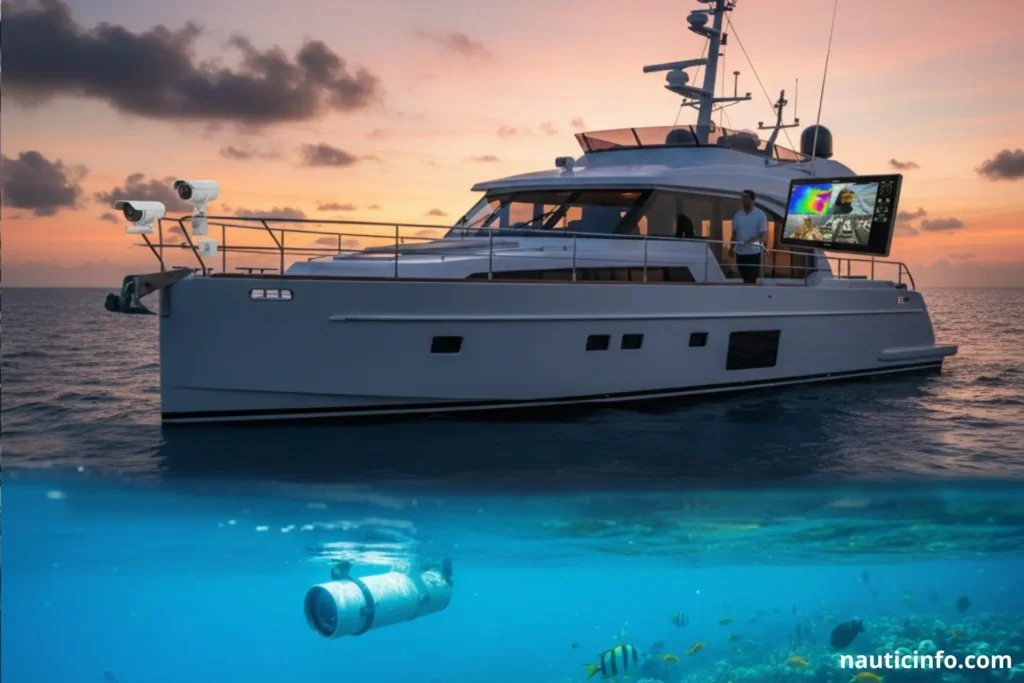
Boating is a passion that combines freedom, adventure, and contemplation. However, whether you’re a seasoned sailor or a casual boater, safety and peace of mind on board are top priorities. Today, technology offers incredible tools to enhance our experience on the water. Among them, boat cameras have become nearly indispensable pieces of equipment. Indeed, far more than simple gadgets, they are true allies for monitoring your vessel, securing your maneuvers, and capturing unforgettable moments.
This comprehensive guide will walk you through the world of boat cameras. We will explore the different types of cameras available, from deck surveillance and underwater exploration to night vision thermal imaging. Furthermore, we will discuss how to seamlessly integrate them with your onboard systems for a connected and secure experience.
Why Install Boat Cameras? The Key Advantages
Before diving into the technical details, it’s essential to understand why installing boat cameras is a wise decision. Once reserved for superyachts, these technologies are now accessible to everyone and offer multiple benefits.
1. Enhanced Security at Anchor and in the Marina
Undoubtedly, one of the main benefits of boat cameras is security. When you leave your boat at the marina or in a secluded cove, a surveillance camera provides invaluable peace of mind.
- Deterrent Effect: First of all, the visible presence of a camera can discourage theft and vandalism.
- Remote Monitoring: Subsequently, thanks to 4G/5G or Wi-Fi connectivity, you can view a live feed of what’s happening on your deck from your smartphone, wherever you are. Some systems even send you motion-detection alerts.
- Evidence in Case of an Incident: Finally, in the event of theft, a break-in, or a collision in the harbor, video recordings serve as irrefutable evidence for your insurance company or the authorities.
2. A Valuable Aid for Docking and Maneuvering
Maneuvering, especially docking in a tight slip or picking up a mooring ball, can be stressful even for experienced skippers. This is why boat cameras are becoming true co-pilots.
- 360° Vision: By strategically placing cameras at the bow, stern, or on the sides, you eliminate blind spots. Consequently, you can see the distances to the dock, other boats, or lines directly on your multifunction display (MFD).
- Assistance for Shorthanded Sailing: If you are sailing solo or with a small crew, a camera pointed at the stern allows you to monitor the distance while you are at the helm, which greatly simplifies maneuvering.
- Crew Safety: Similarly, a camera in the engine room allows you to quickly detect a leak or an issue without having to move into a potentially hazardous environment in rough seas.
3. Sharing Your Voyages and Creating Lasting Memories
Beyond security, boat cameras are fantastic tools for capturing the magic of being on the water. Dolphins playing at the bow, a spectacular sunset, a memorable catch… all these moments can be immortalized.
- Easy Recording: Most modern cameras can record high-definition video. You can then edit these clips to create films of your cruises and share them with loved ones or on social media.
- Live Streaming: Some boat cameras solutions offer the ability to live-stream your journeys, allowing your family and friends to join the adventure from afar.
- Performance Analysis: For racers, a mast-mounted camera can be an excellent tool for analyzing sail trim and crew maneuvers to improve performance.
The Different Types of Boat Cameras: A Complete Guide
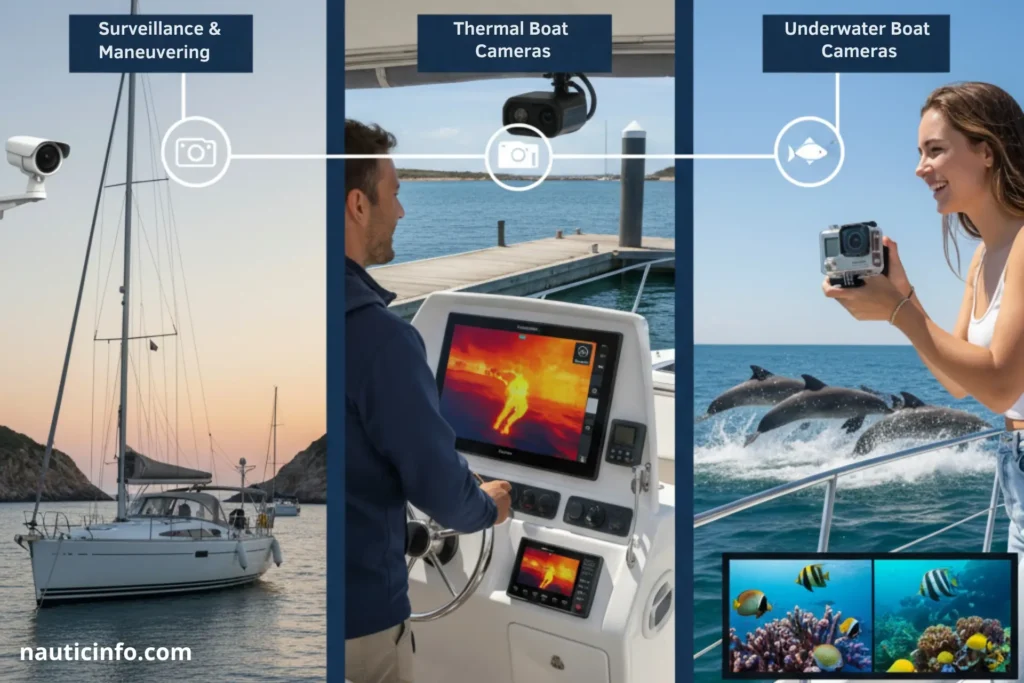
The market offers a wide range of cameras, each designed for specific needs. To choose the most suitable system, it is crucial to understand the features of each type of boat camera.
Surveillance and Maneuvering Boat Cameras: Your Eyes Everywhere Onboard
These are the most common types of cameras. They are designed to withstand the harsh marine environment (salt, humidity, UV rays) and are generally IP66 or IP67 certified.
Key Features:
- Durability and Waterproofing: They are built with corrosion-resistant materials.
- Image Quality: Most offer Full HD (1080p) or even 4K resolution for high-end models, ensuring clear and detailed images.
- Infrared (IR) Night Vision: Essential for nighttime surveillance, infrared technology allows for clear vision even in complete darkness, typically over a range of 30 to 100 feet.
- Wide-Angle Lens: A wide-angle lens helps cover a larger area, such as the entire cockpit or deck.
Integration with Onboard Systems:
One of the greatest advantages of these boat cameras is their ability to integrate with multifunction displays (MFDs) from major brands like Raymarine, Garmin, Furuno, or Simrad. This integration is typically done in two ways:
- Analog Connection: A simple and reliable solution, but with limited image quality.
- IP (Network) Connection: This is the modern standard. The camera connects to your boat’s NMEA 2000 or Ethernet network. This not only allows you to display the video feed on your MFD but also to control the camera (zoom, pan, tilt) and benefit from advanced features like augmented reality (e.g., overlaying AIS data on the video image).
Explanatory Diagram of an IP Camera Network Integration:
              +-----------------------+
              |     IP Camera (Deck)    |
              +-----------+-----------+
                          | (Ethernet Cable)
                          |
+------------------+      |      +---------------------+
|   Onboard Wi-Fi  |<-----+----->|   Network Switch      |
|      Router      |             |  (NMEA 2000 / Eth)  |
+------------------+      |      +----------+----------+
       |   (Wi-Fi)        |                 | (Ethernet Cable)
       |                  |                 |
+------v------+   +-------v-------+   +-----v------+
|  Smartphone |   |   IP Camera   |   |   MFD Screen |
|    (App)    |   | (Engine Room) |   |              |
+-------------+   +---------------+   +--------------+
This diagram illustrates how multiple boat cameras can be connected to a central network, allowing feeds to be viewed on various devices.
Underwater Boat Cameras: Explore the Depths from Your Cockpit
Who hasn’t dreamed of seeing what’s happening beneath their boat’s hull? Underwater cameras make this dream a reality. They are useful for several reasons:
- Hull Inspection: Check the condition of your propeller, keel, or anchor without having to get in the water. This is especially useful if you think you may have hit something.
- Fishing: Observe fish and the seabed to find the best fishing spots.
- Pleasure and Discovery: When anchored in clear water, an underwater camera becomes a window to aquatic life, delighting both kids and adults.
Features to Consider:
- Maximum Depth Rating: Ensure the camera is designed to handle the depths you plan to use it in.
- Image Quality: Water clarity greatly affects visibility. Opt for a camera with good low-light sensitivity.
- Built-in Lighting: Integrated LEDs are essential for seeing in darker or deeper waters.
Thermal Boat Cameras: Next-Generation Night Vision
Thermal boat cameras are no longer just for the military or search and rescue professionals. Their prices have dropped significantly, making them accessible to recreational boaters serious about safety.
Unlike a standard camera that needs light, a thermal camera detects heat (infrared radiation) emitted by objects. Therefore, it can “see” in complete darkness.
Crucial Applications for Night Navigation:
- Obstacle Detection: A thermal camera can spot an unlit lobster pot, a floating container, or debris on the water’s surface long before it’s visible to the naked eye or on radar.
- Man Overboard (MOB): This is one of the most critical advantages. If a crew member falls overboard at night, a thermal camera will detect the heat signature of their body in the water, making search and rescue operations much faster and more effective.
- Spotting Other Vessels: It allows you to clearly see other boats, even those without functioning navigation lights or those that are poor radar targets (like small wooden or fiberglass boats).
Comparison Chart: IR Night Vision vs. Thermal Camera
| Feature | Infrared (IR) Night Vision | Thermal Camera |
| Principle | Amplifies ambient light and uses an IR illuminator to “light up” the scene. | Detects differences in heat signatures (thermal energy) emitted by objects. |
| Light Requirement | Yes, requires minimal ambient light or an IR projector. | No, works in total darkness, fog, and smoke. |
| Range | Limited (typically < 150 ft). | Long (several hundred feet to over a mile, depending on the model). |
| Object Detection | Detects shapes and visual contrasts. | Detects heat signatures. A person in the water is highly visible. |
| Primary Use | Short-range surveillance (deck, cockpit). | Night navigation, safety (MOB), long-range obstacle detection. |
| Price | Affordable. | More expensive, but becoming increasingly accessible. |
Practical Tips for Choosing and Installing Your Boat Cameras
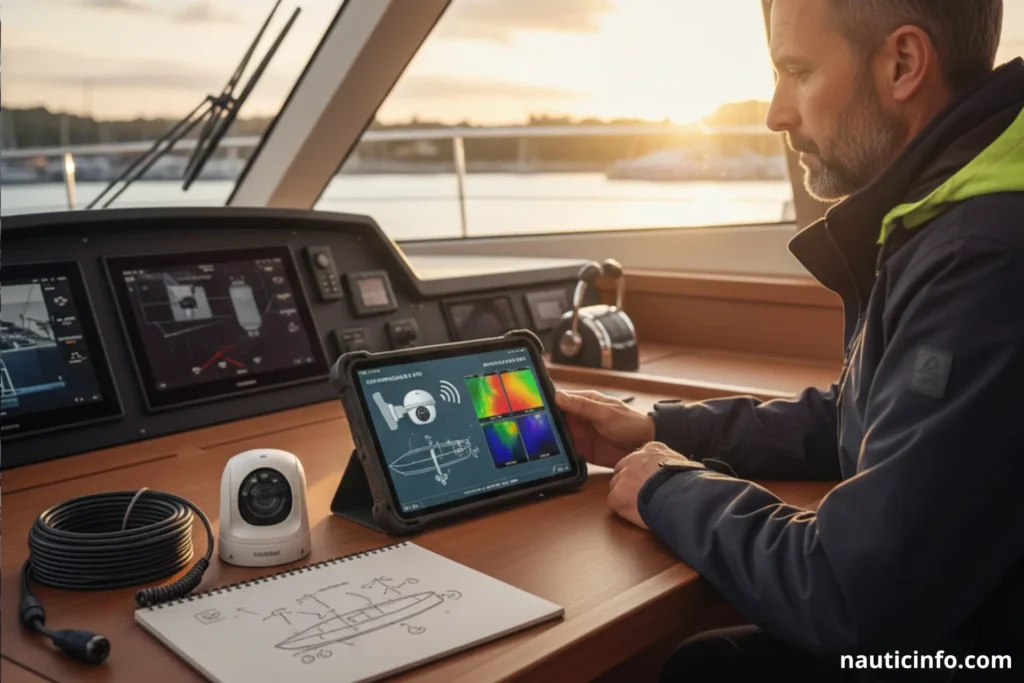
Now that you know the different types of boat cameras, here are some tips to help you make the right choice and ensure a successful installation.
Tip 1: Define Your Actual Needs
Before any purchase, ask yourself the right questions. Is it primarily for security at the marina? To help with maneuvering? For fishing? For navigating at night? Your answers will guide your choice toward a surveillance camera, a thermal camera, or a combination of systems.
Tip 2: Think ‘Integration’
Compatibility is key. Make sure the boat cameras you are considering are compatible with your multifunction display (MFD) and onboard network. Most major brands (Raymarine, Garmin, etc.) offer their own cameras, which guarantees seamless, plug-and-play integration. However, many third-party cameras are also compatible via standard protocols (like ONVIF for IP cameras).
Tip 3: Location is Strategic
A camera’s effectiveness depends heavily on its placement.
- Stern Camera: Ideal for docking maneuvers. Mount it high (on an arch or mast) for a bird’s-eye view of the swim platform and the dock.
- Bow Camera: Useful for picking up a mooring or monitoring the anchor.
- Side-View Cameras: To monitor blind spots along the hull.
- Masthead Camera: Provides an unbeatable overview of the boat and its surroundings, perfect for surveillance and sail trim analysis.
- Engine Room Camera: Essential for safety, it allows you to quickly check the engine’s status without opening the compartment.
Tip 4: Don’t Overlook Power and Wiring
A reliable installation requires marine-grade wiring. Use waterproof cables and corrosion-resistant connectors. For IP cameras, PoE (Power over Ethernet) technology is a major advantage: a single Ethernet cable transmits both video data and electrical power, greatly simplifying the installation process.
Tip 5: Secure Your Network
If your boat cameras are connected to a Wi-Fi network, it is imperative to secure it with a strong password. This will prevent any unauthorized access to your video feeds and your boat’s network.
In conclusion, boat cameras are much more than just an accessory. They are a significant investment in your safety, comfort, and enjoyment of boating. Whether it’s for keeping an eye on your boat from afar, executing a tricky maneuver, or sharing the beauty of a sunrise at sea, these electronic eyes will quickly become an essential part of your crew. Technology is advancing rapidly, offering ever-sharper images and deeper integration. By choosing the right system for your boating style, you will transform your experience on the water, making it safer, more serene, and more memorable. Are you ready to bring this technology aboard?