

Smart Connected Textiles for Sailing: The Upcoming Revolution in Offshore Gear
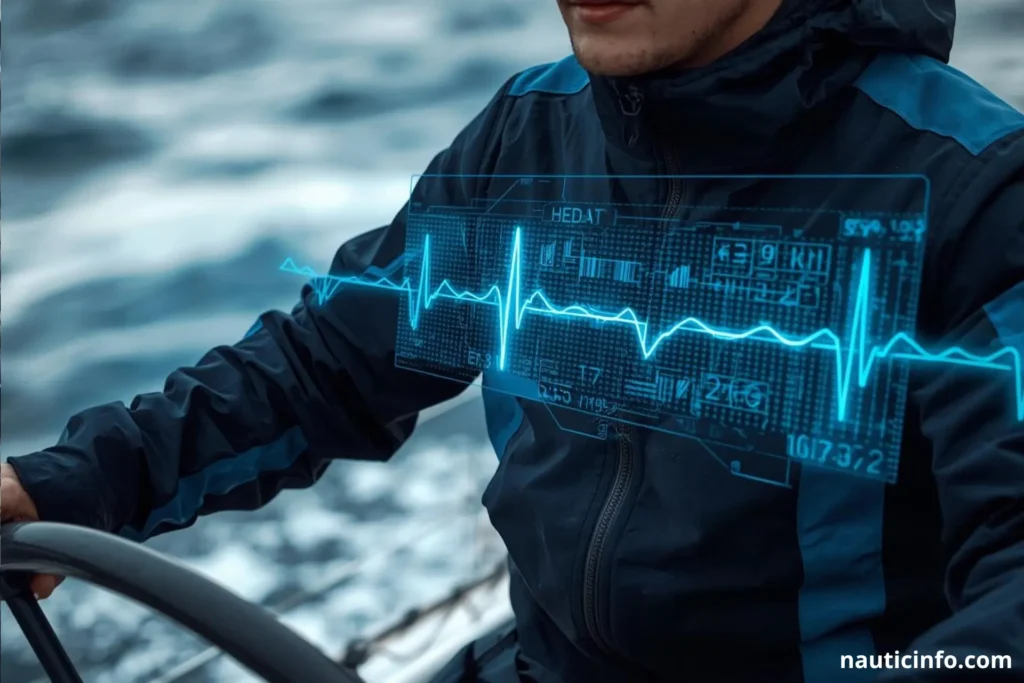
The world of sailing has always been on the cutting edge of innovation. From the first nautical charts to the advent of GPS, and from carbon fiber hulls to foiling boats, sailors have constantly pushed the boundaries of what is possible. Indeed, gear manufacturers have kept pace, offering waterproof, more breathable, and lighter foul-weather jackets. However, despite these considerable advances, the core equipment of the sailor remains, in essence, passive. It protects us from the elements, certainly, but it does not actively interact with us or our environment. Now, we stand on the brink of a major transformation. This revolution will not come (only) from the appendages on our boats, but from what we wear. Henceforth, the future of navigation is being written within the very fibers of our clothing. We are talking about Smart Connected Textiles for Sailing.
Imagine for a moment: your foul-weather gear not only keeps you dry but also measures your heart rate and fatigue level in real-time. Imagine a sail that “feels” the wind and adjusts its shape, or a life jacket that automatically sends an AIS signal not only upon immersion but before impact. Science fiction? Not quite. These technologies, once confined to laboratories or the aerospace domain, are now knocking at the door of our docks.
Therefore, this prospective article aims to explore this new frontier. We will dissect what these smart textiles are, analyze their potential impact on our safety, evaluate the performance and comfort gains they promise, and finally, examine the current prototypes and remaining challenges. In other words, prepare to radically rethink your relationship with your gear.
Part 1: Defining Smart Connected Textiles for Sailing
Before diving into the practical applications, it is crucial to define exactly what we are discussing. As a matter of fact, the term “smart” is often misused.
The Key Difference: Passive vs. Active
On the one hand, we have the advanced “passive” textiles that are already familiar. A membrane like Gore-Tex or eVent, for example, is “smart” in the sense that its microscopic structure reacts to water vapor (sweat) to evacuate it while blocking liquid water molecules (rain, spray). Similarly, a UV-treated fabric or a merino wool base layer that regulates temperature are examples of sophisticated passive technologies.
On the other hand, the Smart Connected Textiles for Sailing we discuss here are active. They go beyond simple material protection. They are capable of:
- Sensing (Detecting): They integrate micro-sensors that measure data (temperature, heart rate, pressure, location).
- Reacting (Responding): They can change their properties in response to a stimulus (e.g., stiffening upon impact, generating heat).
- Adapting (Modifying): They change their behavior based on conditions or data received.
- Communicating (Connecting): They transmit collected data to an external device (smartwatch, boat screen, shore crew).
How Do These Next-Generation Fibers Work?
These textiles are the result of a fusion between textile engineering and micro-electronics. Instead of “sewing” a sensor onto a garment (which creates weak points and discomfort), the technology involves integrating the function directly into the yarn.
- Conductive Fibers: Micro-filaments of metal (silver, copper) or conductive polymers are woven together with polyester or polyamide.
- Printed Sensors: Special inks containing sensors can be “printed” directly onto the fabric.
- Micro-Encapsulation: Substances (like self-repairing agents or thermoregulating compounds) are stored in tiny capsules integrated into the fiber.
Consequently, the garment itself becomes the interface. There is no longer a separate “box”; the fabric is the sensor.
Comparative Table 1: Traditional vs. Smart Connected Gear
Functionality Traditional Gear (Passive) Smart Connected Textiles (Active) Safety (MOB) Manual or water-activated inflatable PFD + PLB (Manual activation). PFD with integrated GPS, shock and immersion detection, automatic AIS alert. Biometrics None. Skipper must “feel” fatigue or cold. Heart rate, core body temperature, hydration sensors embedded in base layers. Thermoregulation Layering system (3-layer rule). Effective but static. Active heating fibers (powered) or Phase Change Material agents. Feedback (Perf) Skipper feel, boat instruments. Posture sensors (for crew), optical fibers in the sail (real-time shape visualization).
Part 2: Safety Reimagined – The Vital Contribution of Smart Connected Textiles for Sailing
At sea, safety is the absolute priority. That is why the first commercially viable applications of smart textiles logically focus on this area.
Biometrics: When Your Gear Monitors Your Health
Cold, fatigue, stress, and dehydration are the silent enemies of the sailor. Yet, in offshore solo racing, or even during a long family cruise, skipper exhaustion puts the entire crew at risk.
Smart Connected Textiles for Sailing integrate biometric sensors, often in the form of elastic bands across the chest or threads woven directly into the base layer.
- What they measure: Heart Rate (HR), Heart Rate Variability (HRV, an indicator of fatigue/stress), respiratory rate, and skin temperature.
- The Practical Application: An onboard system (or a smartwatch app) could analyze this data. For example, if the skipper’s core temperature drops dangerously (a sign of hypothermia) while detecting a high HRV indicating extreme stress, an alert could be triggered.
- Prototypes: Companies like Hexoskin or Spire already offer connected shirts for athletes. Adapting them to the marine environment (salt, constant humidity, connectivity issues) is the next challenge. Furthermore, Vendée Globe skippers already use sleep trackers (ring or bracelet type); integration into the garment is the logical next step.
Beyond the Beacon: Integrated GPS and Fall Detection
The “Man Overboard” (MOB) procedure is the nightmare of every sailor. Currently, we rely on PLB or AIS beacons that must be manually activated, or PFDs that inflate upon contact with water. However, what happens if the person falls overboard unconscious after a blow (e.g., from a boom) even before hitting the water?
Smart Connected Textiles for Sailing offer a much more robust solution.
- Shock Detection: Using accelerometers or piezoelectric sensors (which react to pressure/torsion) woven into the shoulders or back of the jacket, the garment can detect a sudden, violent shock typical of a fall.
- Immersion Detection: Humidity sensors (faster than salt tabs) confirm immersion.
- Automated Alert: If the shock is followed by immersion (or if immersion is detected alone), the life jacket doesn’t just inflate. It immediately activates a GPS/AIS beacon integrated into the garment, transmitting the exact position to the boat’s AIS receiver and surrounding vessels.
Consequently, the reaction time is virtually zero, and localization is instantaneous, even if the sailor is unconscious. This is truly an active life insurance policy.
Part 3: Performance & Comfort – The Edge from Smart Connected Textiles for Sailing
While safety is the foundation, performance and comfort are the driving forces of innovation, especially in the world of yacht racing.
Active Thermoregulation: Never Be Cold (or Too Hot) Again
Temperature management is a perennial challenge at sea. The famous “three layers” adage is effective but passive. Indeed, during an intense maneuver (a sail change on the bow), one sweats profusely. Immediately afterward, during a static watch in the cockpit, this moisture chills, causing an intense cold sensation (the “hot-cold cycle”).
Smart Connected Textiles for Sailing address this issue in two ways:
- Active Heating: Forget chemical hand warmers. We are talking about conductive fibers woven into the base or mid-layer (similar to heated ski gloves, but across the torso) that generate heat. Thus, powered by a small, flexible battery, they activate when your biometric sensors (mentioned above) detect a drop in your surface temperature.
- Adaptive Cooling (Phase Change Materials – PCM): Less “connected” but equally smart, PCMs are micro-capsules in the fabric that absorb heat (sweat) when you are hot, transitioning from solid to liquid. Then, when the body cools, they release that heat by solidifying. This acts as an active thermal buffer.
Posture Analysis and “Living” Sails
Here, we enter the realm of high performance.
For the Crew: Jumpsuits (or “skinsuits”) equipped with strain sensors (piezoelectric fibers) can analyze posture. For example, a winch grinder or mainsheet trimmer could receive haptic feedback (a vibration) if their position is not optimal, thus preventing injuries (back pain) and maximizing movement efficiency. Likewise, this would allow coaches to objectively analyze the physical performance of the crew.
For the Sail: This is perhaps the most fascinating application of Smart Connected Textiles for Sailing. Prototypes of sails integrate optical fibers.
- How does it work? By sending a light signal through these fibers, the sail’s deformation (draft, twist) can be measured in real-time with millimeter precision. The fiber “feels” the stretch.
- The Advantage? Gone are the days of setting sails purely by “feel” or based only on telltales. The trimmer sees the exact 3D profile of their sail on a screen. Consequently, they can adjust it to meet the theoretical “target” profile, optimizing power continuously. Companies like North Sails are actively working on these concepts (e.g., “SailSense”) to quantify performance.
💡 Practical Tip: What to Look For Today?
Although most of these technologies are still in R&D, you can already find “precursor” products:
- Heating: Look for jackets and base layers with active heating modules (often USB-powered). They are already common in the skiing and motorcycle markets.
- Biometrics: Do not underestimate your smartwatch. Brands like Garmin (with its Quatix line) or Apple (with the Apple Watch Ultra) already offer fall detection, ECG, and fitness tracking functions that, when coupled with a good communication system, approach the concept of connected gear.
- Connectivity: Ensure your current equipment can communicate. Having a personal AIS beacon (like the MOB1) integrated into your PFD is an essential first step toward the connected ecosystem.
Part 4: The Future Within Reach – Prototypes and Emerging Applications
We have seen what is possible, but let’s now look at what is probable in the short to medium term. These innovations are not just concepts; they are being actively developed.
Self-Healing Fabrics: No More Sail Tape?
A small tear in a sail or a snag in a foul-weather jacket can quickly become a major problem with wind and salt. Currently, the solution is repair tape or sewing.
The future lies in self-healing fabrics. Inspired by biology, these textiles contain micro-capsules filled with a repair agent (a kind of liquid resin or glue).
- The Process: When a tear occurs, the capsules along the rupture burst.
- The Reaction: The liquid is released, contacts the air (or another activating agent present in a neighboring capsule), and polymerizes (hardens).
- The Result: The tear is sealed within minutes, restoring the structural integrity and waterproofness of the fabric.
Obviously, this won’t fix a sail ripped in half, but for the countless small snags and perforations, it would significantly increase the lifespan of our most expensive gear. Universities (like Penn State) have already demonstrated the effectiveness of this concept on coatings.
Onboard Energy: Textiles That Power Your Devices
The main barrier to all these sensors is power. Indeed, no one wants a foul-weather jacket with a bulky 2-pound battery pack.
The solution will come, once again, from the textile itself. Researchers are developing fibers capable of generating electricity (known as “energy harvesting”):
- Photovoltaic Fibers: Incredibly thin, solar fibers can be woven into the fabric of the bimini, dodger, or even the shoulders of the jacket. They capture sunlight to continuously recharge flexible batteries.
- Piezoelectric Fibers: These generate current when subjected to mechanical stress (bending, movement). Imagine: the simple act of walking on deck, or the flutter of a sail, could generate enough power to run the sail sensors.
Ultimately, the garment becomes a self-sufficient micro power plant, feeding the GPS, biometric, and communication sensors without external intervention.
Comparative Table 2: Emerging Technologies and Maturity
Technology Operating Principle Maturity (out of 5 stars) Potential Impact on Sailing Integrated Biometrics Conductive fibers measuring HR, respiration. ★★★☆☆ (Exists for sports, needs “marinization”) High (Solo safety, crew management) Active Thermoregulation Heating fibers or PCM (Phase Change). ★★★★☆ (PCM common) ★★☆☆☆ (Integrated heating) Medium to High (Comfort, hypothermia safety) Active MOB Detection Accelerometers + integrated GPS/AIS. ★★☆☆☆ (Functional prototypes) Revolutionary (Safety) “Sensitive” Sails Optical fibers measuring deformation. ★★☆☆☆ (Used in R&D, costly) High (Pure racing performance) Self-Repair Micro-capsules of resin in the fiber. ★☆☆☆☆ (Laboratory stage) High (Durability, long-term cost) Energy Harvesting Photovoltaic or piezoelectric fibers. ★☆☆☆☆ (Laboratory stage) Revolutionary (System autonomy)
Part 5: Challenges to Overcome Before Smart Connected Textiles for Sailing Go Mainstream
Of course, this high-tech future will not be on our docks tomorrow morning. Several major challenges, both technical and practical, must be overcome.
Challenge #1: Durability and Maintenance
This is the most obvious question: how do you wash a circuit board?
The marine environment is the worst enemy of electronics: salt, corrosion, constant humidity, UV, chafing. Moreover, the garments must be able to be twisted, folded, and machine-washed.
The solutions lie in the perfect encapsulation of electronic components, the use of waterproof and non-corrosive connectors (perhaps inductive, without metallic contact), and the development of conductive fibers that can withstand thousands of wash cycles. However, this is an immense challenge.
Challenge #2: Cost and Standardization
Currently, producing one square meter of piezoelectric fabric costs a fortune. For these Smart Connected Textiles for Sailing to become widespread, production costs must drop drastically.
In addition, there is the question of the technological “Tower of Babel.” If my Helly Hansen jacket cannot communicate with my Raymarine chartplotter or my Spinlock vest, the connected ecosystem will not work. Consequently, the marine industry will need to agree on common communication protocols (as NMEA 2000 did for instruments) for this new personal gear.
Challenge #3: Data Management and Privacy
Who owns your biometric data? Your shore crew? Your sponsor? The boat’s insurer?
On the one hand, this data can save lives. On the other hand, it raises significant ethical and privacy concerns. If an AI system constantly analyzes the crew, could it “judge” that a crew member is no longer fit and report it to the skipper, creating tension? Managing this information will be a human challenge as much as a technical one.
Conclusion Smart Connected Textiles for Sailing : An Inevitable Wave
Smart Connected Textiles for Sailing are not a fleeting gadget. They represent a fundamental evolution in our relationship with gear, moving from passive protection to active interaction. Admittedly, the challenges related to cost, durability in the saltwater environment, and standardization are real. Nevertheless, the potential benefits, especially in terms of safety, are so significant that this wave of innovation is inevitable.
Firstly, we will see active, integrated MOB safety systems emerge. Subsequently, comfort (thermoregulation) and performance (posture analysis) applications will follow, first in the offshore racing world before spreading, as always, to recreational boating.
In the end, the sailor of tomorrow will be an “augmented” navigator. Their gear will no longer be a simple shell against the elements, but a true co-pilot, a silent guardian watching over their health, optimizing their performance, and ensuring their safety. The revolution is underway, and it is woven into the very heart of our clothing.