
Discover the Cyclades in 15 Days: Mykonos, Paros, Santorini… The Beginner’s (or Not) Itinerary
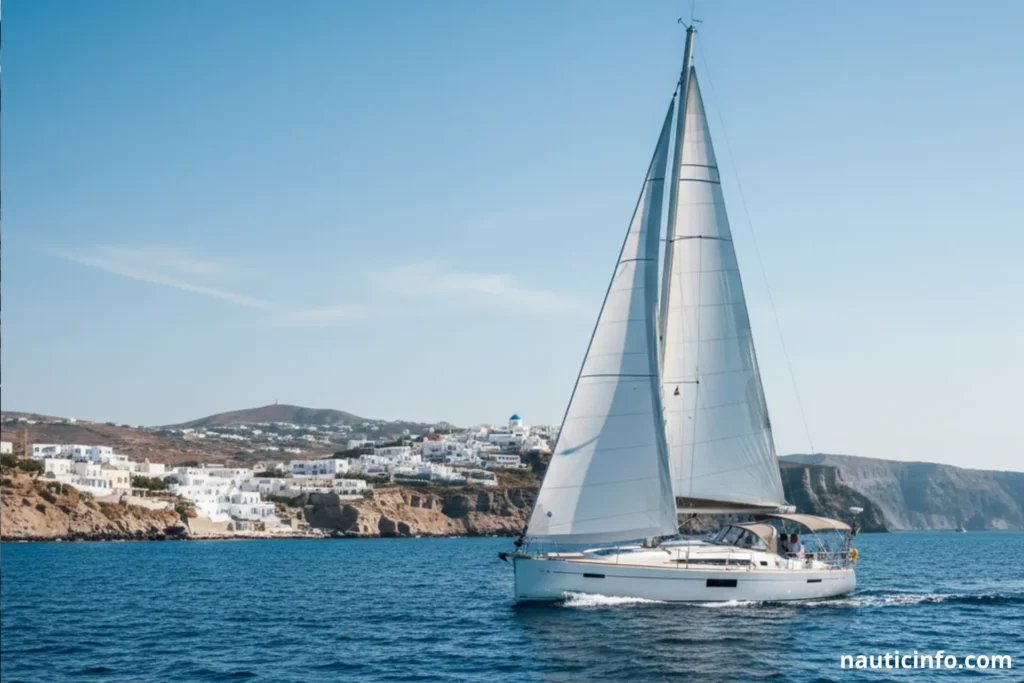
The dream of sailing through the heart of the Aegean Sea, dotted with white and blue islands, has never been more accessible. The Cyclades, this mythical archipelago, attracts thousands of sailors each year, from novices to the most experienced. However, planning a 15-day journey through this island labyrinth can quickly become a headache, especially due to the Meltemi, a formidable strong wind. Our goal is to simplify this task for you and help you chart the perfect adventure. We will not only offer you a comprehensive exploration but also two distinct itinerary versions. Indeed, whether you are a cautious sailor wishing to avoid rough waters or a seasoned seadog seeking thrills, you will find here the ideal route plan for discover the Cyclades in 15 days: Mykonos, Paros, Santorini… The beginner’s (or not) itinerary.
Prepare your charts, because the adventure begins now.
Understanding the Cyclades and the Meltemi Challenge
Before setting sail, it is essential to understand the environment in which you will be operating. The Cyclades, famous for their dazzling architecture and crystalline waters, are also known for a major weather phenomenon.
The Meltemi: The Sailor’s Friend and Foe
The Meltemi is a dry, strong wind that blows from the north (sometimes northeast or northwest) during the summer, from June to September, peaking in July and August.
- Advantages: This wind brings a welcome breath of fresh air against the summer heat and allows for fast sailing, which is a true delight for purists.
- Disadvantages: Its strength can reach 7 to 9 Beaufort, making navigation uncomfortable, or even dangerous. Furthermore, it raises short, choppy seas, which are particularly taxing for the crew.
Therefore, the key to a successful cruise lies in anticipating this wind. This is why we have developed two distinct routes. First, we will detail the “protected” itinerary.
Discover the Cyclades in 15 Days: The Beginner’s (or Cautious Sailors’) Itinerary
This itinerary is designed to minimize exposure to the Meltemi. It favors downwind sailing and short or east-west oriented crossings. First and foremost, it is advisable not to venture too far into the center or east of the archipelago.
Table 1: Summary of the “Protected” Itinerary (15 Days)
| Day(s) | Main Stop | Approximate Distance (NM) | Major Point of Interest | Safety Note |
| 1 | Depart Athens (Lavrio or Alimos) – Kea (Vourkari) | 30 – 45 | Authentic small island, Secure anchorage. | Good warm-up sail. |
| 2-3 | Kea – Kythnos (Kolona) | 20 – 25 | Iconic double beach, natural shelter. | Short, easy anchorage. |
| 4-5 | Kythnos – Serifos (Livadi) | 25 | Magnificent amphitheater-like Chora. | Port well-sheltered from N/NE. |
| 6-7 | Serifos – Sifnos (Vathy or Kamares) | 15 – 20 | Chrissopigi Monastery, Gastronomy. | Vathy is a very safe anchorage. |
| 8-9 | Sifnos – Milos (Adamas or Kleftiko) | 35 – 40 | Kleftiko rock formations, Venus de Milo. | Longer navigation, to be done in light winds. |
| 10-11 | Milos – Folegandros (Karavostasi) | 25 | Spectacular perched Chora. | Guaranteed calm (small island). |
| 12-13 | Folegandros – Santorini (Thira/Oia) | 30 | Impressive caldera, sunsets. | Tricky anchorage, docking is preferred. |
| 14 | Santorini – Return West (Serifos or Kythnos) | 50 – 70 | Long repositioning leg. | Plan for an overnight sail if necessary. |
| 15 | Return to Athens (Base) | 30 – 45 | Final leg. | Arrive late afternoon. |
Details of the “Protected” Stops
Days 1-3: A Gentle Start (Kea & Kythnos)
After leaving port, the first leg takes you to Kea. It’s not a central island, which is an advantage. The crossing is short, allowing you to get acquainted with the boat. The anchorage of Vourkari, though popular, offers good protection.
Next, you set course for Kythnos. Its Kolona bay is an absolute must-see. It’s a fine sandy beach connecting the main island to an islet. Anchorage here is secure in calm weather or moderate winds. However, monitor forecasts, as it becomes untenable in strong westerly winds.
Days 4-7: The Heart of the West (Serifos & Sifnos)
Serifos, with its spectacular Chora, is a fascinating stop. You will mainly sail downwind of Kythnos, which protects you if the Meltemi has already picked up. Livadi port is very well protected from northerly winds.
Then, Sifnos is an island renowned for its cuisine and casually chic atmosphere. Vathy port is an almost enclosed bay, forming an ideal refuge. It is one of the best shelters in all the Cyclades, so it’s a mandatory stop if you fear bad weather.
Days 8-11: The Southwest (Milos & Folegandros)
The crossing to Milos is the longest. Milos is a volcanic island with breathtaking landscapes, especially the caves of Kleftiko. However, for a cautious itinerary, plan this navigation early in the morning, before the wind picks up. Milos, due to its size, offers many “mouse-hole” anchorages for shelter.
After Milos, Folegandros awaits you. Smaller, more isolated, it is often cited as one of the most beautiful Choras in the Cyclades. It offers a sense of authenticity and tranquility.
Days 12-15: The Grand Finale and Return (Santorini)
Santorini is the highlight of any Aegean cruise. It is important to note that anchoring in the Caldera is complicated. We strongly recommend reserving a spot at Vlychada port if you want shelter, or using the available buoys near the small port of Ammoudi (below Oia) in very good weather.
Finally, the return from Santorini to Athens is done in two long stages. Thus, this part of the journey is a good test of your navigation skills, even if you favor motoring.
The Sailor’s Challenge: Discover the Cyclades in 15 Days, the Sporty Itinerary
For experienced sailors, those with good offshore navigation experience who enjoy the thrill of heeling, the itinerary can be radically different. The idea is to face the Meltemi, take it abeam or slightly aft, and enjoy the speed offered by the more sustained conditions.
Why Choose the “Sporty” Itinerary?
- Speed: Under sail, crossings are faster and more rewarding.
- Destinations: Access to central and eastern islands like Naxos, Amorgos, and Mykonos, which are more exposed.
- Thrills: A true sailing experience, demanding but full of adrenaline.
Nevertheless, this itinerary requires meticulous boat preparation (rigging, heavy-weather sails) and a seasoned crew.
Table 2: Summary of the “Sporty” Itinerary (15 Days)
| Day(s) | Main Stop | Approximate Distance (NM) | Major Point of Interest | Safety Note |
| 1 | Depart Athens (Lavrio) – Kea | 30 | Warm-up. | Easy. |
| 2-3 | Kea – Syros (Ermoupoli) | 40 | Capital of the Cyclades, neoclassical architecture. | Large port, easy access anchorage. |
| 4-5 | Syros – Mykonos (Tourlos/Old Port) | 25 | Nightlife, windmills, Little Venice. | Caution, very exposed. Preference for Tourlos. |
| 6-7 | Mykonos – Naxos (Naxos Port) | 35 | Temple of Apollo (Portara), kite-surfing. | Strong crosswind or downwind sailing. |
| 8-9 | Naxos – Amorgos (Katapola) | 35 | Chozoviotissa Monastery, the “Big Blue”. | The most exposed island, but Katapola port is very safe. |
| 10-11 | Amorgos – Ios (Ormos) | 30 | Parties, but also beautiful wild beaches. | Pleasant port for a lively stop. |
| 12-13 | Ios – Santorini (Thira) | 20 | Caldera. | Short crossing, allows for calm arrival. |
| 14 | Santorini – Return (Naxos or Paros) | 50 | Long downwind sail. | Very fast with good following wind. |
| 15 | Return to Athens (Base) | 80 – 100 | Long final leg. | Very early departure or overnight sail. |
Details of the “Sporty” Stops
Days 1-3: The Baptism of Fire (Syros)
After a short first leg, you set course for Syros, the administrative capital of the Cyclades. It’s an important commercial port. You will already feel the wind’s strength upon entering and exiting. Moreover, the crossing to Syros is often fast and full of thrills.
Days 4-5: Facing the Northeast (Mykonos)
Mykonos is located in the most exposed part of the archipelago. If the Meltemi is blowing, the approach will be spirited. Tourlos port (new port) is preferable to the old port, which is exposed to swell. However, the atmosphere and the reward after a demanding sail are worth the effort.
Days 6-7: The Central Crossing (Naxos)
The crossing from Mykonos to Naxos is a classic. Naxos is the largest of the Cyclades and offers excellent shelter in its port. You should have an ideal crosswind for good average speed. Therefore, it’s a very enjoyable sail for those who love heeling.
Days 8-9: The Far East (Amorgos)
Amorgos, immortalized by The Big Blue, is the most distant destination on this itinerary. Furthermore, it is often swept by the Meltemi. Katapola port is a long fjord that offers exceptional shelter, even in force 9 winds. The arrival is spectacular.
Days 10-15: The Return via the South (Ios & Santorini)
The way back takes you through Ios, an island known for its nightlife, but also boasting beautiful wild bays. The crossing to Santorini is short and allows you to arrive in time for the spectacular sunset.
Finally, the return to Athens is the longest part. With a well-established Meltemi, you’ll make good speed. Nevertheless, overnight sailing may be necessary.
Discover the Cyclades in 15 Days : Practical Tips and Optimization for Your Cruise
Whichever version you choose for your discovery of the Cyclades in 15 days: Mykonos, Paros, Santorini… The beginner’s (or not) itinerary, certain tips apply to all sailors.
Logistics and Safety
A. Choosing Your Boat
- Monohull: Ideal for the Meltemi. A deep keel handles waves better. Opt for a well-canvased boat, but with a small jib and a storm mainsail.
- Catamaran: More comfortable at anchor and less heeling, but beware: it slams more in choppy Meltemi seas and offers less maneuverability in ports. Reef sails very early!
B. Greek Anchoring Maneuvers (The “Greca”)
In Cyclades ports, docking is usually “Stern-to” or “Bow-to with Anchor.”
Here’s the ideal sequence:
- Approach the quay slowly.
- Drop the anchor at a sufficient distance (about 3 to 4 boat lengths from the quay).
- Slowly reverse, paying out chain.
- Once at a good distance, give a few bursts of forward gear to properly set the anchor.
- Dock gently, tie up the stern lines.
Consequently, this technique ensures the boat remains stable and makes it easy to depart. Moreover, it optimizes space on the quay.
C. Provisioning and Water
The Cyclades are arid islands. Fresh water is scarce and precious. Therefore, fill your tanks whenever you have the opportunity. Major ports like Syros, Paros, or Naxos have good infrastructure. Conversely, in small coves, you will have to rely on your reserves.
💰 Discover the Cyclades in 15 Days : Budget Management (Port and Daily)
Port fees in the Cyclades are generally reasonable (often free in small municipal ports, paid in private marinas).
Table 3: Cost Comparison (Estimates for a 40-45 ft boat)
| Type of Mooring/Port | Average Cost per Night ($) | Available Services | Character |
| Wild Bay (Anchorage) | 0 – 6 (if private buoy) | None, self-sufficiency required. | Total Freedom. |
| Municipal Port (Town) | 12 – 35 | Water (sometimes), Electricity (rarely), Groceries. | Authentic, lively. |
| Marina (Ex: Tourlos-Mykonos) | 55 – 100+ | All: Showers, Water, Electricity, Laundry. | Comfortable, secure. |
Finally, plan a budget for meals ashore. Greek cuisine is delicious and generally affordable, however, islands like Mykonos or Santorini are significantly more expensive.
Anchorages: Choosing Your Anchor Based on the Seabed
The seabeds of the Cyclades can vary: sand, Posidonia seagrass, or rock. Therefore, adapting your anchoring is crucial.
| Seabed Type | Anchor Recommendation | Holding Power | Difficulty to Unhook |
| Sand | Plow anchor (Spade, Rocna, Delta) | Excellent if well set. | Easy. |
| Posidonia (Seagrass) | Grapnel anchor or heavy weights (CQR) | Very Poor (anchor drags). | Medium, if it snags a hidden rock. |
| Rock (Wreck, Slab) | Lightweight anchor (Britany type) | Variable (risk of snagging). | High (risk of losing the anchor). |
In conclusion, avoid Posidonia seagrass beds at all costs. Not only does the anchor not hold there, but furthermore, Posidonia is a protected species.
Conclusion Discover the Cyclades in 15 Days : The Epilogue of Your Aegean Adventure
Whether you chose the “protected” or “sporty” itinerary, the experience of discovery of the Cyclades in 15 days: Mykonos, Paros, Santorini… The beginner’s (or not) itinerary will remain etched in your memory.
It’s a journey that demands preparation, respect for the Aegean Sea and the Meltemi, but most importantly a thirst for adventure. You will move from the serenity of Sifnos’ isolated coves to the tumultuous sunsets of Santorini, under the watchful eye of a wind eager to push you towards the horizon.
Finally, the greatest advice we can give you is this: be flexible. The Meltemi is the master of the place. If forecasts announce a strong gale, do not hesitate to shelter for two or three days in a safe port. These “forced” days are often an opportunity to discover the island’s inner richness, its gastronomy, and the legendary hospitality of the Greeks.
Fair winds and happy sailing in the Islands of Myths!