

4-Stroke Outboard Oil Change: Master Your Boat’s Maintenance
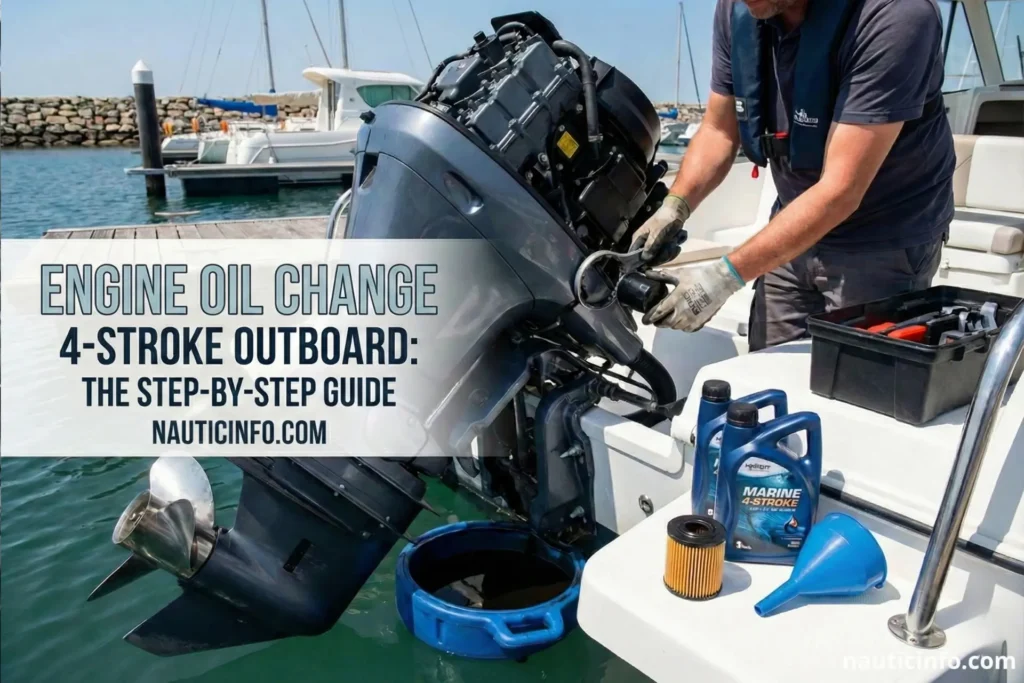
For many boat owners, mechanical maintenance often represents a source of unjustified anxiety or a significant annual expense. However, maintaining your engine is not reserved solely for certified marine mechanics. In fact, performing certain maintenance operations yourself is not only rewarding, but it also allows you to realize substantial savings on labor costs. Among these operations, the 4-stroke outboard oil change is undoubtedly the most accessible and the most crucial procedure for the longevity of your equipment.
This article aims to completely demystify this procedure. Therefore, whether you are a weekend cruiser or a dedicated angler, you will discover that with just a few tools and a methodical approach, you can guarantee the health of your engine. We are going to explore together, step-by-step, how to proceed safely and effectively.
Why Perform a DIY 4-Stroke Outboard Oil Change?
There are numerous valid reasons to take charge of your boat’s maintenance personally. First and foremost, the economic aspect is undeniable. Indeed, a 4-stroke outboard oil change performed by a professional dealer includes not only the price of consumables (often marked up) but also the hourly cost of labor, which can exceed $100 per hour in the US. By doing it yourself, you consequently pay only for the oil and the filter.
Additionally, this process allows you to get to know your machine better. As a result, by spending time on your engine, you will be more likely to spot other potential anomalies, such as a leak or beginning corrosion. Finally, it is a question of autonomy. Knowing that your engine has been serviced with care and the correct products provides invaluable peace of mind once you are offshore.
Understanding the Importance of a 4-Stroke Outboard Oil Change
Before touching any tools, it is essential to understand why this operation is vital. Engine oil has multiple functions: it lubricates moving parts, it cools the engine, and it cleans combustion residues. However, over time, the oil loses its properties and becomes loaded with impurities.
When to Schedule
The frequency of the oil change is dictated by the manufacturer, but general rules apply to almost all brands like Mercury, Yamaha, or Honda.
- Hours of Operation: Generally, it is highly recommended to perform a 4-stroke outboard oil change every 100 hours of use.
- Seasonality: Even if you have not reached the 100-hour mark, a change must be performed at least once a year.
- Winterization: This is the ideal time. In fact, leaving used oil (which is acidic) in the engine throughout the winter can damage internal components.
Marine Oil vs. Automotive Oil: Critical for Your 4-Stroke Outboard Oil Change
A classic mistake involves using standard car oil. However, marine engines undergo very different stresses compared to automobiles. They often run at a constant high RPM, and most importantly, they operate in a humid and saline environment. This is why the oil used for a 4-stroke outboard oil change contains specific anti-corrosion additives that are not found in standard automotive oil. Therefore, ensure you choose an oil that is FC-W certified (Four Cycle Water-cooled) by the NMMA.
Essential Gear for a Successful 4-Stroke Outboard Oil Change
Preparation is the key to success. Before starting, make sure you have all the necessary materials. Fortunately, the list is short and relatively inexpensive.
Table of Tools and Consumables
| Tool / Consumable | Usage | Tip |
| Marine 4-Stroke Oil | Engine lubrication | Check viscosity (often 10W-30 or 25W-40) |
| Oil Filter | Filtering impurities | Get the exact OEM part number |
| Socket Wrench | Loosening the drain plug | Variable size (often 12mm, 14mm, or 17mm) |
| Oil Filter Wrench | Loosening the old filter | Indispensable if the filter was overtightened |
| Drain Pan | Catching used oil | Choose a wide, flat pan |
| Funnel | Pouring new oil | Essential to avoid spills on the boat |
| Shop Towels | Cleaning | Keep plenty on hand |
| Drain Plug Gasket | Sealing | Must be changed at every oil change |
Choosing the Right Viscosity
The choice of oil is decisive. As a general rule, consult your owner’s manual. However, for most temperate climates in the US, 10W-30 or 10W-40 oil is standard. If you are boating in very hot areas like Florida or Texas summers, a higher viscosity might be required.
Step-by-Step Tutorial: Executing the 4-Stroke Outboard Oil Change
Let’s get into the details. Follow these steps scrupulously to guarantee a clean and effective procedure.
Step 1: Engine Prep Before the 4-Stroke Outboard Oil Change
For the oil to drain easily, it must be warm and fluid.
First, if your boat is out of the water (on a trailer or boat lift), install “muffs” (flushing attachment) on the water intakes of the lower unit. Connect the garden hose and turn on the water. Next, start the engine and let it idle for about 5 to 10 minutes.
Warning: Never run an outboard engine without a water supply, even for a few seconds, as this will destroy the water pump impeller.
Once the engine is warm, turn off the ignition and remove the kill switch key to avoid any accidental starting.
Step 2: Draining Old Fluid During the 4-Stroke Outboard Oil Change
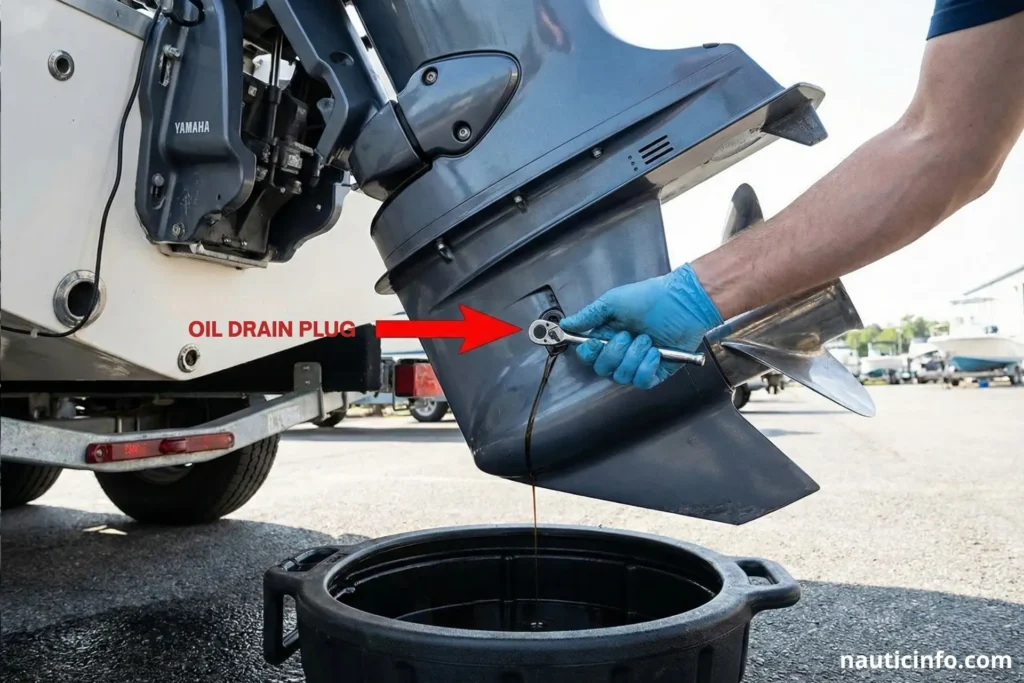
This is where the actual 4-stroke outboard oil change operation begins.
- Positioning: Place the engine in a vertical position. If the engine is tilted up, the oil will not drain completely.
- Locating: Find the drain plug. It is generally located at the rear or on the side of the mid-section, often indicated by a colored label or the text “Oil Drain.”
- Protection: Place your drain pan under the plug. You can use cardboard or plastic to guide the oil if access is tricky.
- Opening: Loosen the plug with the appropriate wrench. Tip: To facilitate flow, also open the oil fill cap (at the top of the engine) and pull the dipstick slightly. This creates airflow.
- Draining: Let the oil flow until the very last drop. Be patient; this can take several minutes.
Step 3: Filter Replacement in the 4-Stroke Outboard Oil Change
While the oil finishes draining, take care of the filter. The oil filter traps metal particles and sludge. Not changing it during a 4-stroke outboard oil change is like taking a shower and putting dirty clothes back on.
- Location: The filter looks like a small cylindrical cartridge screwed onto the engine block.
- Removal: Use your filter wrench to unscrew it counter-clockwise. Be careful, as it still contains a bit of oil; keep a rag underneath.
- Prepping the New Filter: This is a crucial step often forgotten. Take a little new oil on the tip of your finger and coat the rubber gasket of the new filter. This ensures a perfect seal and makes removal easier next year.
- Installation: Screw the new filter on by hand until it makes contact, then tighten about 3/4 of a turn more. Do not use a tool to tighten; hand strength is generally sufficient to avoid damaging the threads.
Step 4: Refilling and Finishing the 4-Stroke Outboard Oil Change
Once the oil is no longer dripping, it is time to close up.
- The Drain Plug: Clean the plug and imperative replace the crush washer (gasket) with a new one. Screw the plug back in firmly, but without forcing it like a brute, to avoid stripping the threads of the oil pan (which is often aluminum, and therefore soft).
- Refilling: Insert the funnel into the top fill hole. Pour the new oil gradually.
- Quantity: Consult your manual to know the exact capacity (usually in Quarts). However, do not pour it all at once. Pour 80% of the capacity, wait a few minutes for the oil to descend into the oil pan, and then check the dipstick.
Step 5: Level Check and Final Verification of the 4-Stroke Outboard Oil Change
To finalize your 4-stroke outboard oil change, check the level on the dipstick. It should be located between the “Low” and “Full” marks (or crosshatched area).
Subsequently, put the flushing muffs back on, start the engine, and immediately check for leaks at the filter and drain plug. The oil pressure warning light should go out quickly. Let it run for a few minutes, turn off the engine, wait 5 minutes, and perform a final check of the level on the dipstick. Adjust if necessary.
Common Mistakes to Avoid During a Oil Change
Even though the procedure is simple, beginners often make the same mistakes. By knowing them, you can avoid them easily.
- Overtightening: This is error number one. Tightening the oil filter or drain plug too hard can cause cracks or make the next removal a nightmare.
- Forgetting the Gasket: Reusing the old drain plug gasket is a near-certain risk for a leak. It is a part that costs pennies; do not skip it.
- Overfilling: Putting in too much oil is as harmful as not putting in enough. In fact, excess oil can cause overpressure, damage seals, and cause aeration (foaming) which lubricates the engine poorly. If you added too much during your oil change, you must drain some out.
- Neglecting Lower Unit Lube: Often confused with engine oil, gear lube lubricates the propeller gears. Although this tutorial concerns the engine, take advantage of the boat being out of the water to check the lower unit as well.
Eco-Friendly Tips for Your 4-Stroke Outboard Oil Change
The ocean is our playground; it is our duty to protect it. A 4-stroke outboard oil change generates polluting waste. Used oil is extremely harmful to the aquatic environment; a single liter of oil can cover a water surface of 1000 square meters and suffocate wildlife.
Therefore, never throw used oil down the drain, in nature, or worse, in the harbor. Collect the oil in sealed containers (you can use the empty bottles from the new oil). Then, take these containers as well as the used filter and soiled rags to the nearest auto parts store (like AutoZone or O’Reilly, which often accept oil) or to the marina’s hazardous waste collection point. It is a simple but essential civic gesture.
FAQ: Common Questions About the 4-Stroke Outboard Oil Change
Here are the answers to the questions we are asked most often regarding this maintenance.
1. Can I use an extractor pump through the dipstick tube?
Yes, it is possible. Some engines (especially small models or those where the plug is inaccessible) are designed for an oil change via suction through the dipstick tube. It is cleaner, but it sometimes leaves a small amount of dirty oil in the bottom of the pan. Gravity draining (from the bottom) remains the most effective method to eliminate all deposits.
2. Do I have to change the filter with every 4-stroke outboard oil change?
Absolutely. New oil passing through a dirty filter will be immediately contaminated. Given the modest price of a filter, changing it systematically is cheap insurance for your engine.
3. My engine is still under warranty; can I do the oil change myself?
Legally, in the United States, yes. Under the Magnuson-Moss Warranty Act, a manufacturer cannot void your warranty simply because you did the maintenance yourself or used aftermarket parts (as long as they meet specifications). However, keep your receipts for the oil and filters as proof of maintenance.
Conclusion
As you have seen, performing a 4-stroke outboard oil change is an operation within everyone’s reach. Not only does it not require advanced mechanical skills, but it also requires very few specific tools. By following this step-by-step guide, you ensure performance and longevity for your engine, while realizing savings that you can reinvest in your trips at sea or in your boat’s equipment.
Remember that consistency is the secret to mechanics. A well-maintained engine will (almost) never let you down. So, get started, grab your tools, and take ownership of your boat!
Next step for you: Have you checked your sacrificial anodes recently? They are often the forgotten item of maintenance, yet they protect your engine from galvanic corrosion.
Before any intervention, always refer to the specific owner’s manual for your engine model.