
The Ultimate 150 HP Outboard Shootout: Yamaha vs. Mercury vs. Suzuki
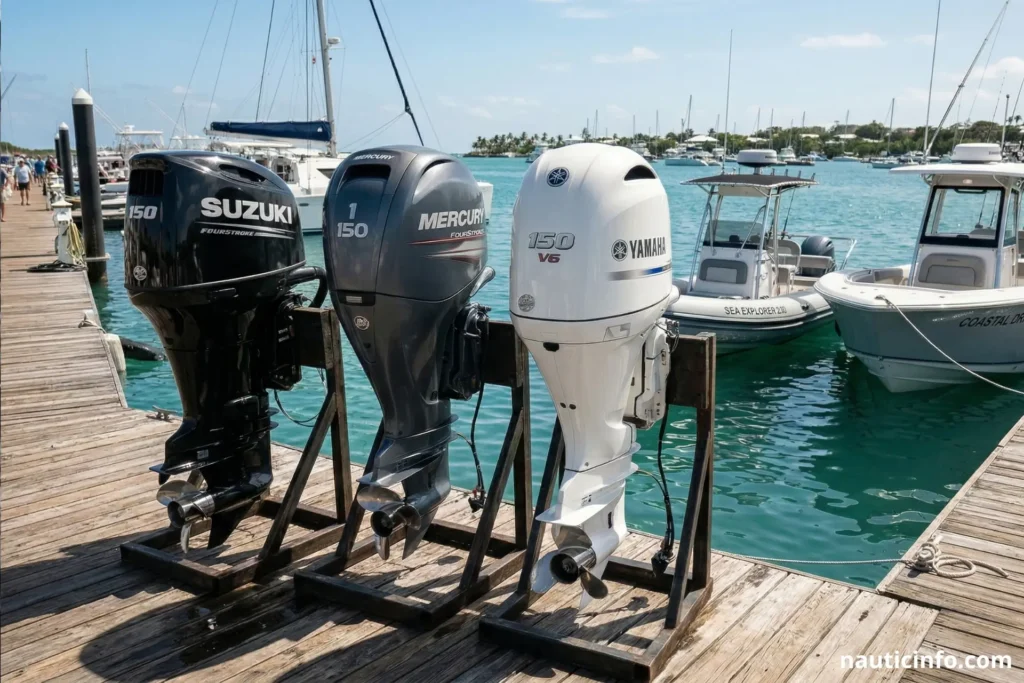
The Evolution of the 150 HP Outboard in Modern Boating
Historically, outboard engines in the 135 to 150 horsepower range have represented the most vital and fiercely contested segment for global marine engine manufacturers. Furthermore, this specific class of outboard engine is universally utilized to power a vast array of vessels. Ranging from 18-foot aluminum trailer boats to 22-foot fiberglass center consoles, powered catamarans, and heavy-duty Rigid Inflatable Boats (RIBs).
Consequently, given the massive sales volume and intense global market demand, every major brand invests heavily in optimizing their 150 HP outboard offerings to secure market dominance. This competition drives the rapid innovation we see today in materials and electronic integration.
Transom Weight and Dynamic Vessel Stability
Specifically, when outfitting a modern center console or a performance RIB, dynamic weight balance on the transom is a paramount engineering concern. Therefore, bolting on an engine that is excessively heavy can severely compromise the vessel’s static stability, lower the aft scuppers dangerously close to the waterline, and negatively impact the dynamic handling characteristics in following seas.
Conversely, an engine that is too light or significantly underpowered will struggle to push a fully loaded center console onto a plane, especially when the vessel is burdened with full livewells, heavy offshore fishing gear, and a full crew. Therefore, a modern four-stroke 150 HP outboard provides exactly enough thrust to get a vessel on a plane quickly, tow water skiers efficiently, and cruise at a comfortable speed without adding excessive bulk.
Technological Trickle-Down and Premium Features
Moreover, recent technological advancements have transformed these mid-range motors into highly sophisticated, computer-controlled machines. Specifically, premium features such as digital throttle and shift (drive-by-wire), integrated electro-hydraulic steering, and adaptive lean-burn fuel mapping were previously reserved exclusively for massive V6 and V8 flagship outboards.
However, manufacturers have recently cascaded these premium innovations down to the 150 HP outboard tier. Ultimately, this technological trickle-down means that today’s boaters have access to an incredibly refined, powerful, and fuel-efficient selection of engines that maximize time on the water while minimizing operational stress.
Yamaha F150: The 150 HP Outboard Benchmark of Reliability
Undoubtedly, the Yamaha F150 holds the prestigious title as the world’s best-selling 150-horsepower four-stroke outboard engine, dominating global sales charts since its original debut in 2003. Furthermore, Yamaha earned its legendary reputation in both the commercial and recreational sectors through decades of bulletproof reliability and proven mechanical longevity. Specifically, it is incredibly common to see Yamaha F150s on commercial docks, sea tow vessels, or water taxis surpassing the 3,000-hour operational mark with only routine, scheduled maintenance.
However, Yamaha has not rested on its historical legacy; the latest iterations of the F150 are thoroughly modernized and engineered for contemporary hull designs. Currently, the lineup is strategically split into mechanical and digital variants to accommodate both simple repower applications and high-tech new boat builds. Specifically, the mechanical version utilizes a proven 2.7-liter inline-four cylinder block, whereas the advanced Digital Electronic Control (DEC) version steps up to a slightly larger 2.8-liter displacement. Additionally, both powerheads feature a sophisticated 16-valve Dual Overhead Cam (DOHC) design, utilizing four valves per cylinder to maximize volumetric breathing efficiency and overall power output.
Furthermore, Yamaha seamlessly integrates its unique Variable Camshaft Timing (VCT) into these advanced powerheads. Consequently, this system actively advances or retards the camshaft timing to dramatically improve intake and exhaust efficiency, substantially boosting torque across the entire low-to-mid RPM range. Therefore, boaters experience a remarkably smooth and strong acceleration curve from the exact moment the throttle is applied, eliminating the sluggish mid-range “bog” found in older four-stroke designs.
Electrical Capabilities of the Yamaha 150 HP Outboard
Additionally, raw electrical output is a major consideration for modern boaters running multiple multifunction displays (MFDs), high-draw livewell pumps, radar systems, and advanced sonar arrays. Consequently, Yamaha equips the mechanical 2.7L F150 with a robust 35-amp alternator, while the digital 2.8L DEC model features an upgraded, high-output 50-amp alternator. Furthermore, the DEC models are fully compatible with Yamaha’s exclusive Helm Master EX system. Specifically, this digital suite provides advanced autopilot functions and intuitive joystick piloting capabilities, rendering dockside maneuvering effortless even in heavy crosswinds or swift currents.
Pro Tip: If you are repowering an older center console that already has mechanical throttle cables and analog gauges, the 2.7L mechanical Yamaha F150 is the most cost-effective plug-and-play solution. However, if you are building a new RIB and demand autopilot integration, the 2.8L DEC model is absolutely essential.
Mercury 150 FourStroke and Pro XS: Lightweight 150 HP Outboard Muscle
Conversely, Mercury Marine approaches the 150 HP outboard segment with a distinctly different engineering philosophy: maximum displacement combined with absolute minimum weight. Specifically, both the standard Mercury 150 FourStroke and the aggressive, performance-tuned Mercury 150 Pro XS utilize a massive 3.0-liter inline-four cylinder block. Furthermore, despite boasting the largest physical displacement in the 150 HP class, the Mercury outboards are engineered to be incredibly light. Specifically, the lightest available 20-inch shaft model tips the scales at a mere 455 to 456 pounds. Consequently, this exceptional power-to-weight ratio yields smooth, effortless thrust that is highly favored for weight-sensitive RIBs and smaller aluminum or fiberglass fishing hulls.
Moreover, Mercury designed this engine with a simplified 8-valve Single Overhead Cam (SOHC) architecture. Consequently, this streamlined design requires almost 15% fewer internal moving parts than its nearest 16-valve DOHC competitors, resulting in a completely maintenance-free valve train. Therefore, long-term ownership costs and professional servicing times are significantly reduced, which represents a major advantage for practical, budget-conscious boaters. Additionally, to support power-hungry modern electronics, the Mercury 150 is equipped with a massive 60-amp belt-driven alternator. Furthermore, Mercury includes its brilliant Idle Charge battery-management technology; this system automatically monitors battery voltage and incrementally increases engine idle RPMs if the voltage drops, ensuring the alternator generates sufficient power to recharge the system while drifting or trolling.
The Performance Edge of the Pro XS 150 HP Outboard
However, for boaters seeking aggressive acceleration, tournament-level hole shots, and high top-end speeds, the Mercury 150 Pro XS variant offers a distinct operational advantage over the standard FourStroke. Specifically, the Pro XS is inherently performance-biased, featuring an increased Wide Open Throttle (WOT) operating range of 5200 to 6000 RPM, compared to the standard model’s 5000 to 5800 RPM limit. Furthermore, the Pro XS is exclusively equipped with Mercury’s Transient Spark Technology. Specifically, this software innovation electronically manipulates and advances spark plug timing during hard, sudden acceleration to optimize low-end combustion power, resulting in unmatched torque when pushing heavy loads onto a plane.
Additionally, the Pro XS utilizes a mechanically lower 2.08:1 gear ratio, whereas the standard FourStroke uses a 1.92:1 ratio. Consequently, this allows the Pro XS to spin the propeller faster for explosive off-the-line performance. Moreover, the Pro XS features a performance-inspired gearcase equipped with four extra water pickups on the nose cone. Therefore, this enables the engine to be mounted significantly higher on a hydraulic jack plate without sacrificing vital cooling water flow, which ultimately reduces hydrodynamic drag and increases top speed.
Suzuki DF150A and AP: The High-Torque 150 HP Outboard Fuel Miser
Meanwhile, Suzuki Marine has systematically built a devout global following among commercial operators, sea-rescue teams, and offshore anglers by prioritizing rugged mechanical innovation, massive torque, and unparalleled fuel economy. Specifically, the Suzuki DF150A (mechanical) and DF150AP (digital drive-by-wire) are based on a formidable inline-four, 16-valve DOHC “Big Block” engine featuring a 2.9-liter (2867cc) displacement. Furthermore, Suzuki engineered this engine block with an exceptionally high 10.2:1 compression ratio, drawing heavily on their motorsport heritage. Consequently, this high-compression design extracts maximum thermodynamic efficiency from the combustion process, generating tremendous low-end torque right off idle.
Moreover, Suzuki’s signature, patented engineering marvel is its offset driveshaft design. Specifically, the engine powerhead is positioned further forward relative to the steering axis and clamp bracket, which actively moves the outboard’s center of gravity closer to the boat’s transom. Therefore, this unique design dramatically reduces steering vibration and significantly improves the static balance of the vessel. Consequently, this offset architecture provides the physical space necessary for Suzuki to implement a two-stage gear reduction system. By mechanically reducing gear speeds once at the crankshaft (30:36 ratio) and again in the lower unit gearcase (12:25 ratio), the Suzuki DF150 achieves a class-leading 2.50:1 final drive ratio. Ultimately, this extreme gear reduction enables the motor to effortlessly turn a much larger diameter propeller, translating internal engine power into raw, gripping thrust rather than simply slipping in the water.
Lean Burn Technology in the Suzuki 150 HP Outboard
Additionally, Suzuki currently sets the marine industry standard for fuel conservation via its proprietary Lean Burn Control System. Specifically, an advanced onboard 32-bit Engine Control Module (ECM) networks continuously with a sophisticated O2 sensor situated in the exhaust tract to monitor operating conditions in real-time. Consequently, during steady, mid-range cruising speeds, the ECM actively leans out the air-to-fuel ratio, delivering a highly precise, fuel-starved mixture that burns incredibly efficiently without sacrificing RPMs. Therefore, owners and independent testers consistently report up to a 15% reduction in overall fuel consumption at mid-range cruise compared to standard EFI engines from competitors.
Furthermore, the premium Suzuki DF150AP model includes Suzuki Precision Control, which is a frictionless electronic throttle and shift system that completely eliminates cable binding. Specifically, this AP model also boasts Suzuki Selective Rotation. This is a world-first technology that allows the exact same outboard engine to operate in either standard clockwise rotation or counter-clockwise rotation simply by altering a wiring connector under the cowling and installing a counter-rotating propeller. Therefore, this brilliant innovation completely eliminates the need for boat builders or marine dealers to stock dedicated left-hand and right-hand engines for twin-engine offshore center console installations.
Head-to-Head 150 HP Outboard Specifications Comparison
To comprehensively evaluate and contrast these engineering marvels, a direct, side-by-side comparison of their foundational specifications is required. Consequently, the table below outlines the core technical metrics for the premium versions of each manufacturer’s 150 HP outboard offering, utilizing strict imperial measurements.
| Specification | Yamaha F150 DEC | Mercury 150 Pro XS | Suzuki DF150AP |
| Engine Architecture | Inline-4, 16-Valve DOHC | Inline-4, 8-Valve SOHC | Inline-4, 16-Valve DOHC |
| Displacement | 2.8 Liters (170.8 cu.in.) | 3.0 Liters (183.0 cu.in.) | 2.9 Liters (174.9 cu.in.) |
| Dry Weight (Lightest) | 522 lbs | 456 lbs | 531 lbs |
| Full Throttle RPM | 5000 – 6000 RPM | 5200 – 6000 RPM | 5000 – 6000 RPM |
| Gear Ratio | 2.00:1 | 2.08:1 | 2.50:1 (Two-Stage) |
| Alternator Output | 50 Amp | 60 Amp (Belt-Driven) | 44 Amp |
| Compression Ratio | 10.3:1 | Standard (Not Published) | 10.2:1 |
| Fuel Delivery | Multi-Point EFI | Computer Controlled EFI | Multi-Point Sequential EFI |
| Steering Compatibility | Integrated Electro-Hydraulic | Mechanical / Standard Hydraulic | Mechanical / Standard Hydraulic |
| Control System | Digital (Drive-by-Wire) | Mechanical Cable | Digital (Drive-by-Wire) |
| Engine Oil Capacity | 4.8 Quarts | 6.3 Quarts | 8.5 Quarts |
Pro Tip: When analyzing outboard weight, always account for the rigging hardware. While the Mercury is 66 pounds lighter than the Yamaha on paper, adding a heavy external hydraulic steering cylinder to the Mercury narrows that physical weight gap considerably when compared to Yamaha’s integrated system.
Steering and Rigging a Modern 150 HP Outboard
When outfitting a modern 22-foot center console or a premium RIB, the steering mechanism and rigging hardware are arguably just as important as the combustion engine itself. Historically, outboard motors utilized messy, exposed hydraulic hoses connected to a bulky, external steering cylinder bolted directly to the front of the engine bracket. Today, seamless structural integration is the new marine industry standard.
Yamaha’s Integrated Steering vs. Bolt-On Systems
Without question, Yamaha currently leads the 150 HP outboard class in steering rigging integration. Recently, Yamaha introduced updated F150 models featuring built-in steering mechanisms completely concealed within the engine bracket itself. Specifically, boaters can choose the standard F150 with Integrated Hydraulic Steering (IHS) for mechanical control setups, or the ultimate F150 DEC with Integrated Electro-Hydraulic Steering (IEHS).
Consequently, by physically moving the hydraulic cylinder inside the transom bracket, Yamaha entirely eliminates the external steering ram. Therefore, the transom and the splash well remain entirely uncluttered, drastically reducing the risk of vital hydraulic parts suffering impact damage or saltwater corrosion. Furthermore, the IEHS system on the digital models communicates seamlessly with Yamaha’s Helm Master EX software network. This digital handshake allows for infinitely adjustable steering friction, true autopilot tracking, and intuitive joystick control without adding any third-party steering hardware to the bilge.
Conversely, both Mercury and Suzuki still rely heavily on traditional bolt-on hydraulic steering cylinders (such as SeaStar or Uflex systems) for their 150 HP models, although integrated steering is widely available on their massive 300+ HP V8 and V6 flagships. However, both brands still offer exceptional digital throttle and shift technologies that enhance the helm experience.
Specifically, the Suzuki DF150AP utilizes Suzuki Precision Control, a highly refined drive-by-wire system that entirely eliminates sticky, degrading mechanical throttle cables, yielding silky-smooth shifting and instantaneous throttle response. Additionally, Mercury’s SmartCraft digital architecture allows the Pro XS to interface perfectly with brilliant VesselView touchscreen displays. Consequently, this provides the captain with real-time engine telemetry, Troll Control for micro-adjusting RPMs while live-bait fishing, and seamless digital fault monitoring.
Propeller Dynamics for Your 150 HP Outboard
Furthermore, it is absolutely critical to understand how varying gear ratios directly impact propeller tuning and ultimate boat performance. Specifically, a marine propeller is defined by two primary measurements: diameter and pitch (e.g., a propeller stamped 14 x 19 signifies a 14-inch diameter with a 19-inch pitch). Pitch represents the theoretical forward distance, in inches, that the propeller travels in one complete revolution through a solid medium.
As a universal golden rule in marine rigging, altering the pitch by 1 inch inversely changes the engine’s WOT RPM by approximately 150 to 200 RPM. This delicate balance is the key to optimizing your engine’s power curve according to your boat’s weight.
The Suzuki Approach: High Torque and Large Gear Reduction
Because Suzuki utilizes a massive 2.50:1 gear reduction, the propeller shaft turns significantly slower than the actual engine crankshaft. Consequently, to achieve a respectable top speed, a Suzuki DF150 must run propellers with massive pitch angles (often 23 to 26 inches) to mathematically compensate for the slower shaft rotational speed.
However, there is a physical hydrodynamic limit to how much pitch can be added to a blade before efficiency severely drops due to slip. This is why Suzuki engineers designed the “Offset Driveshaft” to accommodate larger diameter props that maintain grip even with aggressive pitches.
Speed vs. Thrust: Choosing the Right Gear Ratio
Therefore, Mercury and Yamaha, with their respective 2.08:1 and 2.00:1 gear ratios, spin the propeller shaft much faster relative to engine speed. Consequently, this allows them to utilize more common, highly optimized mid-pitch propellers (ranging from 17 to 21 inches) to easily achieve thrilling top speeds on lighter hulls.
However, the Suzuki’s large gear reduction is not a flaw; it is a deliberate feature. The 2.50:1 ratio allows the Suzuki to swing a propeller with a much larger diameter and more blade area. Consequently, it grips the water with the tenacity of an aggressive mud tire, translating torque into massive thrust without ventilating. Thus, for a heavy 22-foot RIB loaded with dive tanks, the Suzuki provides the best raw pushing power, whereas the Mercury Pro XS remains the king of blistering top speed for light, aerodynamic bass boats.
Fuel Consumption and 150 HP Outboard Efficiency
Undeniably, fuel economy is a dominant operational factor for offshore anglers running center consoles far into the ocean, or for recreational RIB owners exploring remote coastal islands without marina access. Generally, a modern internal combustion marine engine burns approximately 10% of its rated horsepower in gallons per hour (GPH) when operating at Wide Open Throttle. Therefore, a 150 HP engine will inherently consume roughly 15.0 to 16.5 GPH at maximum RPM, almost regardless of the specific manufacturer.
However, prudent boaters rarely run at WOT for extended periods. Instead, approximately 90% of marine operation occurs in the mid-range cruising RPMs (typically spanning from 3500 to 4500 RPM). Here, massive differences in software engineering and fuel mapping philosophies emerge, fundamentally altering the cost of a weekend trip.
Specifically, the Suzuki DF150 shines brilliantly in this specific category. Its Lean Burn Control System anticipates fuel requirements based on load and actively starves the combustion chamber of excess gasoline when full torque is no longer required to maintain a plane. Consequently, rigorous independent tests consistently demonstrate that Suzuki outboards achieve up to 15% better fuel economy at cruising speeds compared to their Yamaha and Mercury counterparts.
Furthermore, while Mercury utilizes its SmartCraft technology to monitor and optimize fuel delivery, its software approach is generally more reactive to throttle input rather than relying on Suzuki’s predictive Lean Burn algorithms. Additionally, the Mercury Pro XS is inherently tuned for aggressive performance; therefore, its advanced spark timing maps consume slightly more fuel under heavy acceleration loads to prioritize speed over efficiency. Conversely, Yamaha’s F150 is highly efficient but lacks the dedicated, aggressive Lean Burn architecture of the Suzuki, placing it squarely in the middle of the pack for overall Miles Per Gallon (MPG).
Comparative Fuel Burn Estimates (20-22 ft Center Console)
To provide a concrete understanding of operational costs, the table below illustrates approximate fuel consumption at various throttle stages.
Note: Data represents aggregated averages across similar hull types. Actual Gallons Per Hour (GPH) fluctuates based on wind, current, vessel load, and trim tab deployment.
| Operating State | Average Engine RPM | Yamaha F150 GPH | Mercury Pro XS GPH | Suzuki DF150 GPH |
| Idle / Trolling | 1000 RPM | 0.7 GPH | 0.9 GPH | 0.6 GPH |
| Efficient Cruise | 3500 RPM | 5.0 GPH | 4.7 GPH | 4.2 GPH |
| Fast Cruise | 4500 RPM | 8.2 GPH | 8.0 GPH | 7.5 GPH |
| Wide Open Throttle | 5800-6000 RPM | 15.5 GPH | 15.8 GPH | 15.2 GPH |
Maintenance, Durability, and 150 HP Outboard Ownership Costs
Ultimately, owning a vessel requires strict adherence to seasonal maintenance schedules, and the underlying engineering of the powerhead dictates the long-term financial cost of ownership. All three manufacturers unequivocally recommend standard servicing every 100 hours or annually, whichever comes first. However, the mechanical realities beneath the cowlings vary drastically, impacting both DIY mechanics and professional labor costs.
Oil and Fluid Capacities
Surprisingly, required engine oil capacities differ significantly between the brands, directly impacting the cost of an oil change. Specifically, the Yamaha F150 requires a highly modest 4.8 quarts of marine oil. In contrast, the Mercury 150 demands a slightly higher 6.3 quarts. Astoundingly, the Suzuki DF150 requires a massive 8.5 quarts of engine oil to fill its sump. While Suzuki’s massive oil capacity allows for superior thermal regulation and excellent contaminant suspension within the engine block during grueling commercial use, it substantially increases the material cost of a standard 100-hour oil change.
Belts, Chains, and Valve Trains
Furthermore, timing systems represent a critical point of divergence in engine longevity. The Yamaha F150 utilizes a traditional, heavy-duty timing belt. While incredibly reliable in practice, belts are rubber-based components that eventually stretch, fray, or degrade over time, requiring professional replacement at specified hourly intervals to prevent catastrophic engine failure.
Conversely, Suzuki employs a heavy-duty, self-adjusting steel timing chain that runs continuously in an oil bath. Consequently, the Suzuki timing chain is considered entirely maintenance-free for the functional life of the engine, representing a significant long-term financial saving and providing immense peace of mind to offshore operators.
However, Mercury claims a massive victory in overall architectural simplicity. The Mercury 150 utilizes an 8-valve SOHC design, which completely eliminates the complex mechanical clearances associated with the 16-valve DOHC engines utilized by Yamaha and Suzuki. Specifically, Mercury’s simplified valve train is completely maintenance-free, entirely negating the need for costly, labor-intensive mechanical valve clearance adjustments over the engine’s lifespan. Moreover, Mercury engineered a spill-free oil drain system and a conveniently located, top-mounted fuel filter to ensure that routine 100-hour services can be easily and cleanly performed by the boat owner in their own driveway, saving hundreds of dollars in dealership labor.
Noise Levels and Acoustic Refinement
Additionally, the auditory experience is a crucial aspect of marine comfort, particularly on open center consoles where passengers sit close to the transom. Historically, four-stroke engines banished the smoky, deafening era of two-strokes, but modern outboards still vary heavily in acoustic refinement.
Specifically, Suzuki places a heavy emphasis on acoustic dampening. The DF150 incorporates an advanced intake resonator that physically suppresses induction noise, while a counter-balancer system neutralizes secondary vibrations inherent to inline-four architectures. Consequently, independent decibel testing reveals that the Suzuki is astonishingly quiet at idle, registering a barely audible 63.5 dB.
Conversely, Mercury took a radically different path with the Pro XS line. Recognizing that tournament anglers and performance boaters genuinely enjoy a visceral, mechanical connection to their engine, Mercury actively tuned the exhaust on the Pro XS to produce a throaty, sportscar-like growl upon startup and rapid acceleration. Therefore, while the standard Mercury 150 FourStroke is relatively quiet, the Pro XS is intentionally louder, bolder, and more aggressive by design.
Furthermore, Yamaha strikes an elegant, sophisticated balance. The F150 features an air silencer box and a surge tank specifically engineered to reduce air intake turbulence and whistling. Moreover, Yamaha incorporates its proprietary Shift Dampener System (SDS) into its matched propellers. This innovative splined rubber hub absorbs the harsh mechanical “clunk” commonly associated with shifting gears from neutral into forward or reverse. Therefore, the Yamaha offers the most refined, vibration-free shifting experience in the 150 HP class, making it ideal for continuous maneuvering around tight marinas.
Pros and Cons of Each 150 HP Outboard
To distill the intricate mechanical data, fuel charts, and performance metrics into an actionable format, the following comprehensive table summarizes the primary advantages and drawbacks of each motor when applied to a center console or RIB platform.
| Outboard Model | Core Advantages | Primary Drawbacks |
| Yamaha F150 | • Legendary commercial reliability & massive global dealer network • Superior integrated steering (IHS/IEHS) cleans up the transom perfectly • Full Helm Master EX joystick and autopilot compatibility • Whisper-smooth, clunk-free shifting via SDS propellers | • Utilizes a rubber timing belt that requires eventual replacement • Physically heavier than the Mercury equivalent • Mechanical models possess a lower 35-amp alternator output |
| Mercury 150 Pro XS | • Lightest in class (456 lbs), absolutely perfect for weight-sensitive RIBs • Largest displacement (3.0L) yields massive, aggressive hole-shot • Maintenance-free valve train drastically lowers long-term ownership costs • High 60-amp alternator output easily supports modern electronics | • Louder, performance-tuned exhaust note isn’t ideal for quiet cruising • Lacks an integrated steering bracket option in the 150 HP class • Fuel economy at mid-range cruise falls slightly behind Suzuki |
| Suzuki DF150AP | • Lean Burn technology offers unmatched, class-leading mid-range MPG • Massive 2.50:1 gear ratio swings large props to move heavy loads easily • Self-adjusting steel timing chain is entirely maintenance-free • Selective rotation allows a single engine to turn left or right | • Heaviest outboard in the class (up to 531 lbs) • Requires a massive 8.5 quarts of synthetic oil for routine changes • Smaller certified dealer network in some rural coastal regions |
NauticInfo Verdict: Choosing Your Next 150 HP Outboard
Ultimately, declaring a single, objective “best” outboard motor is an exercise in futility, as marine engineering always demands careful trade-offs between weight, torque, and complexity. Therefore, the optimal 150 HP outboard depends entirely on the specific hull it will push, the typical payload it will carry, and the primary desires of the captain at the helm.
If you are outfitting a lightweight, high-performance RIB or a sporty aluminum fishing boat…
You should unequivocally choose the Mercury 150 Pro XS. Specifically, its class-leading low weight (456 lbs) will perfectly preserve the delicate static balance of an inflatable tube hull, preventing the stern from squatting at rest. Furthermore, the massive 3.0-liter displacement and Transient Spark Technology will catapult a lightweight RIB onto a plane instantly, while the higher 6000 RPM limit and performance gearcase guarantee the most thrilling top-end speeds available in this horsepower bracket.
If you run long offshore distances and prioritize maximum fuel economy and torque…
The Suzuki DF150AP is the undisputed champion of the long offshore haul. Specifically, when pushing a heavy, deep-V fiberglass center console loaded with ice, bait, and a full crew, the Suzuki’s massive 2.50:1 gear reduction provides the raw, gripping torque required to maintain a steady plane in rough seas. Most importantly, the advanced Lean Burn Control System operates flawlessly in the 4000 RPM cruising range, allowing offshore anglers to stretch their fuel tank range significantly further than the competition, ensuring a safe return to port.
If you desire premium refinement, a pristine transom, and absolute, bulletproof reliability…
The Yamaha F150 DEC is the absolute pinnacle of polished marine engineering. Specifically, for modern boaters who hate cluttered splash wells and exposed hydraulic hoses, Yamaha’s Integrated Electro-Hydraulic Steering is a masterpiece of clean, functional design. Furthermore, the whisper-smooth operation, seamless plug-and-play compatibility with the Helm Master EX joystick system, and an unparalleled global reputation for surviving thousands of hours in brutal saltwater environments make the Yamaha the safest, most refined, and highest-resale investment in the 150 HP outboard class.