

The Ultimate Buyer’s Guide to the Best Boat Grills and Planchas 2026
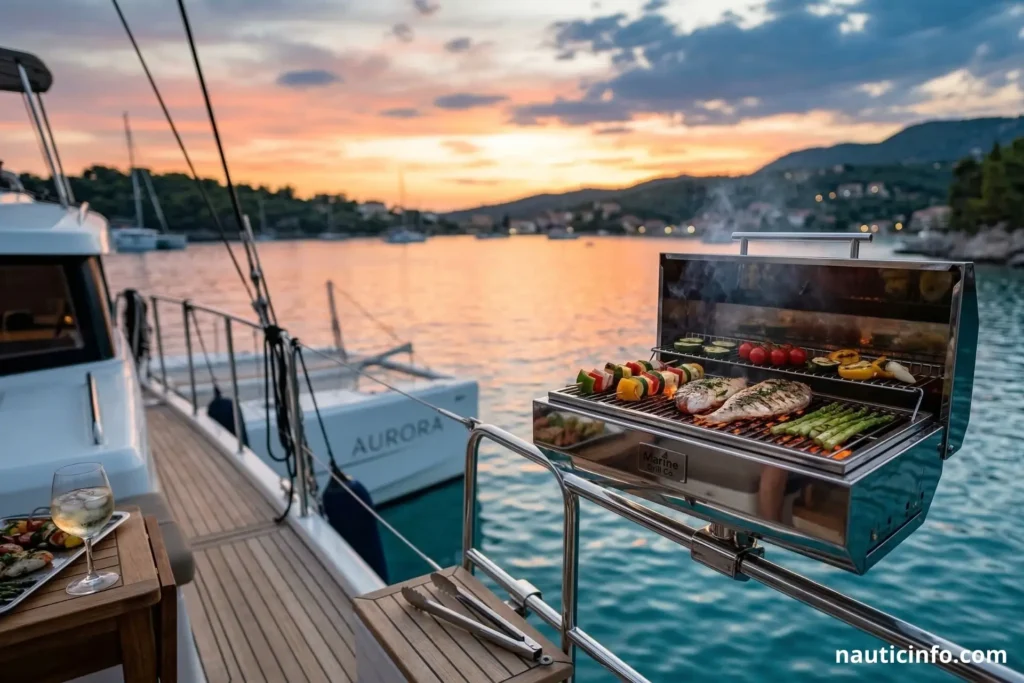
Selecting the ideal marine cooking apparatus demands a rigorous, uncompromising understanding of advanced metallurgy, fluid thermodynamics, and complex maritime safety protocols. Furthermore, the unforgiving saltwater environment relentlessly attacks inferior materials, making genuine marine-grade stainless steel an absolute necessity for any serious vessel. Consequently, this exhaustive research report evaluates the leading gas, charcoal, and electric options, alongside dedicated flat-top griddles and structural mounting systems. Best boat grills and planchas we provide deep technical analysis to ensure you equip your galley with the ultimate seaworthy equipment for the upcoming season.
Evolutionary Market Trends Shaping the Best Boat Grills and Planchas 2026
The marine culinary landscape has experienced a dramatic technological shift leading into the current boating season. Specifically, manufacturers are decisively moving away from traditional open-flame grates toward flat-top griddle surfaces, modular cooking ecosystems, and high-voltage electric platforms. Furthermore, the inherent physics of cooking on the open water present unique, highly complex challenges that terrestrial backyard barbecues never face. High wind shear rapidly strips convective heat away from standard cooking surfaces, while turbulent waves demand incredibly secure mounting hardware. Consequently, the marine industry has aggressively responded with advanced anti-blowout burners, engineered infrared radiant heat plates, and highly specialized marine-grade alloy constructions.
Moreover, regulatory bodies such as the United States Coast Guard (USCG) and the American Boat & Yacht Council (ABYC) have updated their critical safety guidelines regarding onboard combustion. Specifically, the ABYC A-1, A-3, and A-26 standards dictate stringent, non-negotiable rules for marine liquefied petroleum gas (LPG) systems and cooking appliances. Therefore, selecting a compliant device is no longer merely about culinary preference; rather, it is a strict matter of severe vessel safety and maritime insurance compliance. Additionally, as high-performance pontoon boats and luxury center consoles grow exponentially in popularity, the demand for high-capacity, deck-mounted culinary systems has surged concurrently. Thus, understanding the precise technical specifications, thermal dynamics, and structural limitations of these units is paramount for any boat owner aiming to upgrade their vessel.
Metallurgical Science Behind the Best Boat Grills and Planchas 2026
The absolute longevity of any marine accessory is entirely dependent upon its underlying metallurgical composition. Specifically, top-tier marine cooking appliances utilize 18-8 or 304 marine-grade stainless steel. Furthermore, the numerical designation “18-8” indicates an advanced alloy composed of exactly 18 percent chromium and 8 percent nickel. Consequently, this specific atomic ratio provides exceptional, long-lasting resistance to the highly corrosive effects of airborne coastal salinity and direct saltwater spray. When exposed to oxygen, the chromium rapidly forms a microscopic, passive layer of chromium oxide that shields the underlying iron from oxidizing.
However, raw material composition alone does not guarantee survival on the corrosive ocean. Moreover, the physical finish of the steel plays a critical, often overlooked role in preventing rust propagation. Leading marine manufacturers deliberately employ a mirror-polished finish, specifically adhering to the #8 high-polished standard, to completely eliminate microscopic crevices on the metal’s surface. Consequently, abrasive salt crystals and acidic moisture have zero microscopic anchor points to initiate the rapid oxidation process. In contrast, brushed or satin finishes, while aesthetically pleasing in terrestrial kitchens, inherently possess microscopic manufacturing striations that can harbor corrosive marine elements. Therefore, a mirror-polished 304 stainless steel shell remains the absolute, undisputed gold standard for maritime durability and thermal longevity.
Thermodynamic Engineering and Wind Shear Mitigation
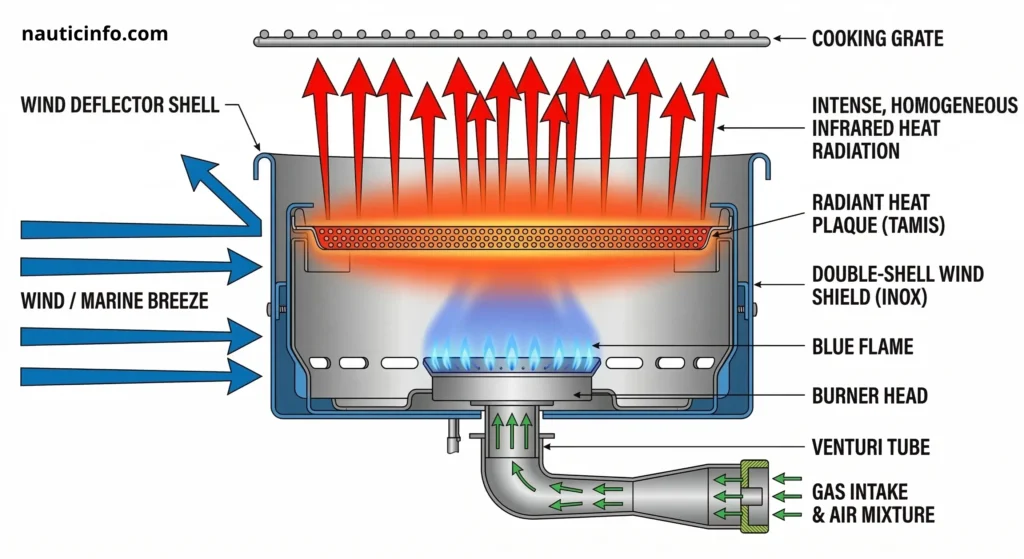
Producing and maintaining high cooking temperatures in a dynamic, windy marine environment requires sophisticated thermodynamic engineering. Specifically, standard convective gas burners lose massive amounts of thermal energy the moment a coastal breeze sweeps across the cooking deck. Consequently, premium marine brands have developed highly specialized venturi tubes and proprietary anti-blowout burner assemblies. Furthermore, these precision-machined tubes expertly mix vaporized propane with ambient oxygen deep within a sheltered firebox, preventing crosswinds from starving or extinguishing the primary flame.
Additionally, advanced models incorporate double-lined stainless steel inner shells. Specifically, this double-wall construction traps an insulating layer of ambient air between the combustion chamber and the exterior housing. Therefore, it effectively prevents severe exterior heat discoloration and keeps the outside of the unit relatively cool to the touch, drastically reducing accidental burn hazards on crowded boat decks. Moreover, cutting-edge models now utilize infrared radiant screens. Consequently, these screens absorb raw convective gas heat and re-emit it as highly intense, directional infrared energy, which is virtually impervious to wind shear. Thus, infrared technology represents a massive leap forward in marine thermal efficiency.
Premium Gas Models Defining the Best Boat Grills and Planchas 2026
Gas-powered systems absolutely dominate the marine market due to their rapid ignition capabilities, predictable heat curves, and incredibly minimal cleanup requirements. Specifically, utilizing standard 1-pound disposable liquid propane canisters offers a highly portable, easily sourced fuel solution for boaters. Furthermore, premium marine manufacturers engineer these specialized units with swiveling control valves that allow for the safe, ergonomic exchange of fuel canisters even when the vessel is pitching in heavy seas.
Magma Cabo and Chefsmate: Compact Heavyweight Competitors
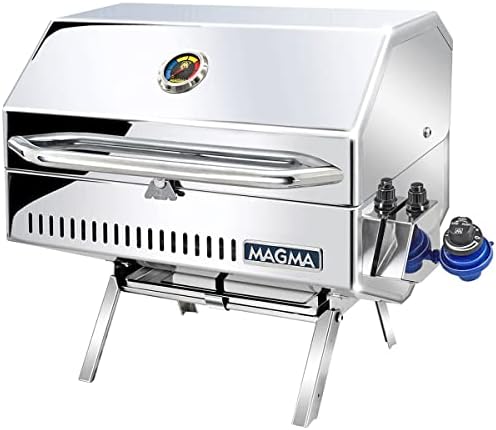
Magma Products continues to overwhelmingly dictate the baseline for marine culinary quality. Specifically, the Magma Cabo Gas Grill represents the absolute pinnacle of compact, portable utility. Furthermore, this meticulously engineered unit features a 162 square-inch primary cooking surface and delivers a robust, concentrated 11,200 BTUs of heat energy. Consequently, the Cabo is engineered with a proprietary anti-blowout turbo venturi tube, ensuring the localized flame remains powerfully lit even in stiff, unpredictable coastal breezes. Moreover, it features a heavy-duty lockable lid and a draw-tight latch, securely battening down the internal components when the vessel is violently slamming through heavy offshore ocean swells.
However, boaters requiring more extensive fuel flexibility often upgrade to the closely related Magma Chefsmate. Specifically, the Chefsmate shares the exact same 162 square-inch sectional cooking grid and 11,200 BTU thermal output, but it incorporates the highly desired double-lined stainless steel inner shell. Consequently, this double-wall construction aggressively insulates the outer housing. Additionally, the Chefsmate is uniquely and safely adaptable; it can run on 1-pound disposable propane, plumbed onboard low-pressure propane (LPG), or even Compressed Natural Gas (CNG). Therefore, CNG presents a highly desirable safety profile because its vapor is significantly lighter than ambient air, allowing it to dissipate harmlessly upward rather than pooling dangerously in the deep hull.
The Magma Infrared Series: Monterey II, Newport 2, and Catalina II
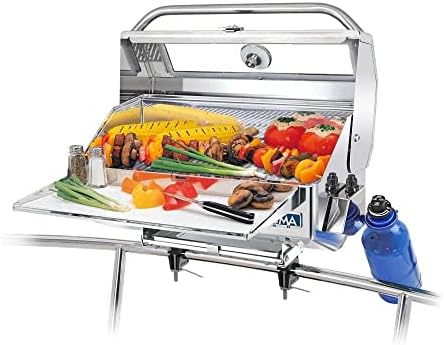
For culinary enthusiasts demanding absolute perfection at sea, Magma’s Infrared series introduces restaurant-grade searing capabilities to the cockpit. Specifically, the Magma Marine Monterey II Infrared Gas Grill stands as the flagship model, boasting an enormous 420 square-inch total cooking area (288 primary, 132 secondary). Furthermore, this colossal unit generates a blistering 18,000 BTUs of grilling surface energy. Consequently, the Monterey II utilizes sophisticated stainless steel dual-element infrared radiant screens. These critical screens ensure perfectly even heat distribution across the entire massive cooking surface and are highly instrumental in physically vaporizing drippings to instantly reduce dangerous grease flare-ups.
Moreover, the Monterey II is equipped with an ultra-high temperature glass viewing window and a hermetically-sealed, analog stainless steel thermometer. Therefore, the chef can precisely monitor food progress without opening the lid, thereby preventing massive convective heat loss in windy environments. Additionally, the series includes the smaller Newport II (162 square inches, 11,200 BTUs) and the mid-sized Catalina II (315 square inches, 12,500 BTUs). Thus, boaters can meticulously scale their infrared cooking capacity to exactly match their vessel’s physical deck constraints.
Dickinson Sea-B-Que Large and Small: Rugged Offshore Utility
For large commercial vessels, trawlers, and heavy offshore cruisers requiring immense, unyielding durability, the Dickinson Sea-B-Que Large stands completely apart from lighter recreational competition. Specifically, this massive, imposing unit is constructed from exceptionally heavy 20-gauge grained 304 marine-grade stainless steel. Furthermore, its unique, visually striking octagonal architecture is structurally engineered to maximize chassis rigidity and completely prevent wind-induced flame-outs via advanced aerodynamic deflection.
Moreover, the Sea-B-Que Large provides a sprawling 11 by 20-inch primary cooking surface, translating to exactly 220 square inches of culinary real estate. Consequently, its robust, heavy-duty burner pushes an impressive 11,000 BTUs, reliably generating searing temperatures even in the harshest, freezing northern latitudes. Additionally, the sheer density of the materials means the unit weighs a substantial 30 lbs, explicitly highlighting its thick-gauge construction. Therefore, it is highly favored by serious offshore anglers who demand uncompromising thermal performance. Alternatively, the Sea-B-Que Small offers the identical octagonal geometry and rugged 20-gauge construction but scales the output down to 10,000 BTUs across a 148 square-inch grilling area, weighing a more manageable 18 lbs.
Kuuma Stow N’ Go Series: Value-Driven Best Boat Grills and Planchas 2026
While premium, mirror-polished models command predictably premium prices, the Kuuma Stow N’ Go Elite 216 aggressively disrupts the marine market by offering massive cooking capacity at a significantly lower price point. Specifically, this highly capable unit generates an impressive 13,000 BTUs across a 216 square-inch total cooking area, which ingeniously includes a highly practical upper warming rack. Furthermore, unlike the entry-level Magma Cabo which relies on archaic match-lighting, the Kuuma Elite comes standard with a highly reliable push-button electronic ignition and a built-in analog thermometer.
However, there is a distinct, measurable engineering trade-off for this exceptional value. Consequently, Kuuma utilizes a physically thinner gauge of 304 stainless steel compared to the heavy walls of Magma or Dickinson. Moreover, independent long-term testing indicates that while the Kuuma performs flawlessly out of the box, its thinner chassis is slightly more susceptible to surface oxidation if not rigorously and aggressively maintained. Nevertheless, for inland freshwater lake boaters, casual pontoon owners, and highly budget-conscious coastal cruisers, the Kuuma Stow N’ Go Elite 216 remains an incredibly powerful, versatile, and economically viable option.
| Premium Marine Gas Grills | Magma Monterey II | Magma Cabo | Dickinson Sea-B-Que Large | Kuuma Stow N’ Go Elite 216 |
| Material Grade | Mirror-Polished 304 SS | Mirror-Polished 304 SS | 20-Gauge 304 SS | 304 Stainless Steel |
| Total Cooking Area | 420 sq. in. | 162 sq. in. | 220 sq. in. | 216 sq. in. |
| Maximum Thermal Output | 18,000 BTUs | 11,200 BTUs | 11,000 BTUs | 13,000 BTUs |
| Heat Distribution Tech | Infrared Radiant Screens | Stainless Radiant Plate | Porcelain Grill Sections | Stainless Radiant Plate |
| Ignition System | Electronic Single Spark | Manual Match Light | Spark Igniter | Push-Button Electronic |
| Physical Weight | 33 lbs | 12 lbs | 30 lbs | 21 lbs |

The Rise of Flat-Tops: Griddles and the Best Boat Grills and Planchas 2026
The traditional, open-slatted cooking grate is rapidly losing market dominance to the solid-surface plancha, more commonly known in the United States as a griddle. Furthermore, planchas offer distinct, undeniable tactical advantages on a moving, wind-swept boat. Specifically, a solid steel or cast-iron cooking surface completely blocks atmospheric wind from ever reaching the delicate burner flames beneath it. Consequently, planchas maintain far more consistent, edge-to-edge surface temperatures. Moreover, they entirely eliminate the catastrophic risk of liquid grease dripping directly onto open flames, thereby completely neutralizing the dangerous flare-ups that routinely plague traditional slatted barbecues.
ENO Cook ‘n Boat Gas Plancha: European Cast-Iron Excellence
Leading the premium European yachting market and rapidly gaining massive traction in the US is the ENO Cook ‘n Boat Gas Plancha. Specifically, ENO is a highly prestigious, century-old French manufacturer globally renowned for its high-end marine galleys and specialized enameled cast-iron surfaces. Furthermore, the Cook ‘n Boat plancha utilizes an immensely heavy, highly heat-retentive cast-iron plate that is meticulously coated in a proprietary, multi-layer marine-grade enamel.
Consequently, this specific, highly engineered material choice completely prevents underlying rust while offering an unparalleled, naturally non-stick culinary surface. Moreover, because solid cast iron possesses massive thermal mass, the ENO plancha does not instantly drop in surface temperature when massive, cold proteins are placed upon it. Therefore, it delivers a vastly superior, restaurant-quality sear for thick steaks and freshly caught, deep-sea tuna. Additionally, the solid, unperforated surface allows boaters to effortlessly cook highly delicate items like cracked eggs, loose hash browns, and flaky white fish that would inevitably fall through the wide gaps of traditional wire grates.
Blackstone 17-Inch Marine Conversions: The Pontoon Phenomenon
For the massive pontoon and freshwater houseboat demographic, the Blackstone 17-inch portable griddle has become an absolute cultural phenomenon. However, standard terrestrial Blackstone units are explicitly not designed for highly corrosive marine environments. Consequently, the marine aftermarket has rapidly engineered custom, heavy-duty mounting solutions to safely adapt these beloved griddles to the water. Specifically, specialized 16-gauge carbon steel tables with textured, highly protective black powder-coated finishes are now explicitly manufactured to perfectly mate with the Blackstone 17-inch footprint.
Furthermore, these heavy-duty marine conversion kits feature towering 27-inch chrome-plated pedestals that securely lock into standard, flush-mount deck accessory bases. Therefore, pontoon owners can successfully establish a permanent, rigid, waist-high cooking station without dangerously balancing a heavy, hot griddle on unstable fiberglass seating or flammable carpets. Moreover, it is absolutely critical to note that the Blackstone’s rolled cold-steel surface requires highly aggressive, repeated seasoning with polymerized cooking oils to repel saltwater corrosion, demanding a significantly higher, more labor-intensive maintenance routine than standard stainless steel.
Magma Crossover Modular System: Unprecedented Culinary Versatility
Brilliantly bridging the technological gap between traditional wire-grate barbecues and dedicated flat-top planchas is the highly innovative Magma Crossover Series. Specifically, this highly advanced, fully modular cooking system begins with a highly robust foundation: either a single (CO10-101M) or double (CO10-102) high-output, brushed stainless steel marine firebox. Furthermore, boaters can seamlessly and instantly swap out massive, heavy-duty cooking tops based strictly on the day’s specific culinary requirements.
Consequently, a hungry crew can securely lock in the Crossover Plancha Top for a massive morning breakfast of pancakes and bacon, effortlessly swap to the traditional Grill Top for afternoon cheeseburgers, and finally transition to the highly insulated Crossover Pizza Oven Top for evening waterfront entertaining. Moreover, the complete Crossover system features a dedicated, highly engineered grease catch pan and heavy-duty heat diffusers, producing blistering cooking temperatures in roughly 8 minutes. Thus, it undeniably represents the most versatile, technologically advanced, and spatially efficient cooking ecosystem currently available to modern mariners.
Pro Tip: Plancha Temperature Management
When operating a solid plancha on a boat, heat retention is absolutely massive. Specifically, once a cast iron or thick steel griddle reaches 500 degrees Fahrenheit, it will remain dangerously hot for well over an hour after the fuel is completely severed. Consequently, never attempt to dismount, clean, or securely stow a marine plancha immediately after cooking. Furthermore, a sudden splash of cold seawater onto a blistering hot cast-iron plancha can cause catastrophic thermal shock, instantly cracking the heavy metal. Therefore, allow the unit to cool naturally in the ambient air for at least 45 minutes before initiating your topside cleanup routine.
| Modular & Plancha Systems | ENO Cook ‘n Boat | Blackstone 17″ (Marine Mount) | Magma Crossover (Single Firebox) |
| Cooking Surface Material | Enameled Cast Iron | Rolled Cold Steel | Cast Aluminum / Stainless Base |
| Primary Culinary Function | Dedicated Flat-Top | Dedicated Flat-Top | Multi-Modular (Grill, Plancha, Pizza) |
| Corrosion Resistance | Excellent (Enamel Shield) | Low (Requires Heavy Seasoning) | High (Brushed Stainless Steel) |
| Mounting Architecture | Tabletop / Custom Rail | Custom 27-inch Deck Pedestal | Magma LeveLock / Rail Compatible |
| Wind Deflection Capability | Superior (Solid Surface) | Good (Solid Surface) | Superior (Deep Firebox Integration) |
High-Voltage Innovations: Electric Best Boat Grills and Planchas 2026
As marine lithium-iron-phosphate (LiFePO4) battery technology and high-output inverter systems exponentially improve, marine cooking is experiencing a massive paradigm shift toward high-voltage electric appliances. Specifically, the Kenyon VDC 48V IntelliKEN represents a massive, unprecedented leap forward in the strictly electric category. Furthermore, this highly advanced unit operates entirely on a dedicated 48-volt direct current battery bank, drawing an intense 27 amps to produce a blistering 1300 watts of thermal energy.
Kenyon VDC 48V IntelliKEN: The Future of Battery-Powered Searing
Consequently, the Kenyon VDC 48V achieves searing surface temperatures exceeding 500 degrees Fahrenheit in less than 7 minutes, directly rivaling the thermal output of high-end propane systems. Moreover, it utilizes a patented, completely concealed electric heating element that remains in direct, physical contact with the non-stick cooking grate. Therefore, it utterly eliminates frustrating hot and cold zones, ensuring perfectly even, incredibly precise heat distribution across its entire 155 square-inch surface.
Additionally, electric units completely and entirely remove the severe, catastrophic hazards associated with open combustion flames, explosive heavier-than-air LPG vapors, and deadly carbon monoxide emissions. Thus, they easily exceed the most stringent ABYC safety standards for operation within enclosed or semi-enclosed vessels. Specifically, the 24-pound Kenyon unit features a highly waterproof digital touch control panel and a fail-safe automatic shut-off timer (set at 60 or 90 minutes). Further solidifying its absolute status as the safest, most technologically advanced marine cooker currently on the global market. Ultimately, for luxury yachts equipped with robust, high-capacity battery banks. The Kenyon VDC 48V eliminates the logistical nightmare of transporting highly explosive propane canisters entirely.
Traditional Charcoal Options Among the Best Boat Grills and Planchas 2026
Despite the overwhelming, undeniable convenience of pressurized gas and high-voltage electricity. Culinary purists still aggressively demand the authentic, deep, smoky flavor generated exclusively by burning raw hardwood lump charcoal or compressed briquettes. However, deploying raw, burning charcoal on a moving, wind-swept vessel introduces severe, unparalleled logistical and safety challenges. Specifically, burning, lightweight embers can be easily blown by sudden gusts directly onto highly flammable canvas bimini tops, exposed fiberglass decks, or auxiliary fuel tanks.
Magma Marine Kettle Charcoal Series: Flavor Versus Hazard
To meticulously mitigate these immense, catastrophic risks while preserving traditional flavor, Magma heavily engineered the Marine Kettle Charcoal Grill. Furthermore, this iconic, highly recognizable unit is available in a compact 15-inch Original size (yielding 177 square inches of grate) and a larger 17-inch Party size (yielding 227 square inches). Specifically, it is constructed from deep-drawn 18-8 mirror-polished stainless steel and features a perfectly balanced, mechanically hinged lid. Consequently, this highly aerodynamic clamshell design ensures the heavy lid will not slam shut violently and unexpectedly when the boat rolls violently in the deep trough of an ocean wave.
Moreover, the Marine Kettle ingeniously incorporates a secondary lower charcoal grate and a highly specialized, tightly sealed ash compartment. Therefore, blistering hot ash is safely and securely contained deep within the lower bowl. Drastically reducing the terrifying risk of a runaway deck fire. Additionally, an adjustable, rotating draft door provides reliable, precise volumetric airflow control to mechanically manipulate the internal cooking temperature.
However, post-cook maintenance for charcoal at sea remains highly tedious and heavily regulated. Specifically, stringent maritime environmental regulations and the USCG absolutely prohibit dumping carbonized charcoal ash directly into coastal or inland waters. Consequently, responsible boaters must patiently allow the glowing briquettes to cool entirely over several hours. Meticulously transfer the greasy, dusty ash into heavy-duty plastic garbage bags, and securely store the hazardous waste below deck until it can be legally disposed of in a proper shoreside receptacle. Thus, while the culinary results are undeniably spectacular, the operational overhead is severe.
Structural Mounting Systems for the Best Boat Grills and Planchas 2026
A marine cooking apparatus is only as inherently safe as the absolute structural integrity of its underlying mounting hardware. Furthermore, loosely sitting a 500-degree appliance directly on a slick, wet fiberglass deck is a guaranteed invitation to catastrophic. Permanent cosmetic damage or a rapidly spreading vessel fire. Consequently, marine manufacturers have developed highly engineered. Mechanically locking mounts specifically tailored to the wildly diverse, complex geometry of modern boat railings, gunwales, and fishing rod holders.
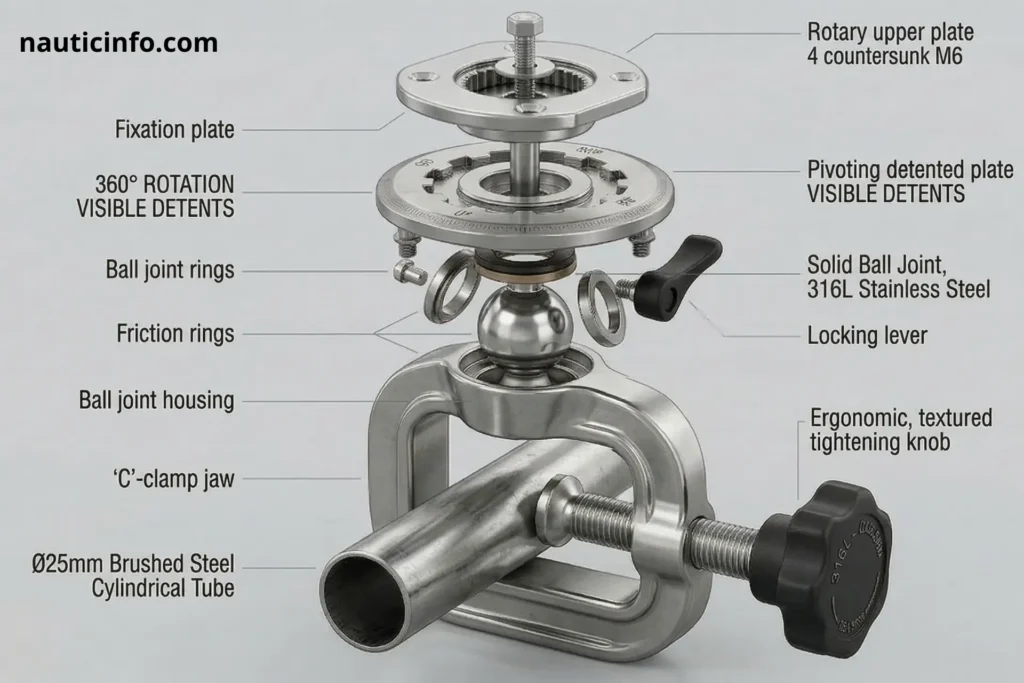
LeveLock and Pow’r Grip Rod Holder Hardware Mechanics
The rod holder mount is the absolute, undisputed industry standard for offshore center consoles and dedicated sportfishing vessels. Specifically, the Magma LeveLock all-angle mount features a brutally strong, cast 356 hard-anodized aluminum bracket that slides directly and seamlessly into standard cylindrical hull rod holders. Furthermore, it utilizes an intricate, highly engineered gear-toothed locking joint that allows the user to instantly level the heavy cooking surface. Regardless of the aggressive angle at which the rod holder was originally welded into the fiberglass hull.
For vessels frequently operating in rough, highly turbulent heavy seas. The Pow’r Grip system dramatically upgrades the standard LeveLock with a secondary, extreme cam-locking mechanism. Therefore, it securely and permanently locks the internal shaft inside the rod holder. Completely eliminating any dangerous rotational rattling, intense vibration, or vertical ejection when the vessel is violently pounding through waves at high speeds.
Round, Square, and Pedestal Deck Mounting Architecture
Conversely, sailboats and aluminum pontoon boats generally lack flush-mount rod holders; therefore, they rely entirely on external rail mounts. Specifically, these heavy-duty split-bracket clamps bolt aggressively and permanently onto 7/8-inch to 1-1/4-inch round stainless stanchions, or onto the 1-1/4-inch square aluminum rails ubiquitous on modern pontoons. Moreover, heavy-duty “dual extended” horizontal rail mounts intentionally utilize two independent, widely spaced clamping points. Consequently, they provide the massive, unyielding structural rigidity required to safely support oversized, exceptionally heavy units like the Magma Monterey 2 Infrared or the dense Dickinson Sea-B-Que Large.
Additionally, for large teak swim platforms or expansive pontoon decks, locking flush-mount deck sockets provide a completely robust, freestanding foundation. Consequently, a heavily threaded, vertical stainless steel pipe is screwed directly into the recessed deck socket, safely supporting the heavy cooking apparatus at an ergonomic, comfortable standing height, entirely independent of the vessel’s perimeter railings.
Maritime Safety and Compliance for the Best Boat Grills and Planchas 2026
Operating a 500-degree, open-flame combustion device atop a fiberglass vessel loaded with highly volatile, highly explosive gasoline demands absolute, unwavering adherence to United States Coast Guard (USCG) and ABYC safety protocols. Specifically, the ABYC A-3 “Galley Stoves,” A-1 “Marine Liquefied Petroleum (LPG) Systems,” and A-26 standards dictate exactly how these incredibly dangerous systems must be engineered, securely mounted, and safely operated.
Navigating ABYC A-1, A-3, and A-26 Propane Standards
Furthermore, while 1-pound disposable propane canisters are phenomenally convenient for weekend warriors, they pose a massive, highly lethal, and completely invisible threat. Specifically, propane gas is physically heavier and denser than ambient atmospheric air. Consequently, if a cheap, disposable canister develops a microscopic valve leak, the highly explosive, heavier-than-air vapor will sink rapidly and silently into the absolute lowest point of the hull—the enclosed bilge.
Therefore, the ABYC explicitly and forcefully forbids the stowage or operational use of 1-pound disposable propane canisters anywhere below decks. Thus, all primary and backup fuel canisters must be securely stored in dedicated, topside, heavily vented lockers that allow heavy gas to drain harmlessly and directly overboard, far away from any internal ignition sources or electrical bilge pumps. Moreover, all modern ABYC standards actively encourage the integration of hard-wired gasoline and propane gas detection systems (ABYC A-14) to provide early, audible warnings of catastrophic gas accumulation.
USCG Regulations and Operational Hazard Mitigation
Cooking actively underway (while the vessel is actively motoring, sailing, or drifting in heavy currents) is universally and unequivocally condemned by marine safety experts and the USCG. Specifically, unexpected wave action, sudden rogue wakes from passing commercial vessels, or violent changes in wind direction can instantaneously throw a pan of boiling cooking grease directly onto the deck, or violently extinguish the flame while raw, unignited gas continues to aggressively flow.
Therefore, all intense culinary operations must be strictly and absolutely limited to periods when the vessel is securely anchored, firmly moored, or heavily tied to a slip in perfectly calm, protected waters. Furthermore, the USCG legally mandates that all recreational vessels carry approved, fully charged B-1 type marine fire extinguishers. Consequently, an operator must ensure that a fully functional fire extinguisher is physically within arm’s reach of the grill at all times. Ultimately, the golden rule of marine grilling is singular and absolute: never, under any circumstances, leave a lit, active grill unattended on a boat.
Culinary Pro Tips and Maintenance for the Best Boat Grills and Planchas 2026
Even the absolute highest-grade 304 mirror-polished stainless steel will eventually succumb to severe galvanic corrosion, ugly surface pitting, and deep structural rust if it is chronically neglected in a harsh, salt-laden marine environment. Consequently, implementing a strict, unyielding maintenance protocol is not merely optional; it is a fundamental, non-negotiable requirement for basic equipment survival.
Fighting Galvanic Corrosion and Saltwater Degradation
Never leave carbonized food residue or charred, greasy debris inside the firebox after a weekend trip. Specifically, when organic food particles carbonize and subsequently mix with dense, atmospheric saltwater humidity, they form highly corrosive, incredibly destructive organic acids. Furthermore, these aggressive acids will rapidly and effortlessly eat through the microscopic, protective chromium oxide layer of the stainless steel, causing severe, irreversible structural pitting. Therefore, you must heavily scrub the stainless grates with warm, soapy water and a soft, non-abrasive pad immediately after the unit completely cools.
Additionally, after thoroughly cleaning and completely drying the stainless steel components, metallurgical experts aggressively mandate applying a microscopic, highly uniform coating of polymerized cooking oil (such as high-smoke-point grapeseed or canola oil) to all exterior and interior surfaces. Consequently, this microscopically thin layer of polymerized fat acts as a highly effective, impenetrable hydrophobic barrier, violently repelling salt moisture when the unit is stored.
Moreover, while heavy, tightly woven canvas grill covers adequately protect against UV degradation and acidic bird droppings, they inadvertently trap dense, salty ambient humidity directly against the steel. Thus, it is absolutely imperative to remove the canvas cover periodically while at the dock to allow the trapped, corrosive moisture to evaporate entirely in the natural, dry breeze.
Advanced Galley Preparation and Topside Fuel Management
Furthermore, to ensure absolute safety and efficiency, always perform complex culinary preparation in your spacious shoreside kitchen long before ever stepping onto the narrow docks. Specifically, attempting to slice raw, slippery poultry or manually form ground beef patties on a violently rolling, highly unstable fiberglass deck is a guaranteed invitation to severe cross-contamination, dangerous slips, and catastrophic knife injuries.
Therefore, highly experienced mariners aggressively marinate all proteins in thick vacuum-sealed bags and meticulously pre-chop all dense vegetables at home. Thus, the onboard, topside cooking process is reduced strictly and exclusively to the safe application of intense heat, saving critical, limited galley space and ensuring a vastly safer, highly streamlined culinary experience. Additionally, 1-pound disposable propane tanks notoriously offer only 1.5 to 2 hours of actual burn time. Consequently, always carry at least two fully sealed backup cylinders stored safely in an overboard-venting topside locker to prevent a sudden, highly frustrating loss of flame mid-cook.
Pro Tip: The Inward Flip Technique
When aggressively manipulating food over an open body of water, physics is rarely your ally. Specifically, a sudden wind gust or a slight miscalculation with your stainless steel tongs can easily send expensive steaks plummeting directly into the ocean. Consequently, highly experienced marine chefs physically train themselves to execute the “inward flip.” Furthermore, this technique requires you to always angle your spatula or tongs so that the rotational momentum of the flipping food is directed forcefully toward the physical center of the grill grate, rather than outward toward the perilous edge. Therefore, if the protein slips, it falls harmlessly onto a cooler zone of the grate, saving your crew’s heavily anticipated dinner.
NauticInfo Verdict
The 2026 marine culinary market definitively offers completely unprecedented levels of high-end technological refinement, leaving educated boaters with highly specialized, precision-engineered choices tailored exactly to their vessel’s unique architecture. For the uncompromising, hardcore offshore angler demanding supreme, unyielding wind resistance and absolute portability, the Magma Cabo remains the undisputed, rugged king of compact, match-lit gas setups. Conversely, for inland pontoon owners prioritizing vast, expansive cooking areas and massive economic value, the Kuuma Stow N’ Go Elite 216 provides absolutely phenomenal, class-leading thermal performance, provided the owner diligently commits to a rigorous, uncompromising anti-corrosion maintenance schedule.
However, looking forward, the future of marine culinary arts undeniably belongs to the flat-top marine griddle. Specifically, the solid-surface, wind-blocking geometry of the heavy cast-iron ENO Cook ‘n Boat and the brilliantly versatile, multi-stage Magma Crossover Series fundamentally and permanently solve the severe, highly dangerous flare-up and wind-extinguishment issues that have plagued marine cooking for several decades. Furthermore, for elite luxury yachts heavily equipped with robust, advanced generator or high-capacity lithium battery banks, the Kenyon VDC 48V completely rewrites the stringent rules of maritime safety by eliminating hazardous open flames and explosive gas entirely. Ultimately, by meticulously and aggressively matching your specific vessel’s structural mounting architecture, topside fuel storage capabilities, and electrical battery capacity to these top-tier, highly engineered systems, you definitively guarantee decades of flawless, incredibly safe, restaurant-quality dining on the open water.