
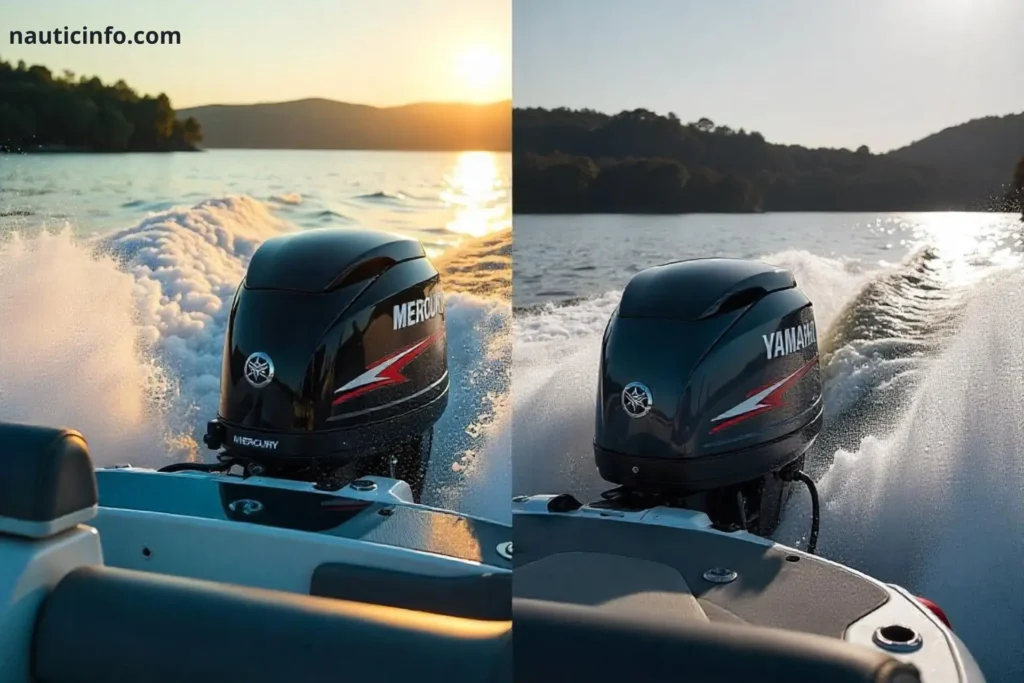
Choosing an outboard motor “Mercury vs Yamaha Outboard” is a crucial decision for any boater. In 2025, Mercury and Yamaha continue to dominate the market with their innovative and high-performance ranges. These two giants of the marine industry offer cutting-edge technologies adapted to various uses. Our in-depth analysis will guide you in making the choice best suited to your needs, whether for fishing, pleasure boating, or water sports. We will compare the technical characteristics, reliability, costs, and performance to help you make an informed decision.
Mercury vs Yamaha Outboards: Comparison of 2025 Ranges
The Mercury 2025 Range
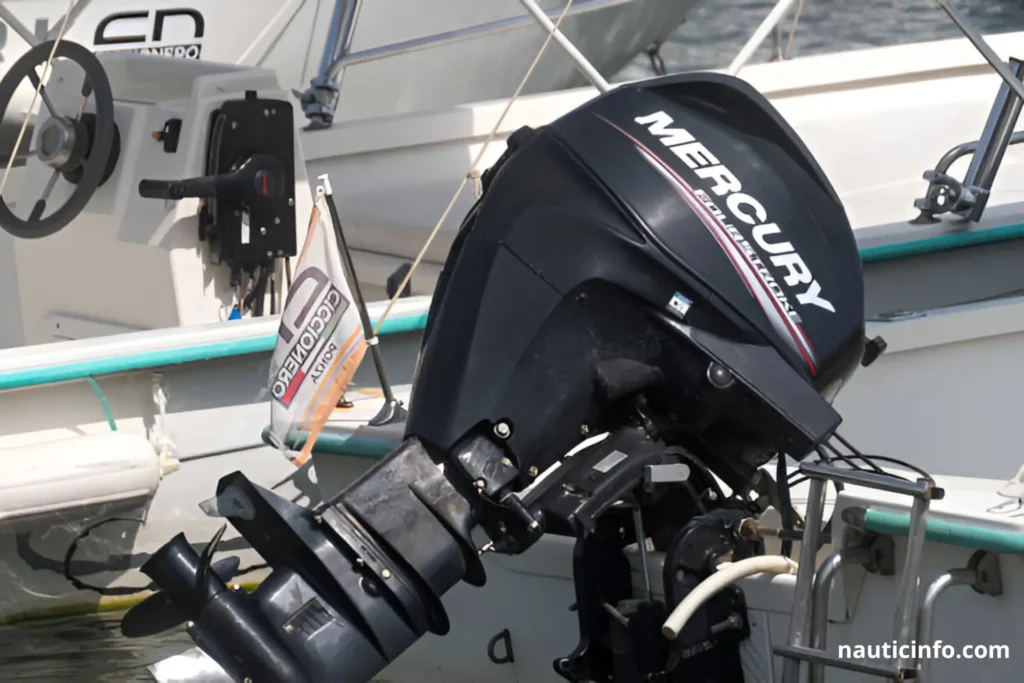
Mercury offers an impressive range of outboard motors in 2025, ranging from 2.5 HP to the imposing Verado 600 HP. This diversity allows them to meet the needs of virtually all types of vessels and uses.
Small Mercury motors, such as the 2.5 HP and 3.5 HP 4-stroke, are particularly appreciated for their lightness (17 kg) and their ease of use without a license. These engines are equipped with an automatic decompression system ensuring immediate and effortless starting. Multiple TRIM positions improve performance and allow for easy use in shallow water, particularly on the 3.5 HP model which also offers 360° steering for full thrust in all directions.
In the mid-range, the Mercury 6 HP 4T stands out for its versatility, featuring both a tiller handle and a remote control conversion kit. The 9.9 HP and 15 HP models offer options such as electric start, EFI (Electronic Fuel Injection) system, and Power Trim.
A major asset of Mercury is its 5-year national warranty across its entire range, testifying to the manufacturer’s confidence in the durability of its products.
The Yamaha 2025 Range
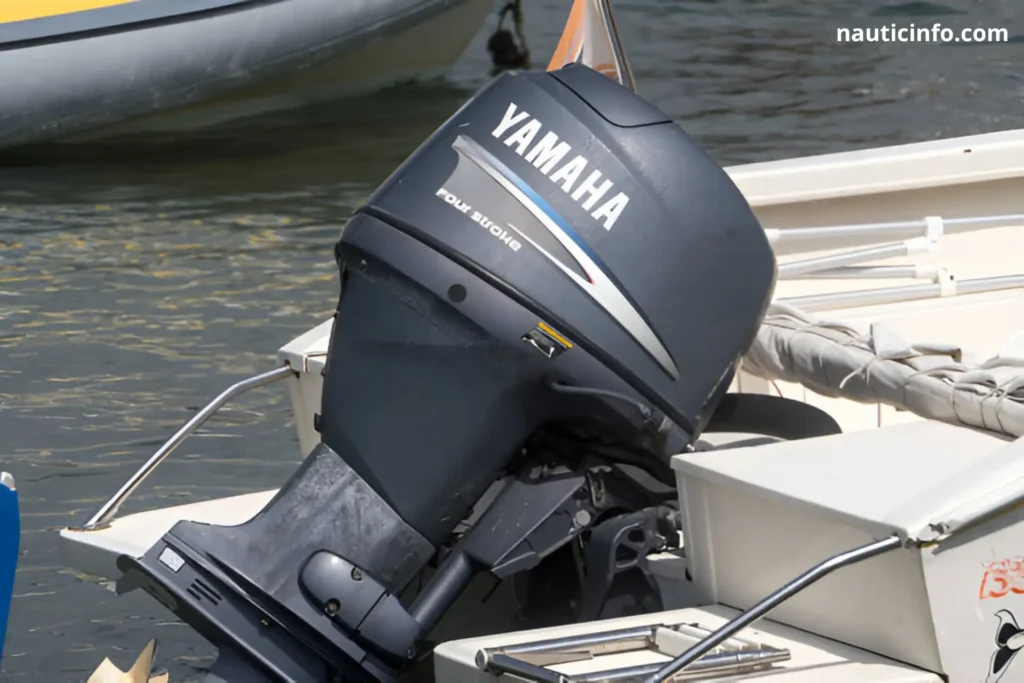
Yamaha offers an equally comprehensive range, with motors ranging from 2.5 HP up to the powerful 450 HP XF450. The Japanese manufacturer particularly focuses on lightness and energy efficiency.
The Yamaha F25C, for example, is presented as the lightest outboard in its category. This 432cc 4-stroke engine with 2 cylinders developing 25 HP offers various configuration options: short (15 inches) or long (20 inches) shaft, manual or electric start, and manual or hydraulic tilt.
Yamaha also stands out with its extended warranty which can reach 6 years (3 additional years) on certain models such as the F25SMHC, F25LMHC, and F25SWTHC, as part of a special offer. This warranty extension significantly enhances the attractiveness of these models for users seeking long-term peace of mind.
Mercury vs Yamaha Outboards: The High-Performance Range (300 HP and Up)
For performance boats, offshore rigs, and multi-engine center console setups — a hugely popular category among American boaters — both Mercury and Yamaha field serious firepower at the top of their lineups.
Mercury Verado: Up to the V12 600 HP
Mercury’s flagship is the Verado V12 600 HP, delivering extraordinary range and performance thanks to its V12 powerhead. It’s the first-ever naturally aspirated V12 outboard motor on the market, a breakthrough that earned an innovation award in 2022. It also debuts the industry’s first two-speed automatic transmission and the first-ever steerable lower unit on an outboard.
On the comfort side, Mercury put serious engineering into keeping things quiet: even at 600 HP, noise and vibration are comparable to the V8 Verado 300 HP, and Mercury reports fuel savings of 20-24% versus equivalent competitor setups. The full Verado lineup runs from the V8 350-425 HP up through the V10 600 HP and V12, all backed by Mercury’s SmartCraft digital technologies, including Digital Throttle & Shift (DTS) for smooth, quiet shifting and instant response.
Yamaha XTO Offshore: The Big-Water Standard
Yamaha’s flagship series is the XTO line (“Xtreme Thrust Output”), paired with the Helm Master system for a fully integrated power and control solution built for the biggest offshore boats. It’s available as the V8 XF425 and XF450, purpose-built to combine power, performance, reliability, and comfort for serious boaters and offshore anglers.
Technically, these engines are built around efficiency: a 12.3:1 compression ratio for outstanding fuel economy and power, an industry-first integrated electric steering system, and phase-angle-controlled charging. They’re also compatible with Helm Master EX, which delivers full joystick maneuverability for one to five engines plus automated functions for fishing and cruising — a big draw for U.S. boaters running twin, triple, or quad outboard setups on center consoles.
Verado vs. XTO: Which One for a Big Rig?
| Feature | Mercury Verado | Yamaha XTO Offshore |
|---|---|---|
| Max Power | 600 HP (V12) | 450 HP (V8) |
| Engine Architecture | V8, V10, V12 | V8 only |
| Standout Strength | Raw power, quiet at high RPM | High torque, efficiency, multi-engine control |
| Helm Control | Joystick Piloting + Skyhook | Helm Master EX (up to 5 engines) |
| Best For | Performance, large vessels, thrill-seeking | Offshore cruising, heavy-displacement hulls |
Bottom line: if the goal is the highest horsepower on the market with class-leading refinement, Mercury’s V12 600 HP Verado has no direct rival at Yamaha. If proven long-range reliability and best-in-class multi-engine control are the priority, Yamaha’s XTO lineup remains the go-to choice for offshore and big-water boaters.
Strengths and Weaknesses of Each Range : Mercury vs Yamaha Outboard
Mercury distinguishes itself with its raw power and peak performance. Mercury engines are known for their robustness, rapid acceleration, and advanced control technologies. They excel particularly in applications requiring power and speed.
On the other hand, Yamaha emphasizes energy efficiency, long-term reliability, and quiet operation. Yamaha engines are recognized for their smooth power distribution, making them ideal for long and regular cruising. Their design also prioritizes ease of transport and storage, with ergonomic handles and optimized weight.
| Characteristic | Mercury | Yamaha |
|---|---|---|
| Power Range | 2.5 HP – 600 HP | 2.5 HP – 450 HP |
| Engine Type | 2-stroke & 4-stroke | 2-stroke & 4-stroke |
| Warranty | 5 years | Up to 6 years |
| Key Technologies | EFI, Power Trim | Digital Network, Anti-Corrosion Protection |
Performance and Technologies: Mercury vs Yamaha Outboard

In terms of pure performance, Mercury tends to offer better acceleration and higher top speeds. This characteristic is particularly appreciated by thrill-seekers and those looking for an immediate response from their engine.
Yamaha, meanwhile, favors a more balanced navigation experience, with smooth and constant power distribution. This approach generally translates into better fuel economy and increased navigation comfort, particularly over long distances.
Mercury’s Technological Advantages
Mercury has made significant investments in developing innovative technologies to improve the performance and control of its engines. Notable advances in the 2025 range include:
- EFI (Electronic Fuel Injection) System: Present on several models such as the Mercury 15HP 4T, this system optimizes fuel injection for increased performance and reduced consumption.
- Power Trim: Available on models such as the Mercury 15HP 4T EFI, this technology allows adjustment of the engine angle relative to the boat’s transom, thus optimizing performance in various navigation conditions.
- Advanced Starting Systems: Mercury engines offer easy manual or electric starting options, with an automatic decompression system that ensures immediate and effortless starting.
- 360° Steering: On certain models such as the Mercury 3.5hp, this feature allows full thrust in all directions, significantly improving maneuverability.
These advanced technologies allow Mercury engines to adapt to a wide variety of navigation conditions and offer optimal performance in virtually all situations.
Yamaha’s Technological Advantages
Yamaha distinguishes itself with innovations focused on reliability, efficiency, and ease of use:
- Compatible with the Advanced Digital Network: Yamaha engines, such as the F25C when equipped with the electric starter, can integrate with the brand’s digital network, offering advanced control and diagnostic features.
- Advanced Corrosion Protection: A particularly important feature for saltwater navigation, extending the engine’s lifespan.
- Ergonomics and Transport: Yamaha engines are designed with comfortable carrying handles and particular attention to ease of handling and storage.
- Energy Efficiency Technologies: Yamaha emphasizes systems that optimize fuel consumption, thus reducing operating costs and environmental impact.
Yamaha’s approach clearly aims to offer a hassle-free user experience, combining reliable performance and ease of daily use.
| Performance | Mercury | Yamaha |
|---|---|---|
| Acceleration | Fast | Progressive |
| Top Speed | High | Balanced |
| Fuel Consumption | Variable | Optimized |
| Maneuverability | Excellent | Very Good |
Reliability and Maintenance: Which is More Durable?
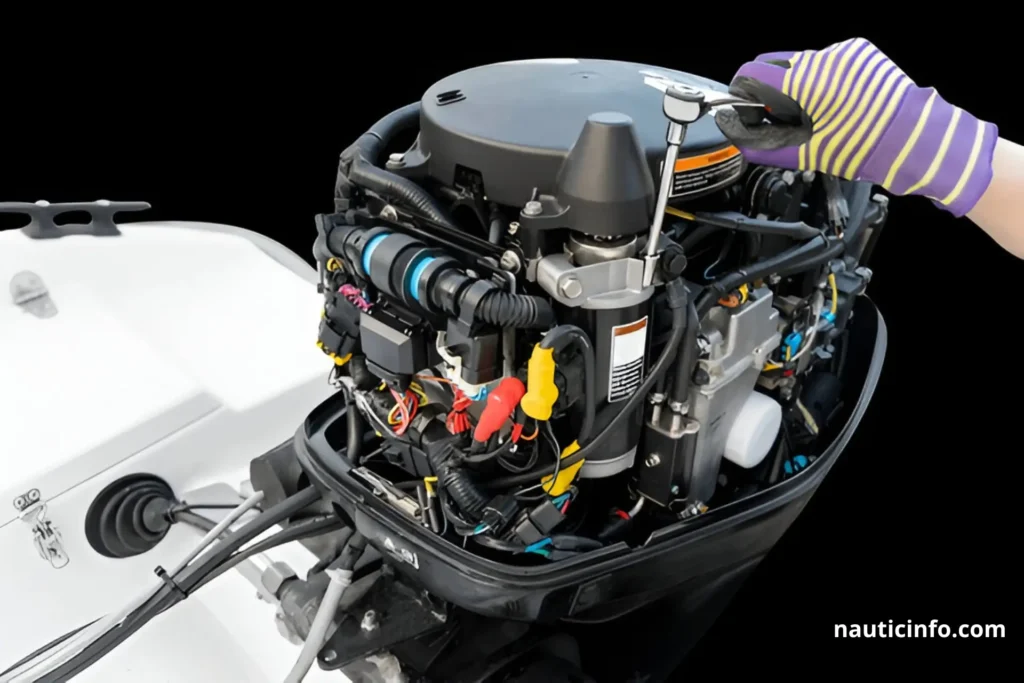
Both brands enjoy an excellent reputation in terms of reliability, but with significant nuances.
Mercury is often praised for the robustness of its engines, capable of withstanding difficult conditions and intensive use. Their solid design allows for prolonged use even in demanding environments. The 5-year national warranty offered by Mercury testifies to this confidence in the durability of their products.
Yamaha, for its part, is frequently cited for the exceptional longevity of its engines and their consistency over time. The warranty extension of up to 6 years offered on certain models reinforces this image of unfailing reliability. This characteristic is particularly valued by regular users and professionals who depend daily on their equipment.
In terms of maintenance, Yamaha seems to have a slight advantage thanks to designs that facilitate access to essential components. For example, the Yamaha F25C has an easily accessible hose connection for maintenance operations.
Mercury is not far behind, with engines described as “easy to maintain” such as the Mercury 3.5hp 4-stroke. However, the complexity of some of Mercury’s advanced technologies can sometimes make maintenance more delicate on high-end models.
Regarding maintenance costs, it’s important to note that both brands offer factory pre-broken-in engines, which eliminates the traditional break-in period and simplifies initial maintenance.
Choice According to Use: Fishing, Pleasure Boating, Water Sports

For Fishing : Mercury vs Yamaha Outboard
Fishermen have specific needs: a quiet engine to avoid scaring the fish, good maneuverability at low speeds, and unfailing reliability.
For this use, Yamaha engines are often preferred thanks to their particularly quiet operation and excellent energy efficiency. The Yamaha F25C, for example, offers a good balance between power and discretion, ideal for fishing sessions.
On the Mercury side, models such as the Mercury 6HP 4T are perfectly suited to fishing boats, with the advantage of being usable without a license. The 360° steering available on certain Mercury models is also a significant asset for the precise maneuvers needed during fishing sessions.
For Pleasure Boating : Mercury vs Yamaha Outboard
For family outings or trips with friends, the priority is generally reliability, comfort, and fuel economy.
Yamaha engines excel in this area thanks to their smooth power distribution and optimized consumption, allowing for long and pleasant cruises. Models such as the F25LWHC with its 20-inch shaft offer an ideal solution for medium-sized pleasure boats.
Mercury also offers excellent options for pleasure boating. Particularly with its range of medium-power engines (6HP to 15HP) which offer a good balance between performance and economy. The Mercury 9.9HP 4T with electric start and remote control is particularly suitable for family outings on compact vessels.
For Water Sports : Mercury vs Yamaha Outboard
Thrill-seekers and water sports enthusiasts primarily look for power, acceleration, and top speed.
In this segment, Mercury tends to take the advantage with its powerful engines designed to offer dynamic performance and rapid acceleration. Models equipped with electronic injection (EFI) and Power Trim are particularly suited to this use, such as the Mercury 15HP 4T EFI with Power Trim.
Yamaha is not far behind, also offering high-performance engines. But with an approach that generally favors balance and regularity rather than raw power. This characteristic can be an advantage for certain water sports requiring constant and predictable power.
| Use | Mercury | Yamaha |
|---|---|---|
| Fishing | Good maneuverability | Quiet operation |
| Pleasure Boating | Versatile performance | Fuel economy |
| Water Sports | Raw power | Consistent power |
Key Factors to Consider Before Purchase
Budget
The financial factor is often decisive in choosing an outboard motor. One must consider not only the initial purchase price but also the total cost of ownership.
Mercury currently offers interesting promotions on several models, with discounts of up to 30%. On certain engines such as the Mercury 2.5hp 4t ($890 instead of $1280). The Mercury 6HP 4T short shaft is also offered at $1395 instead of $1980, a 29% reduction.
Similarly, Yamaha offers special prices, such as the F25SMHC at $4475 (instead of the regular price of $5099) and the F25SWTHC at $5299 (instead of $6325) as part of its winter offer valid until March 31.
Beyond the purchase price, one must consider:
- Fuel consumption (generally an advantage for Yamaha)
- Regular maintenance costs
- The duration and extent of the warranty (5 years for Mercury, up to 6 years for certain Yamaha models)
- Resale value, generally high for both brands but sometimes higher for Yamaha due to its reputation for longevity
| Cost/Maintenance | Mercury | Yamaha |
|---|---|---|
| Purchase Price | Frequent promotions | Special offers |
| Fuel Consumption | Variable | Economical |
| Maintenance Cost | Standard | Easy access |
| Resale Value | Very good | Excellent |
Type of Vessel

The choice of engine must be adapted to the vessel on which it will be mounted.
For small light craft (canoes, small boats), low-power engines such as the Mercury 2.5hp or 3.5hp (17 kg) or their Yamaha equivalents are perfectly suited.
For medium-sized boats, engines in the 6HP to 15HP range offer a good compromise between power and maneuverability. Mercury offers versatile options such as the 6HP 4T which is suitable for “both barges and boats equipped with a console”.
For larger vessels requiring more power, it is essential to consider not only the raw power. But also the type of shaft (short or long) depending on the height of your boat’s transom. Mercury specifies, for example, that its 6HP 4T short shaft engine “will be suitable for all types of boats whose transom height does not exceed 45cm”.
Navigation Environment
The environment in which you will primarily navigate should also influence your choice.
For saltwater navigation, corrosion resistance becomes paramount. Yamaha highlights its corrosion protection on models such as the F25C, which can represent a significant advantage for maritime use.
For shallow waters, features such as the “multiple TRIM positions” of the Mercury 3.5hp can be decisive for easy use. This characteristic allows adjustment of the engine position for efficient navigation even in areas where depth is limited.
The usual weather conditions in your navigation area should also be taken into account: in windy areas or with strong waves, the power and robustness of Mercury engines can be an advantage for maintaining control and stability of the vessel.
Conclusion: Which Outboard to Choose in 2025?
At the end of this in-depth comparison, it appears clear that both Mercury and Yamaha offer excellent quality outboard motor ranges in 2025, but with distinct philosophies.
Mercury distinguishes itself by power, robustness, and performance-oriented cutting-edge technologies. It’s the ideal choice for thrill-seekers, users in rough waters, or those who prioritize acceleration and speed. The 5-year warranty testifies to the brand’s confidence in the durability of its products. The constant improvements in electronic injection and control systems make Mercury outboards particularly attractive options for those seeking peak performance.
Yamaha excels with its legendary reliability, energy efficiency, and quiet operation. It’s the preferred option for long cruises, fishing, or those looking for an optimal balance between performance and economy. Warranty extension of up to 6 years on certain models reinforces this position as a leader in terms of reliability. The ergonomic design and ease of maintenance of Yamaha engines also make them wise choices for users prioritizing simplicity and durability.
The final choice will therefore depend on your specific priorities, your type of vessel, your budget, and your navigation environment. Whatever your decision, these two brands will continue to dominate the outboard market in 2025 thanks to their ongoing commitment to innovation and quality.