
Close Menu
Nautic Info
  • HOME
  • POWERBOATING
    • Motors & Parts
    • Maintenance
    • Buying Guides
  • SAILING
    • Sailboats
    • Sailing Techniques
    • Regattas & Events
  • GEAR & TECH
    • Safety
    • Electronics
    • Accessories
  • APPAREL
    • Technical Wear
    • Footwear
  • DESTINATIONS
    • Pacific
    • Caribbean
    • Mediterranean
    • Atlantic
  • LIFESTYLE
    • Practical Tips
    • Adventure Stories
    • Laws & Licenses

Subscribe to our newsletter

The ultimate guide for boating enthusiasts

What's Hot

Sailing Brittany North vs South

Liveaboard Family World Tour

Must-Watch Regattas 2026

Facebook X (Twitter) Instagram YouTube
  • About Us
  • Contact Us
  • Nautic Info FR 🇫🇷
Facebook X (Twitter) Instagram YouTube
Nautic Info
Demo
  • HOME
  • POWERBOATING
    1. Motors & Parts
    2. Maintenance
    3. Buying Guides
    4. View All

    Electrical Issues Outboard Engines

    Spare Parts for Inboard Engines

    Choose a Boat Propeller

    Gasoline Outboard Motors

    Inboard vs. Outboard Maintenance

    Change a water pump impeller

    4-Stroke Outboard Oil Change

    Cleaning Outboard Motor Cooling System

    Motorboat vs Sailboat: A Detailed Comparison

    Mercury vs Yamaha Outboard : Comprehensive Comparison Guide 2025

    How to Choose Your First Motorboat: Budget, Use, Maintenance

    Inboard vs. Outboard Maintenance

    Change a water pump impeller

    4-Stroke Outboard Oil Change

    Electrical Issues Outboard Engines

  • SAILING
    1. Sailboats
    2. Sailing Techniques
    3. Regattas & Events
    4. View All

    Offshore Sailing Yachts

    Top 5 Affordable American Sailboats

    Short-Handed Sailing

    Sailboat Reefing

    How to Anchor a Boat

    How a Sailboat Works

    Must-Watch Regattas 2026

    Must-Watch Regattas 2026

    Short-Handed Sailing

    Sailboat Reefing

    How to Anchor a Boat

  • GEAR & TECH
    1. Safety
    2. Electronics
    3. Accessories
    4. View All

    Boat Cameras

    Marine Carbon Monoxide Detector

    Automatic vs Manual Life Jackets

    Safety Checklist for Going Out to Sea

    Managing Onboard Energy

    AIS for boat safety

    Fixed vs. Portable VHF

    Marine Autopilot

    Bimini Tops and Boat Sun Shades

    Boat Accessories : 10 Must-Have

    Bimini Tops and Boat Sun Shades

    Boat Cameras

    Marine Carbon Monoxide Detector

    Managing Onboard Energy

  • APPAREL
    1. Technical Wear
    2. Footwear
    3. View All

    Smart Connected Textiles for Sailing

    Technical clothing maintenance

    How to Choose a Sailing Jacket

    Rubber vs Breathable Sailing Boots

    Rubber vs Breathable Sailing Boots

    Smart Connected Textiles for Sailing

    Technical clothing maintenance

    How to Choose a Sailing Jacket

  • DESTINATIONS
    1. Pacific
    2. Caribbean
    3. Mediterranean
    4. Atlantic
    5. View All

    Sailing Tuamotu Atolls

    Sailing Cuba

    British Virgin Islands Sailing Vacation

    10-Day Grenadines Sailing Itinerary

    Discover the Cyclades in 15 Days

    Bonifacio Maddalena Sailing

    10-Day Croatia Yacht Charter Split to Dubrovnik

    Corsica Sailing Itinerary: 1 Week

    Sailing Brittany North vs South

    Sailing Brittany North vs South

    Sailing Tuamotu Atolls

    Sailing Cuba

    British Virgin Islands Sailing Vacation

  • LIFESTYLE
    1. Practical Tips
    2. Adventure Stories
    3. Laws & Licenses
    Featured

    Liveaboard Family World Tour

    Recent

    Liveaboard Family World Tour

    USCG Required Safety Equipment

    Do I need a boating license

  • About Us
  • Contact Us
  • Nautic Info FR 🇫🇷
Facebook X (Twitter) Instagram
Nautic Info
Home » AIS for boat safety
Electronics GEAR & TECH

AIS for boat safety

Share
Facebook Twitter WhatsApp LinkedIn Pinterest Email

AIS for Boat Safety: See and Be Seen on the Water
AIS for boat safety
AIS for boat safety

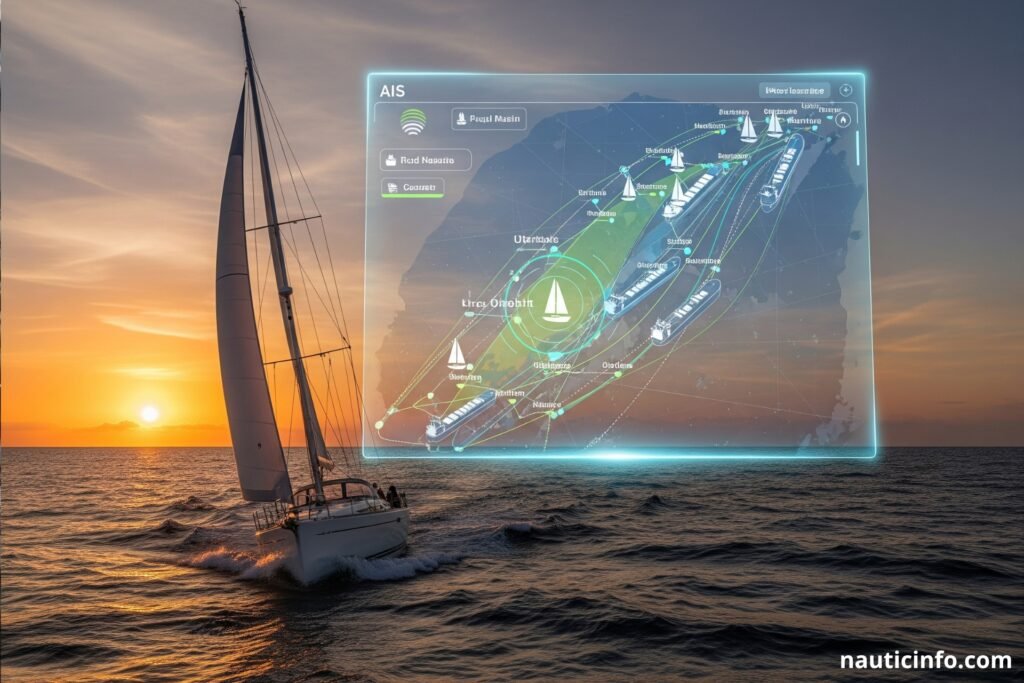
In a world where technology constantly redefines the boundaries of our daily lives. Safety at sea is undergoing its own revolution. At the heart of this transformation is a crucial piece of technology: the Automatic Identification System (AIS). For many recreational boaters, AIS for boat safety has become synonymous with peace of mind. An invisible guardian on the water. But beyond simply “appearing” on an electronic chart, has AIS become truly essential for your boating needs? This article will dive deep into this technology to demystify its operation. Clarify the key differences between its various forms, and ultimately, evaluate its critical role for all mariners.

Understanding the Core of the System: How AIS Works
The Core of the System: How AIS Works

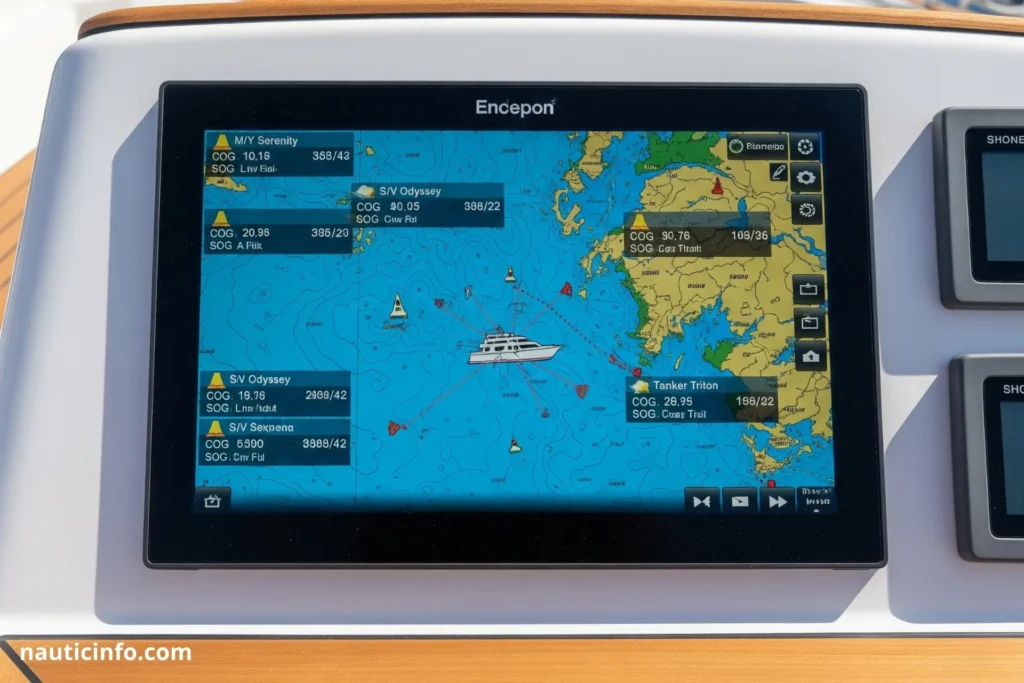
Initially designed for tracking commercial vessels and preventing collisions on the high seas. AIS has become widely accessible, evolving into a valuable ally for recreational boating. Fundamentally, AIS is an automated data exchange system that uses VHF radio waves to communicate. This allows equipped vessels to share and receive crucial information in real-time with other vessels and shore-based stations within range. Forming the backbone of modern AIS for boat safety.

The operation of AIS relies on a smart combination of technologies:

  • GPS (Global Positioning System): Every AIS system integrates a GPS receiver that continuously determines the vessel’s position. Speed over ground (SOG), and course over ground (COG).
  • VHF Transceiver: This is the communication backbone. The AIS system uses two dedicated VHF channels (161.975 MHz and 162.025 MHz) to broadcast and receive information.
  • Data Processor: It compiles the vessel’s static and dynamic information, formatting it into standardized messages.

These messages are then broadcast at regular intervals. The frequency of these transmissions depends on the vessel’s speed and changes in its course. Ensuring that the most critical updates are shared more frequently. As a result, you can visualize a truly dynamic map of the surrounding maritime traffic on a screen (chartplotter, computer, or tablet). Each target displayed represents a vessel, and by selecting it. You can access a wealth of information that is vital for collision avoidance and overall situational awareness.

The Crucial Question for Boat Safety: Receiver or Full Transponder?
The Crucial Question for Boat Safety: Receiver or Full Transponder?

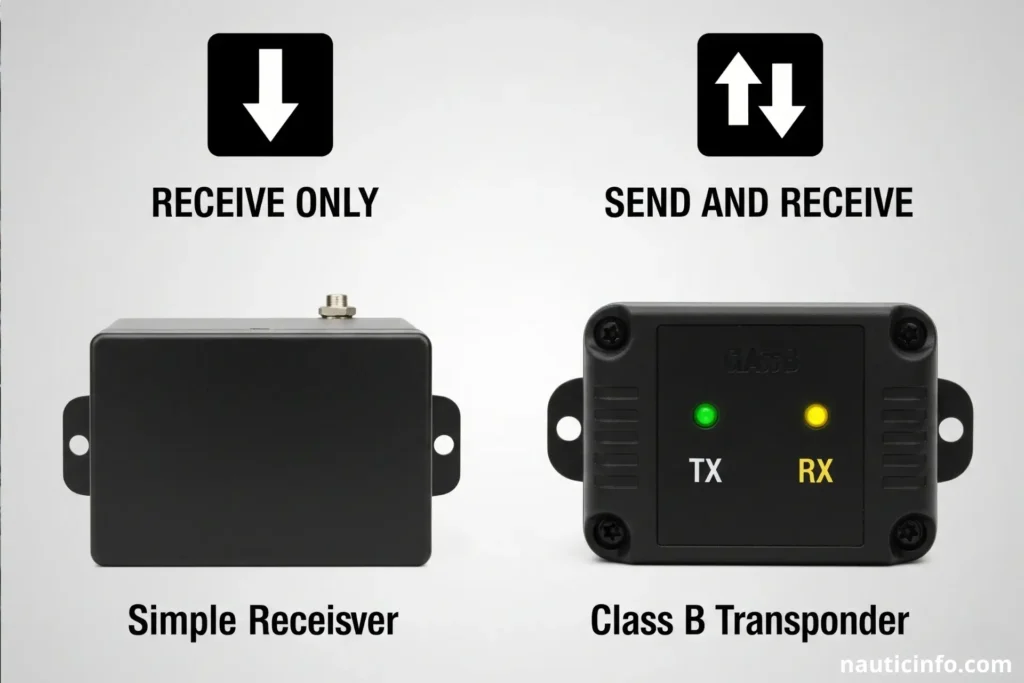
One of the first decisions to make when considering AIS for boat safety is the type of equipment. There is a fundamental distinction that determines your role in this safety ecosystem. Will you be a passive observer or an active participant? This is the key difference between a receiver and a transponder.

The AIS Receiver: The Silent Watcher

An AIS receiver, as its name implies, is a device that only receives signals broadcast by other vessels. It allows you to “see” the surrounding traffic on your screen. This is a great first step toward better situational awareness. You get a clear view of the cargo ships, ferries, and other boaters who are transmitting. Which helps you anticipate their routes and avoid potentially dangerous situations.

However, its main drawback is a significant one: you remain invisible to others. You can see, but you can’t be seen. For a small sailboat navigating near a commercial shipping lane. This invisibility can be extremely perilous and undermines the goal of using AIS for boat safety. The 900-foot cargo ship steaming at 20 knots will not detect you on its AIS display and might only spot you visually or on radar when it’s far too late.

The AIS Transponder: The Complete Safety Dialogue

An AIS transponder is a transceiver; it both transmits and receives. Not only does it receive information from others, but it also broadcasts your own. This is the solution that fully embodies the “see and be seen” philosophy. By opting for a transponder, your vessel appears as a target on the screens of all surrounding boats. From the smallest dinghy to the largest supertanker, making it the superior choice for active safety.

There are two main classes of transponders:

  • Class A: Mandatory for vessels over 300 gross tons and passenger vessels. They are more powerful (12.5 Watts) and transmit more frequently.
  • Class B: Designed for recreational boating. Newer models, known as Class B+ or SOTDMA, offer 5 Watts of power and more reliable transmission in crowded areas. Bringing their performance closer to that of Class A.

Choosing a transponder, particularly a Class B+ model, is unequivocally the best choice when implementing AIS for boat safety. It transforms your boat from an unknown variable into a clearly identified entity.

Is AIS an Essential Piece of Gear for Your Type of Boating?
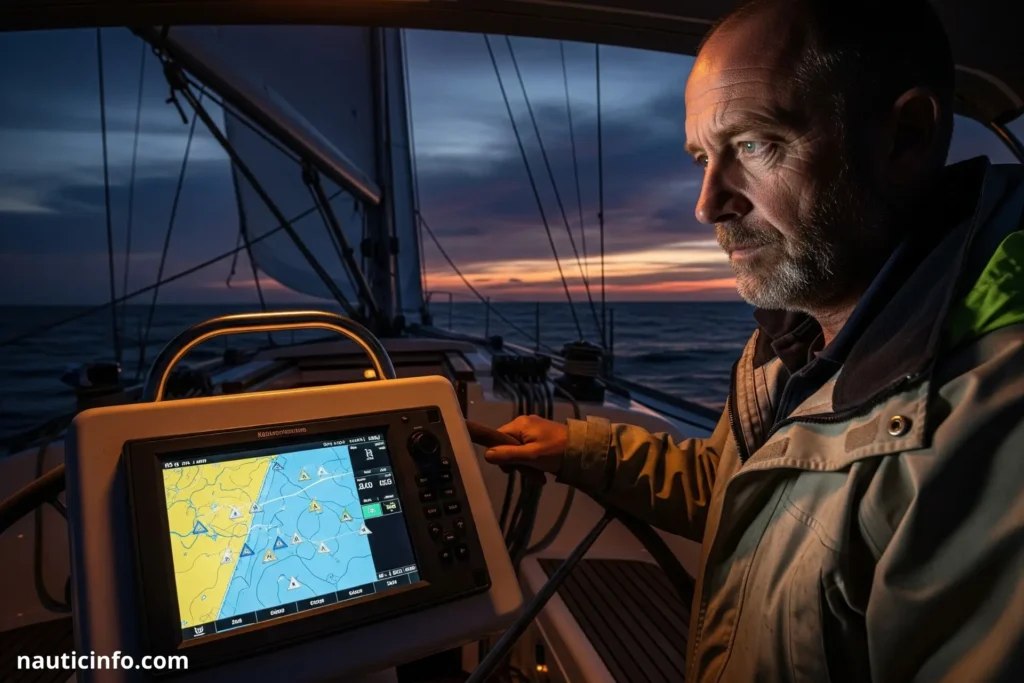
AIS an Essential Piece of Gear for Your Type of Boating

The answer to this question depends on how you use your boat. But for the majority of boaters, the trend is a clear and resounding yes. AIS is no longer a luxury gadget but a cornerstone of modern marine safety.

An Unmatched Anti-Collision Shield with AIS for Boat Safety

The primary and most obvious advantage of AIS is its ability to prevent collisions. Unlike radar, which can sometimes be difficult to interpret and struggles to detect small targets in heavy seas. AIS provides clear and unambiguous identification.

Imagine a night passage through a busy shipping channel. With a simple receiver, you can see the steel giants heading your way. With a transponder, they see you too. You can then anticipate an avoidance maneuver long before the situation becomes critical. Many modern navigation systems allow you to set CPA (Closest Point of Approach) and TCPA (Time to Closest Point of Approach) alarms. These alerts will trigger if a vessel is on a collision course. Notifying you well before the danger is imminent and giving you ample time to react calmly. This proactive alerting is a key feature of AIS for boat safety.

Beyond Collision Avoidance: The Added Benefits

While preventing collisions is its main function, AIS offers many other advantages:

  • Aids Navigation in Ports and Channels: Visualizing inbound and outbound traffic allows for better planning of your approach and departure.
  • Assistance in Rescue Operations: In an emergency, the Coast Guard and other rescue services can pinpoint your location instantly.
  • Peace of Mind for Loved Ones Ashore: Thanks to websites like MarineTraffic or VesselFinder. Your family and friends can follow your voyage in real-time.

In the United States, an AIS transponder is not federally required on most recreational vessels. However, for offshore passages or navigating in areas with heavy commercial traffic, the vast majority of experienced mariners now consider a transponder to be as fundamental as a life raft or an EPIRB.

In conclusion, when asking if you should invest in AIS for boat safety, the answer is an emphatic yes. Although regulations may not yet mandate it for your vessel, its contribution to active safety is so significant that it would be unwise to go without it. The choice between a receiver and a transponder is really a choice between passive and active safety. In an environment where anticipation is everything, ensuring you are visible is not just an option—it’s a necessity. The investment in an AIS transponder is, without a doubt, one of the smartest you can make for your safety and the safety of your crew.

Share. Facebook Twitter WhatsApp Pinterest LinkedIn Email

Articles connexes

Bimini Tops and Boat Sun Shades

Boat Cameras

Marine Carbon Monoxide Detector

Managing Onboard Energy

Fixed vs. Portable VHF

Marine Autopilot

Demo
Top Posts

Mercury vs Yamaha Outboard : Comprehensive Comparison Guide 2025

How to Choose Your First Motorboat: Budget, Use, Maintenance

Inboard vs. Outboard Maintenance

Don't Miss

Sailing Brittany North vs South

Sailing Brittany: North vs. South – The Ultimate Summer Cruising Guide France’s Brittany coast (Bretagne)…

Liveaboard Family World Tour

Must-Watch Regattas 2026

Rubber vs Breathable Sailing Boots

Stay In Touch
  • Facebook
  • YouTube
  • Twitter
  • Instagram
Motors Parts
Demo
Most Popular

Mercury vs Yamaha Outboard : Comprehensive Comparison Guide 2025

How to Choose Your First Motorboat: Budget, Use, Maintenance

Inboard vs. Outboard Maintenance

Our Picks

Sailing Brittany North vs South

Liveaboard Family World Tour

Must-Watch Regattas 2026

Subscribe to our newsletter

The ultimate guide for boating enthusiasts

© 2026 Nautic Info. Privacy Policy | Terms of Use & Disclosure
  • HOME
  • POWERBOATING
    1. Motors & Parts
    2. Maintenance
    3. Buying Guides
    4. View All

    Electrical Issues Outboard Engines

    Spare Parts for Inboard Engines

    Choose a Boat Propeller

    Gasoline Outboard Motors

    Inboard vs. Outboard Maintenance

    Change a water pump impeller

    4-Stroke Outboard Oil Change

    Cleaning Outboard Motor Cooling System

    Motorboat vs Sailboat: A Detailed Comparison

    Mercury vs Yamaha Outboard : Comprehensive Comparison Guide 2025

    How to Choose Your First Motorboat: Budget, Use, Maintenance

    Inboard vs. Outboard Maintenance

    Change a water pump impeller

    4-Stroke Outboard Oil Change

    Electrical Issues Outboard Engines

  • SAILING
    1. Sailboats
    2. Sailing Techniques
    3. Regattas & Events
    4. View All

    Offshore Sailing Yachts

    Top 5 Affordable American Sailboats

    Short-Handed Sailing

    Sailboat Reefing

    How to Anchor a Boat

    How a Sailboat Works

    Must-Watch Regattas 2026

    Must-Watch Regattas 2026

    Short-Handed Sailing

    Sailboat Reefing

    How to Anchor a Boat

  • GEAR & TECH
    1. Safety
    2. Electronics
    3. Accessories
    4. View All

    Boat Cameras

    Marine Carbon Monoxide Detector

    Automatic vs Manual Life Jackets

    Safety Checklist for Going Out to Sea

    Managing Onboard Energy

    AIS for boat safety

    Fixed vs. Portable VHF

    Marine Autopilot

    Bimini Tops and Boat Sun Shades

    Boat Accessories : 10 Must-Have

    Bimini Tops and Boat Sun Shades

    Boat Cameras

    Marine Carbon Monoxide Detector

    Managing Onboard Energy

  • APPAREL
    1. Technical Wear
    2. Footwear
    3. View All

    Smart Connected Textiles for Sailing

    Technical clothing maintenance

    How to Choose a Sailing Jacket

    Rubber vs Breathable Sailing Boots

    Rubber vs Breathable Sailing Boots

    Smart Connected Textiles for Sailing

    Technical clothing maintenance

    How to Choose a Sailing Jacket

  • DESTINATIONS
    1. Pacific
    2. Caribbean
    3. Mediterranean
    4. Atlantic
    5. View All

    Sailing Tuamotu Atolls

    Sailing Cuba

    British Virgin Islands Sailing Vacation

    10-Day Grenadines Sailing Itinerary

    Discover the Cyclades in 15 Days

    Bonifacio Maddalena Sailing

    10-Day Croatia Yacht Charter Split to Dubrovnik

    Corsica Sailing Itinerary: 1 Week

    Sailing Brittany North vs South

    Sailing Brittany North vs South

    Sailing Tuamotu Atolls

    Sailing Cuba

    British Virgin Islands Sailing Vacation

  • LIFESTYLE
    1. Practical Tips
    2. Adventure Stories
    3. Laws & Licenses
    Featured

    Liveaboard Family World Tour

    Recent

    Liveaboard Family World Tour

    USCG Required Safety Equipment

    Do I need a boating license

Type above and press Enter to search. Press Esc to cancel.