

The Ultimate Boat Winterization Checklist: A Step-by-Step Guide to Bulletproof Your Boat
As the boating season winds down and the temperatures begin to drop, every boat owner faces the same inevitable reality: Winter is coming. Whether you are storing your vessel in a heated customized barn in Maine or keeping it on a trailer in the Carolinas, proper preparation is absolute key. Consequently, neglecting this process can lead to cracked engine blocks, dead batteries, and a moldy interior come spring. This guide is designed to be your bible for the off-season. We are going to dive deep into the mechanics, the chemistry, and the crucial steps required to protect your investment. Therefore, grab your tools and let’s get to work on the Ultimate Boat Winterization Checklist.
The Engine Room – The Core of the Ultimate Boat Winterization Checklist
First and foremost, your engine is the most expensive component on your boat, and ironically, it is also the most vulnerable to freezing temperatures. When water freezes, it expands by approximately 9%. Inside a cast-iron engine block, that expansion is enough to crack metal like an eggshell.
Fuel Stabilization
Before you even touch a wrench, you must address the fuel system. Modern fuel, particularly E10 (fuel with 10% ethanol), attracts water through phase separation.
- The Procedure: Fill your fuel tank to about 95% capacity. Leaving a little room for expansion is smart, but filling it minimizes the air space where condensation can form.
- The Additive: Add a high-quality marine fuel stabilizer.
- Crucially: Run the engine for at least 15 minutes after adding the stabilizer. This ensures the treated fuel cycles through the lines and into the injectors or carburetor.
The Oil Change
Many boaters ask, “Why change the oil now? Why not in the spring?” The answer is chemistry. Old oil contains acids and contaminants that can pit bearings and corrode internal components if left to sit for four or five months.
- Warm it up: Run the engine to get it up to operating temperature. Warm oil flows faster and carries more suspended contaminants out with it.
- Extract: Use an oil extractor pump (through the dipstick tube) to remove the old oil.
- Filter: Always replace the oil filter.
- Refill: Fill with fresh marine-grade oil.
Flushing and Fogging
This is the most technical part of the Ultimate Boat Winterization Checklist. You need to replace the raw water in your cooling system with non-toxic propylene glycol antifreeze (the pink stuff).
WARNING: Never use automotive ethylene glycol (green) antifreeze. It is highly toxic to marine life.
For Inboards/Sterndrives:
- Locate the raw water intake.
- Hook up a “winterizing bucket” or fake-a-lake system.
- Run the engine until the thermostat opens (approx. 160°F).
- Switch the intake to the antifreeze bucket.
- Run until you see pure pink fluid exiting the exhaust.
- Fogging: While the engine is running on the last of the antifreeze, spray fogging oil into the carburetor or air intake until the engine stalls (or smokes heavily). This coats the cylinders in a protective film.
Table: Antifreeze Ratings Guide
| Antifreeze Type | Burst Protection | Use Case |
| -50°F Pink (PG) | Protects to -50°F | General plumbing, potable water systems. |
| -60°F Purple (PG) | Protects to -60°F | Engines and heavy-duty plumbing. |
| -100°F Blue (PG) | Protects to -100°F | Extreme cold climates (Alaska, Upper Midwest). |
Plumbing and Water Systems
Furthermore, ignoring your freshwater system is a recipe for burst pipes and flooded bilges. Even a small amount of water trapped in a PVC elbow can shatter the pipe when the temperature hits 30°F.
Detailed Steps for Plumbing in the Ultimate Boat Winterization Checklist
To successfully navigate this phase, you must be methodical.
- Drain the Tanks: Open all faucets (galley, head, transom shower) and run the water pump until the tank is dry.
- Bypass the Water Heater: This is a pro-tip. Connect the input and output lines of your water heater together. You do not want to fill your 6 or 10-gallon heater with antifreeze; simply drain the heater via its drain plug.
- Add Antifreeze: Pour non-toxic -50°F antifreeze into the main water tank.
- Pressurize: Turn the pump back on.
- Open Faucets Individually: Start with the faucet furthest from the pump. Open the cold tap until it flows pink. Then the hot tap. Repeat for every sink and shower head.
- The Marine Head: Flush the toilet until antifreeze is visible in the bowl. If you have a holding tank, ensure it is pumped out before adding any chemicals.
Electrical Systems and Batteries
Moreover, batteries are chemically active devices. If left discharged in freezing weather, the electrolyte can freeze and crack the casing. Conversely, a fully charged battery has a much lower freezing point.
The Battery Protocol
- Disconnect: If you are storing the boat on land, switch the battery switch to “OFF.” Better yet, disconnect the negative cables.
- Clean: Use a wire brush to clean corrosion off the terminals. Apply a dielectric grease to prevent future oxidation.
- Charge: Fully charge the batteries using a smart charger.
- Storage: Ideally, remove the batteries from the boat and store them in a cool, dry place (like a garage bench) connected to a trickle charger / maintainer. If they must stay on the boat, ensure they are 100% charged.
Hull and Exterior Maintenance
Initially, you might think the hull doesn’t need care since it’s just fiberglass. However, winter is the perfect time for osmosis blisters to form if the hull is wet and covered for months.
Exterior Preservation in the Ultimate Boat Winterization Checklist
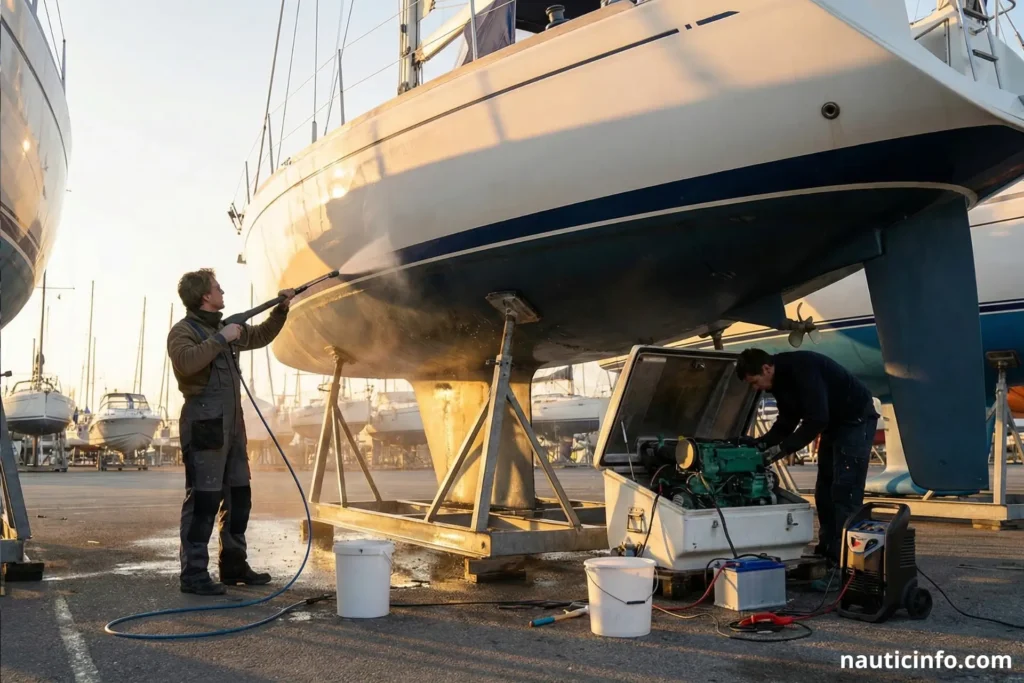
- Pressure Wash: As soon as the boat is hauled, blast away the barnacles, slime, and algae. If this dries on the hull, it becomes like concrete.
- Inspect: Look for blisters, cracks, or deep scratches in the gel coat.
- Wax: Apply a coat of high-quality marine paste wax. This protects the gel coat from the harsh winter elements, especially if you are tarping rather than shrink-wrapping.
- Covering:
- Shrink Wrap: The gold standard. It sheds snow, creates a greenhouse effect to keep things dry, and stays tight in high winds. Ensure you install vents to prevent mildew.
- Canvas Tarp: If using a tarp, build a frame (PVC or wood) to create a pitch. You do not want heavy snow load to pool in the center and collapse the cover.
Interior and Cabin Care
Finally, we move inside. The enemy here is mildew. A closed boat is a damp environment, and without airflow, mold will consume your upholstery.
- Remove Soft Goods: Take home all cushions, curtains, life jackets, and canvas. Store them in a climate-controlled area.
- Moisture Absorbers: Place buckets of calcium chloride (like DampRid) in the cabin, head, and bilge.
- Fridge: Clean it out thoroughly. Prop the door open. If you close the fridge door, you will open a science experiment in the spring.
- Clean Surfaces: Wipe down all hard surfaces with a mildew-resistant cleaner.
Summary: The Ultimate Winterization Toolkit
To ensure you have everything ready, utilize this comparison table for your shopping list.
| Category | Essential Item | Quantity (Avg. 25ft Boat) |
| Engine | Fogging Oil Spray | 1 Can |
| Engine | Marine Fuel Stabilizer | 8-16 oz (Treats 40-80 Gals) |
| Engine | Oil Filter & 4-Stroke Oil | 1 Filter + 5-8 Quarts |
| Engine | Lower Unit Gear Lube | 1 Quart + Pump |
| Cooling | -60°F or -100°F Antifreeze | 3-5 Gallons |
| Plumbing | -50°F Pink Antifreeze | 2-3 Gallons |
| Hull | Hull Cleaner (Acid based) | 1 Bottle |
| Interior | Moisture Absorber Buckets | 2 Units |
Conclusion Ultimate Boat Winterization Checklist : Peace of Mind for the Off-Season
In conclusion, completing the Ultimate Boat Winterization Checklist is not just about maintenance; it is about peace of mind. When the blizzard hits in January, you won’t be lying in bed wondering if your engine block is cracking. You will know that your vessel is pickled, protected, and ready to roar back to life the moment the first warm breeze of spring arrives.
Take the time now. Spend the weekend doing it right. Your future self (and your wallet) will thank you.