
USCG Required Safety Equipment 2026 Checklist: The Ultimate Guide for American Boaters
Welcome aboard, Captain. If you are reading this, you probably know that hitting the water isn’t just about horsepower and high tides; it is fundamentally about preparation. In France, they have “Division 240.” Here in the United States, we have the US Coast Guard (USCG) Federal Requirements. (USCG Required Safety Equipment)
Think of this list not just as a legal hoop to jump through, but as your primary insurance policy against the unpredictable nature of the open water. Whether you are running a bass boat on a quiet lake or piloting a 50-foot cruiser offshore, compliance is non-negotiable.
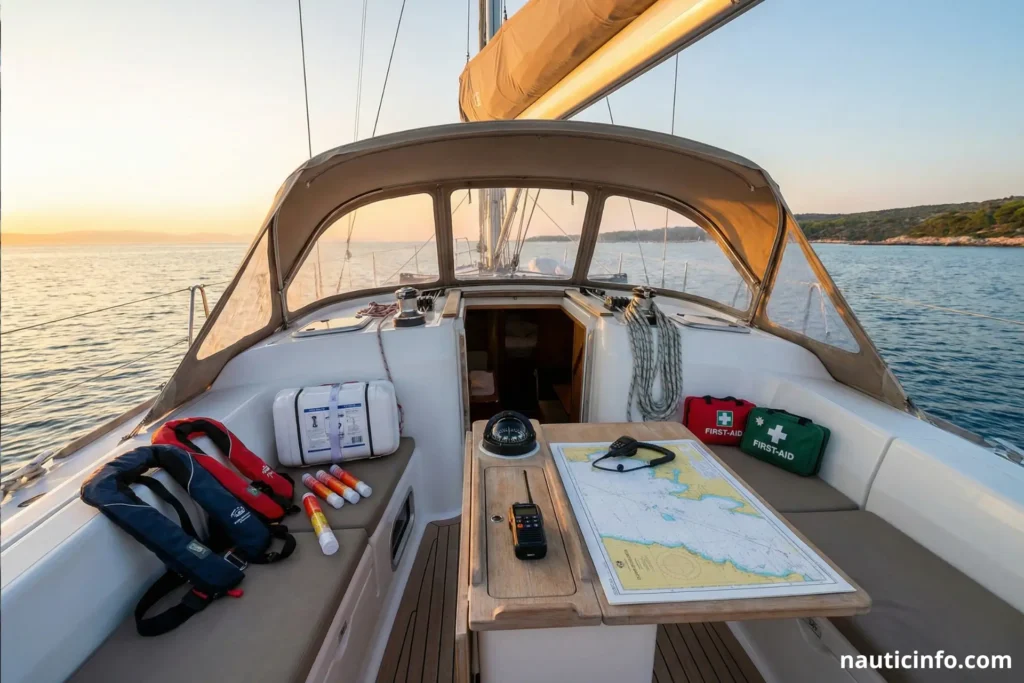
Below is your definitive, deep-dive checklist into the mandatory safety gear for 2026. We have broken it down by boat size and gear type, ensuring you are 100% legal and 100% safe.
USCG Required Safety Equipment : The “Golden Rules” of 2026 Compliance
Before we inspect the gear, we must establish the ground rules. First and foremost, the USCG sets the federal minimum. However, individual states often have stricter regulations regarding life jacket wear for children or specific boating education cards (which are mandatory in states like New York and California as of 2026).
Furthermore, “serviceable condition” is the watchword for this year. Having a fire extinguisher on board is useless if it expired during the Obama administration. Consequently, the Coast Guard is cracking down on expired flares and “dead” fire extinguishers.
Finally, accessibility is key. In an emergency, seconds count. Therefore, your gear must be readily accessible, not buried under a mountain of towels or fishing tackle.
USCG Required Safety Equipment : Mandatory Gear by Boat Size
The USCG categorizes requirements based on the length of your vessel. Find your bracket below to see exactly what you need.
1. Vessels Under 16 Feet (Class A)
Includes Kayaks, Canoes, SUPs, and small skiffs.
Even the smallest craft require serious attention. Because you are lower to the water, visibility and buoyancy are your primary concerns.
- Personal Flotation Devices (PFDs): You must have one USCG-approved wearable life jacket (Type I, II, III, or the new Level 70+) for each person on board.
- Note: It must be the correct size for the wearer.
- Visual Distress Signals (VDS): Required only if you are operating on coastal waters or the Great Lakes between sunset and sunrise.
- Minimum: Night signals (like an electric distress light).
- Sound Producing Device: A portable air horn or a whistle is sufficient. It must be audible for at least 0.5 miles.
- Fire Extinguisher: Not required for outboard boats of this size unless you have enclosed compartments where fuel fumes can get trapped.
- Navigation Lights: Required if operating between sunset and sunrise.
2. Vessels 16 to 26 Feet (Class 1)
The heart of the American recreational fleet: Center consoles, runabouts, and bass boats.
As you step up in size, the requirements strictly increase. In addition to the items above, you enter the territory of “throwable” devices and mandatory fire suppression.
- PFDs: One wearable jacket per person PLUS one Type IV throwable device (like a ring buoy or seat cushion). This throwable device must be immediately available.
- Fire Extinguisher:
- 2018 Model Year or Newer: One 5-B extinguisher.
- 2017 Model Year or Older: One 5-B (or the old B-I rating) if it is serviceable.
- Visual Distress Signals: You must carry signals suitable for both Day and Night use if on coastal waters.
- Common Setup: 3 handheld red flares (Day/Night combination) or an electronic SOS light (Night) + Orange Flag (Day).
- Engine Cut-Off Switch (ECOS): Since April 2021, if your boat was built with an ECOS, you must use it while operating on plane.
3. Vessels 26 to 40 Feet (Class 2)
Cruisers, larger sportfishers, and trawlers.
With more space comes more responsibility. The primary change here is the quantity of fire fighting equipment.
- PFDs: One wearable per person + one Type IV throwable.
- Fire Extinguishers:
- One 20-B extinguisher OR two 5-B extinguishers.
- Pro Tip: If you have a fixed fire extinguishing system in the engine room, you only need one 5-B portable unit.
- Sound Signals: You must have a device audible for 1 mile (usually a mounted horn) and a whistle.
- Pollution Placards: You must display an “Oil Discharge” placard (5×8 inches) and a “Garbage Disposal” placard (Marpol).
4. Vessels 40 to 65 Feet (Class 3)
Yachts and large recreational vessels.
At this length, you are effectively running a small ship.
- PFDs: Same as above.
- Fire Extinguishers:
- Three 5-B extinguishers OR one 20-B plus one 5-B.
- With Fixed System: Two 5-B extinguishers.
- Sound Signals: Must carry a bell (audible for 0.5 miles) in addition to the horn and whistle.
- Navigation Lights: Must comply with strict International/Inland rules regarding visibility range and arc.
Deep Dive: The “Big Four” Safety Pillars
Let’s look closer at the specific gear, because the regulations have evolved significantly in the last few years.
1. Personal Flotation Devices (PFDs): The New Labels
Forget the old “Type I, II, III” system. While those jackets are still legal if serviceable, the new 2026 standard uses “Performance Levels” (50, 70, 100, 150) to harmonize with Canadian and European standards.
- Level 70: The new standard for coastal boating (similar to the old Type III). Comfortable and buoyant.
- Level 150: Designed for offshore use; will turn an unconscious wearer face up.
Crucial Note: Inflatable PFDs are excellent for comfort, however, they require regular maintenance. Check the CO2 cylinder status indicator before every trip.
2. Fire Extinguishers: The 12-Year Rule
This is where most boaters fail inspections. As of recent USCG rulings, disposable (non-rechargeable) fire extinguishers are expired 12 years after their manufacture date.
- Check the Date: Look at the bottom of the cylinder. If it says “05” (2005), throw it away. It is dead.
- The New Ratings:
- 5-B: Replaces B-I.
- 20-B: Replaces B-II.
- The number indicates the square footage of fire it can extinguish.
3. Visual Distress Signals (VDS): Pyrotechnic vs. Electric
Flares expire every 42 months (3.5 years). This is a constant headache for boat owners. Consequently, many are switching to non-pyrotechnic options.
Comparison Table: Traditional Flares vs. E-Flares
| Feature | Pyrotechnic Flares (Red Handheld) | Electronic SOS Light (LED) |
| Expiration | Expires every 42 months | No expiration (Batteries only) |
| Safety | Fire hazard, drips hot slag | Safe to touch, no flame |
| Duration | Burns for ~3 minutes | Flashes for hours (usually 20+) |
| Visibility | Extremely bright, seen for miles | Visible, but less intense than fire |
| Cost | Cheap upfront ($30/pack) | Higher upfront ($90+), cheaper long term |
| USCG Rating | Day & Night Approved | Night Only (Must carry flag for Day) |
4. Engine Cut-Off Switch (ECOS)
The law is clear: If your boat is under 26 feet, has 3+ HP, and the helm is not in an enclosed cabin, you must wear the link (lanyard or wireless fob) when the boat is on plane.
- Why? It prevents the “Circle of Death” where a boat continues to spin and strike the ejected operator.
- Upgrade: Wireless fobs (like FELL Marine) allow freedom of movement without being tethered.
Beyond the Minimum: Smart Additions for 2026
The USCG list keeps you legal; this list keeps you alive. If you are venturing more than 3 miles offshore, consider these mandatory for your standards.
- VHF Radio with DSC: Cell phones do not work 10 miles out. A VHF radio with Digital Selective Calling (DSC) allows you to press one red button to send your GPS location to the Coast Guard.
- EPIRB or PLB: For deep-sea adventures, an Emergency Position Indicating Radio Beacon is essential. It connects directly to satellites.
- High-Quality Anchor: Not just a lunch hook, but a storm anchor with at least 10 to 20 feet of chain and adequate scope (7:1 ratio).
- First Aid Kit: Upgrade the basic plastic box. Add tourniquets, seasickness meds, and waterproof bandages.
USCG Required Safety Equipment : 2026 Equipment Specs Sheet
Here is your quick-reference cheat sheet for the chandlery (marine store).
| Equipment | Requirement (Imperial Units) | Note |
| Life Jackets | 1 per person + 1 Throwable (if >16′) | Check “Serviceable” status |
| Fire Extinguisher | 5-B or 20-B rated | Disposables expire after 12 years |
| Horn/Whistle | Audible for 0.5 to 1.0 mile | Air horns need spare canisters |
| VDS (Signals) | 3 Day/Night Combo | Or 1 Electric Light + 1 Flag |
| Ventilation | Blower system | Run for 4 mins before starting |
| Backfire Flame Arrestor | Required on inboard gas engines | Must be clean and secured |
USCG Required Safety Equipment : Practical Tips for the 2026 Season
- The “Shake” Test: Take your dry chemical fire extinguisher and turn it upside down. Shake it or whack it with a rubber mallet. You want to feel the powder moving inside. If it is a solid brick, it won’t work when you pull the pin.
- Label Your Gear: Use a waterproof marker to write the expiration date of your flares and the inspection date of your inflatables on a piece of tape on the dashboard. Don’t rely on memory.
- Brief Your Crew: Before leaving the dock, show every passenger where the PFDs and the fire extinguisher are located. It takes 30 seconds and saves lives.
Safe boating is happy boating. By adhering to this USCG Required Safety Equipment 2026 Checklist, you ensure that your focus remains on the horizon, the fish, and the family fun—not on the flashing lights of a patrol boat.